Blog / Pay & Benefits / Travel Nursing
Travel nursing after the bubble: what the money actually looks like in 2025
By Diana Perez · Facebook LinkedIn Email
Three years ago we wrote a post asking whether travel nurses should be worried about contracts being cancelled and rates coming down. The honest answer now is that the rates did come down, a lot, and then they stopped.
The market has settled. So this is a good moment to lay out what travel nursing actually pays in 2025, and to clear up a confusion that makes almost every conversation about it useless.
The number you keep seeing is not your paycheck
There are two completely different numbers floating around, and they get mixed up constantly, including by people who should know better.
The first is the bill rate: what the hospital pays the agency, per hour, all-in. That is the number in industry reports and hospital budget meetings. Out of it comes your pay, your stipends, your housing and insurance if the agency provides them, the recruiter's commission, and the agency's profit.
The second is what lands in your account.
When you read that travel nursing "was $154 an hour," that is a bill rate. It was never anyone's wage. Confusing the two is how nurses end up feeling cheated by an agency paying a perfectly normal cut, and how hospital executives end up believing travel nurses personally pocketed $300,000 a year.
What hospitals pay: $154 an hour down to $94
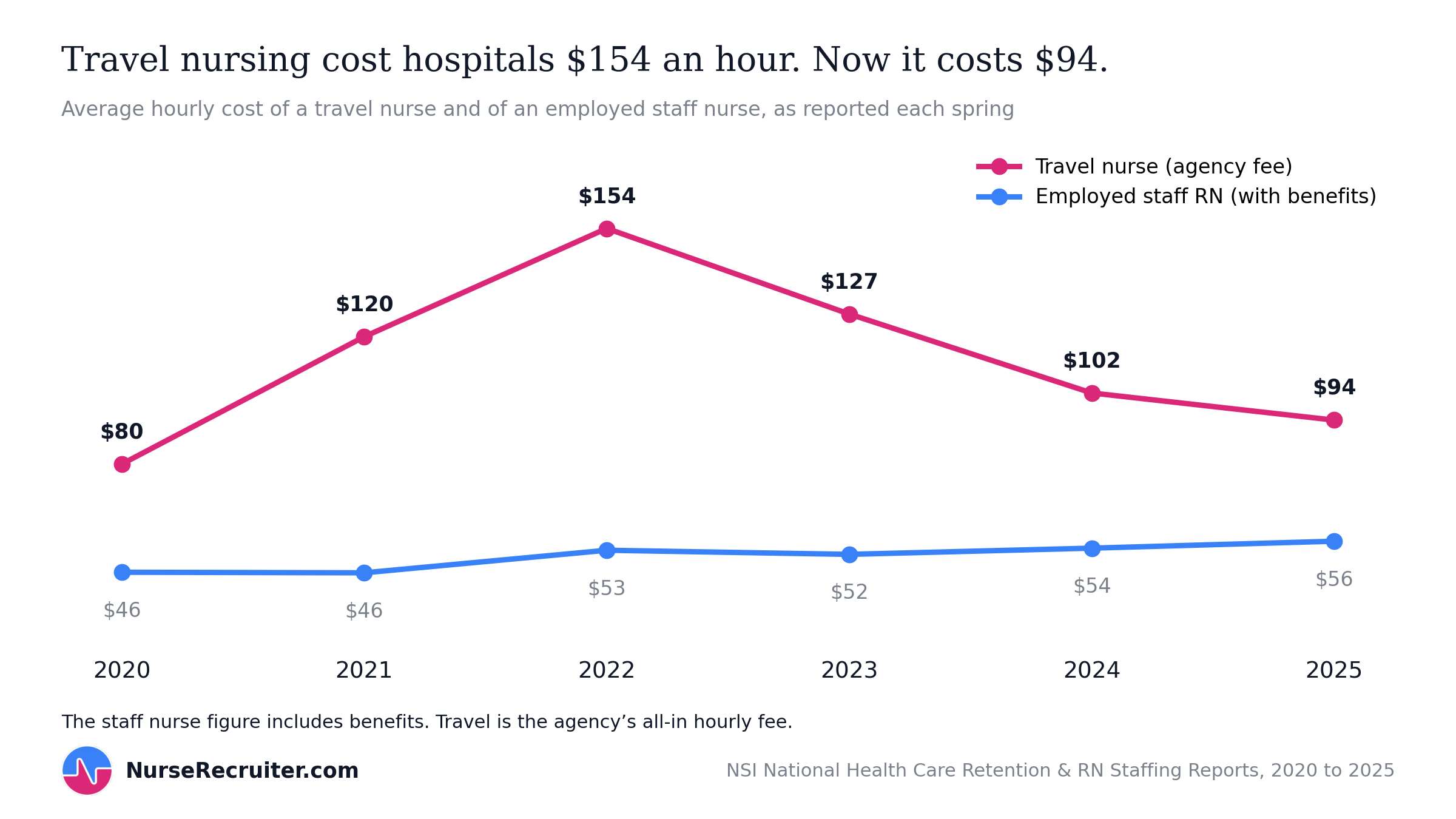
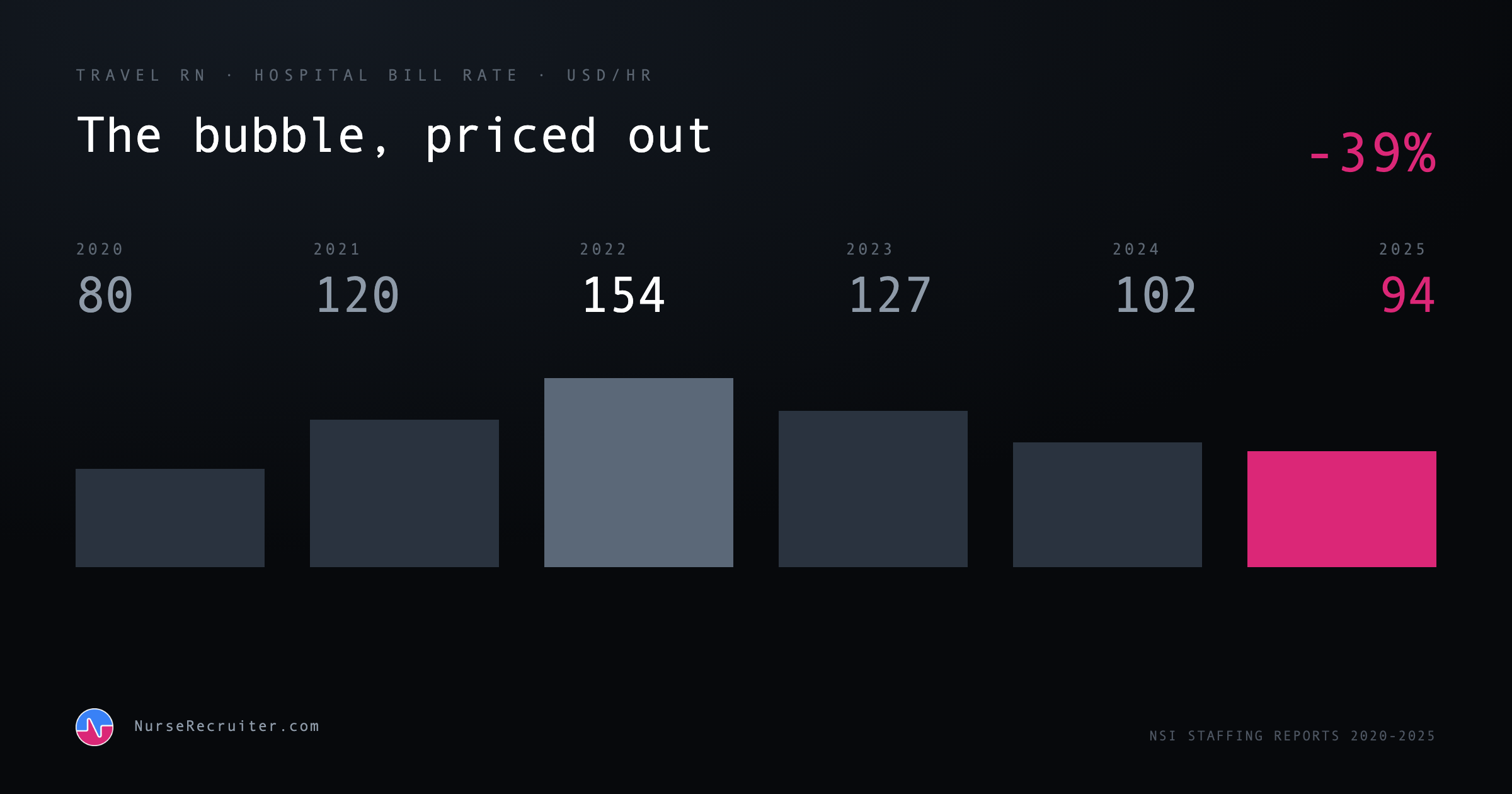
The staffing survey that hospitals benchmark against has tracked this every spring since before the pandemic. In spring 2020 the average travel nurse cost a hospital $80 an hour. By spring 2022 it was $154, nearly double, with the top of the range at $225 an hour and weekly packages that touched $12,000. Then came $127 in 2023, $102 in 2024, and $93.81 this spring.
That is a fall of 39% from the peak. It is also still 17% above where it stood in 2019. The bubble deflated; it did not pop back to where it started.
An independent benchmarking survey of staffing firms tells the same story from the other side, with average bill rates of $133.47 in 2022 falling to $106.78 in 2023.
The other line on that chart is the quiet one. The hospital's cost for an employed staff nurse, wages plus a roughly 26% benefits load, went $46, $46, $53, $52, $54, $56. Almost flat, straight through the chaos. Whatever the pandemic did to the price of a travel nurse, it barely moved the price of a staff nurse.
What that means for your contract
Here is where we are going to be straight with you rather than confident.
There is no reliable public record of what travel nurses actually take home. Bill rates get surveyed, audited and published because hospitals and staffing firms need them for benchmarking. Nurse earnings do not. The weekly "average travel pay" figures that circulate online are averages of advertised packages on job boards. They are marketing material, restated whenever a platform changes what it counts, and never reconciled against what anyone was actually paid. We would rather give you one number we can stand behind than five we cannot.
So: the number we can stand behind is $93.81 an hour, and it is more useful to you than it looks.
At that rate, a 36-hour week bills the hospital about $3,377. Everything comes out of that single figure: your taxable pay, your stipends, housing, insurance, the recruiter's cut, the agency's margin. It is the ceiling on your package, and now you know where it sits.
Which gives you a way to read an offer. If a recruiter presents a package and the whole thing lands far below that ceiling, the agency is taking an unusually wide cut, and you are entitled to ask about it. If it lands close to it, they are running thin and there is genuinely not much more to get. Either way you are negotiating against a real number instead of a vibe.
And the direction is not in doubt. Bill rates fell 39% and agency margins did not expand to absorb the fall, so nurse pay came down with them. Anyone telling you travel pays what it did in 2022 is selling something.
There is also less work than there was
Rates are only half the picture. Volume is the other half.
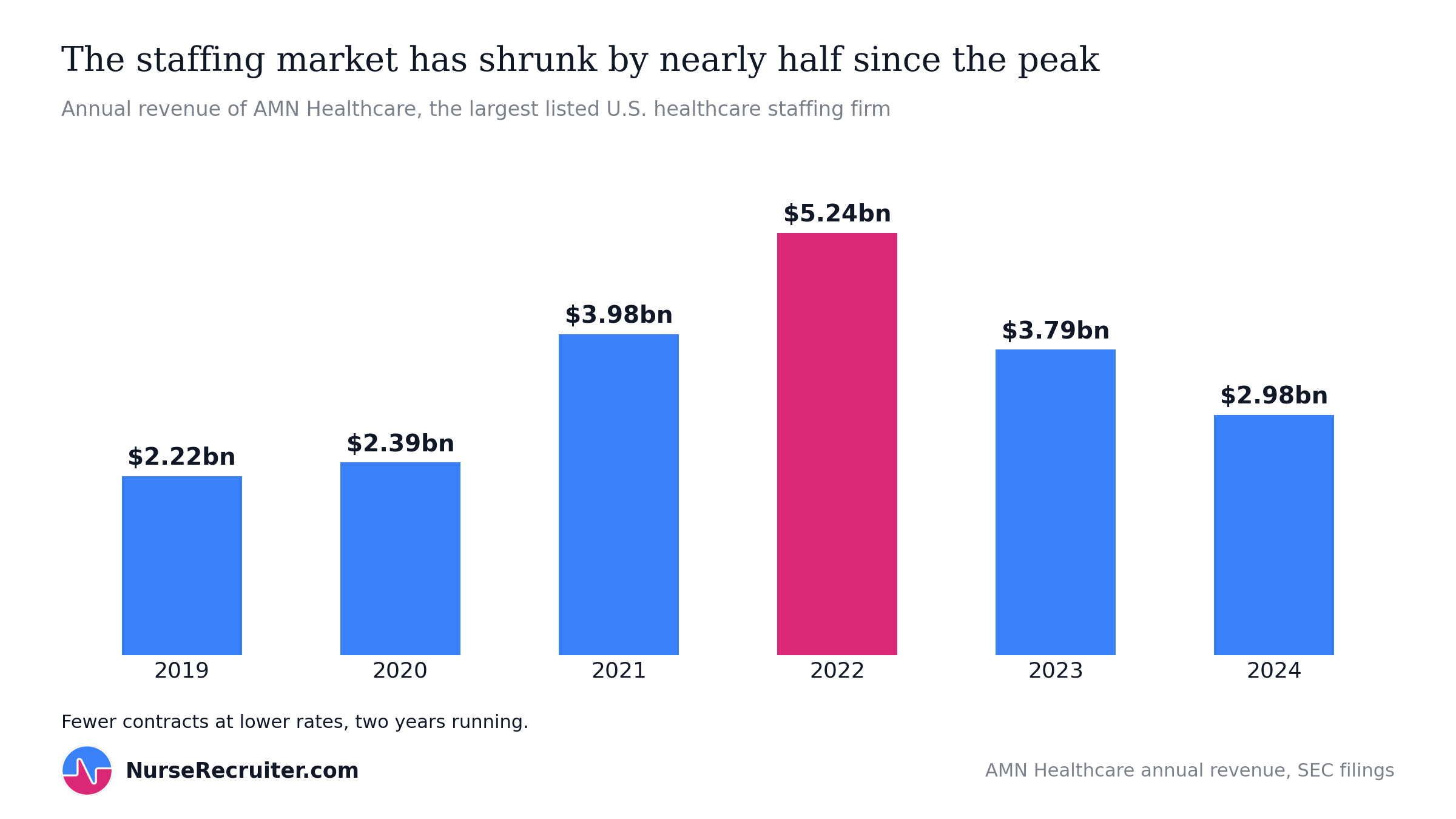
The largest publicly traded healthcare staffing firm in the country booked $5.24 billion in revenue in 2022 and $2.98 billion in 2024, down 43% from the peak, in audited filings that nobody gets to spin. Travel nurse hours billed across the industry fell 17% in 2023 alone.
Fewer contracts at lower rates is a harder market, and it explains why nurses report more competition for the good assignments than they saw two years ago.
The counterweight is that the underlying shortage never went away. Hospitals still average 47 unfilled RN positions each and still take about three months to fill one, as we covered in April. The work exists. It just is not paying a crisis premium any more, because the crisis pricing was always temporary and everyone knew it.
So is travel still worth it?
On the money: yes, but the margin is ordinary now rather than extraordinary.
Two things to budget for honestly, whatever your rate:
- You will not work 52 weeks. Gaps between contracts, licensing waits and travel time are unpaid. A staff nurse's annual salary assumes a full year; yours should not.
- Benefits are not in your hourly. Health coverage, retirement matching and paid time off are worth real money on the staff side. Compare packages, not headline rates.
Add those in and travel sits closer to a good staff job than it did during the boom, which is a genuine change, because for about two years it was not close at all.
What has not changed is everything that was never about the money: choosing where you live, being able to leave a bad unit at thirteen weeks, the range of hospitals you get to work in. If you are thinking of starting, those reasons are as good as they ever were. If you started in 2021 because the money was absurd, this is a different job than the one you signed up for, and it is fair to reassess.
What this means if you are hiring
If you run a hospital budget, this is the most favourable travel market since 2019, and it is still your most expensive way to cover a shift.
The arithmetic from this year's staffing survey: an average travel nurse costs $195,125 a year against $116,035 for an employed RN with benefits. That is $79,090 per nurse, per year. Replace twenty travel contracts with permanent hires and the saving runs to roughly $1.6 million.
Nearly three-quarters of hospitals (73.5%) say they intend to reduce travel and agency use this year. They said the same last year, and travel remained the single most common answer to a short-staffed unit, because cutting agency spend is not a decision. It is a recruiting capability. You only stop paying $195,125 when you can reliably hire someone for $116,035, and hiring capacity is precisely what most teams have not been given.
If that describes your position, the lever is reach rather than headcount. Post your openings where the audience is nurses only, search the nurse database directly instead of waiting on applications, or set up a Search Agent so matching candidates arrive before the vacancy does.
The short version
Hospital-side travel rates are down 39% from the 2022 peak and have been roughly flat for a year. Contract volume is down harder than rates. Travel still pays better than staff nursing, by a normal margin rather than a spectacular one, and it still buys the freedoms it always did.
The bubble is over. The job is still here. Browse the current travel nursing assignments, and judge the rate in front of you against the $94 ceiling. That is what it is for.