Blog / Working Conditions / Burnout & Mental Health / The Aging Workforce / Retention & Turnover
Burnout finally fell. So why do four in ten nurses say they are leaving?
By Diana Perez · Facebook LinkedIn Email
Every two years, the boards of nursing survey the entire profession. Not a panel, not a customer list, but a stratified sample drawn from the licensure database itself. The 2024 edition landed in April, and it is the best picture anyone has of who is actually doing this job.
It contains the single most encouraging number we have seen in five years, and one of the most alarming. Both are true at once, and the relationship between them is the story.
The encouraging one: nurse burnout fell hard. The share of registered nurses who felt burned out every day or a few times a week dropped from 45.2% to 35.4% in two years. Nurses reporting they were at the end of their rope fell from 29% to 22%. After half a decade of numbers that only pointed one way, something finally gave.
The alarming one: 39.9% of working nurses say they plan to retire or leave nursing within five years. In 2020 that figure was 22.1%.
First, the good news, because it is real
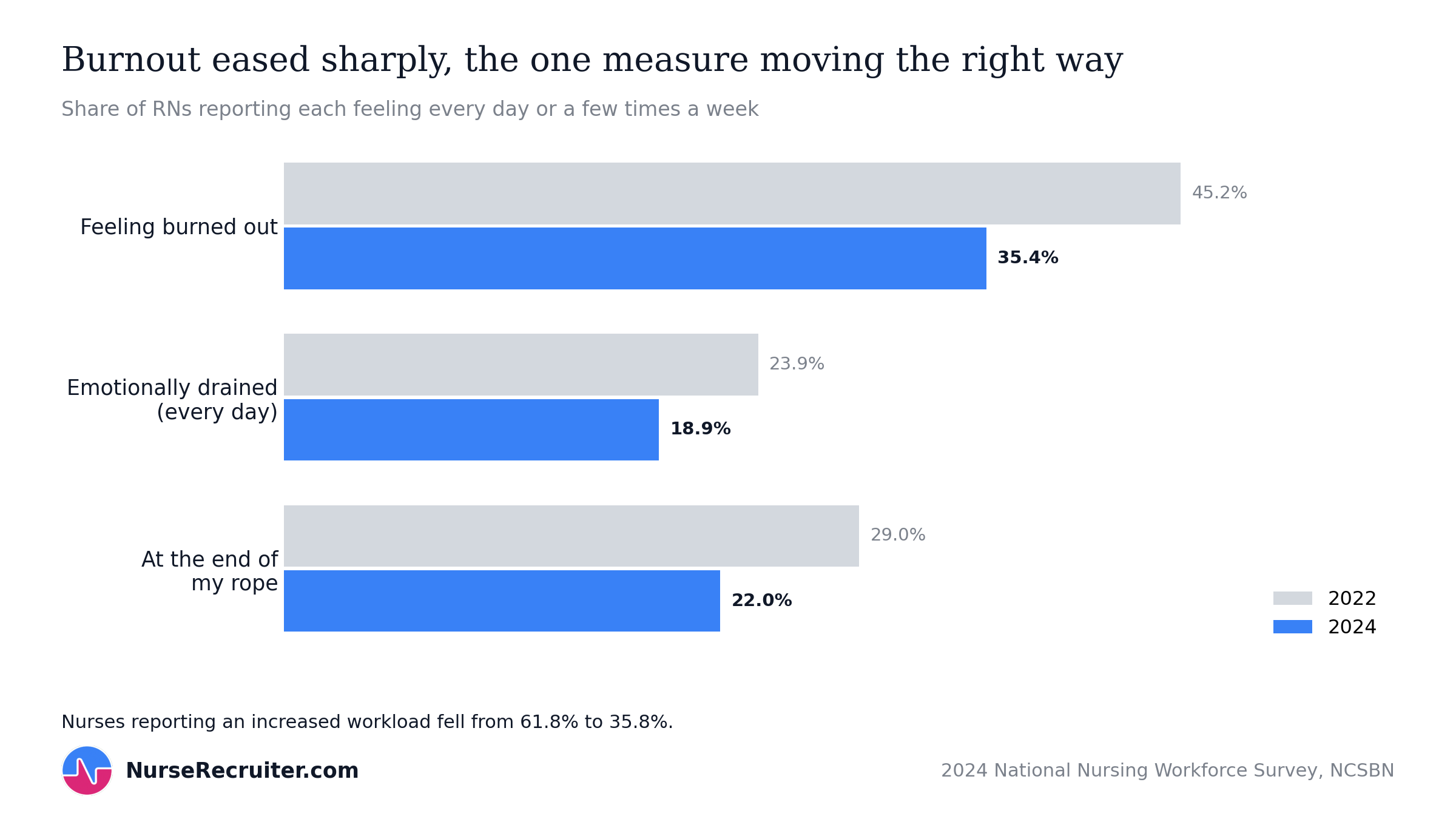
Every well-being measure in the survey improved. Nurses feeling emotionally drained every single day fell from 23.9% to 18.9%. The share reporting their workload had grown collapsed from 61.8% to 35.8%, though that particular comparison is softer than it looks, because the 2022 survey asked specifically about changes caused by the pandemic and the 2024 one asked more broadly about the past two years.
Pay moved too. Median RN earnings rose from $80,000 to $88,000 over the two years, consistent with what the federal wage data showed us last month, where the middle of the pay scale climbed faster than the top.
None of this is a small thing. Conditions on the floor genuinely improved between 2022 and 2024.
The reason the workforce stabilized is not the reason anyone hoped
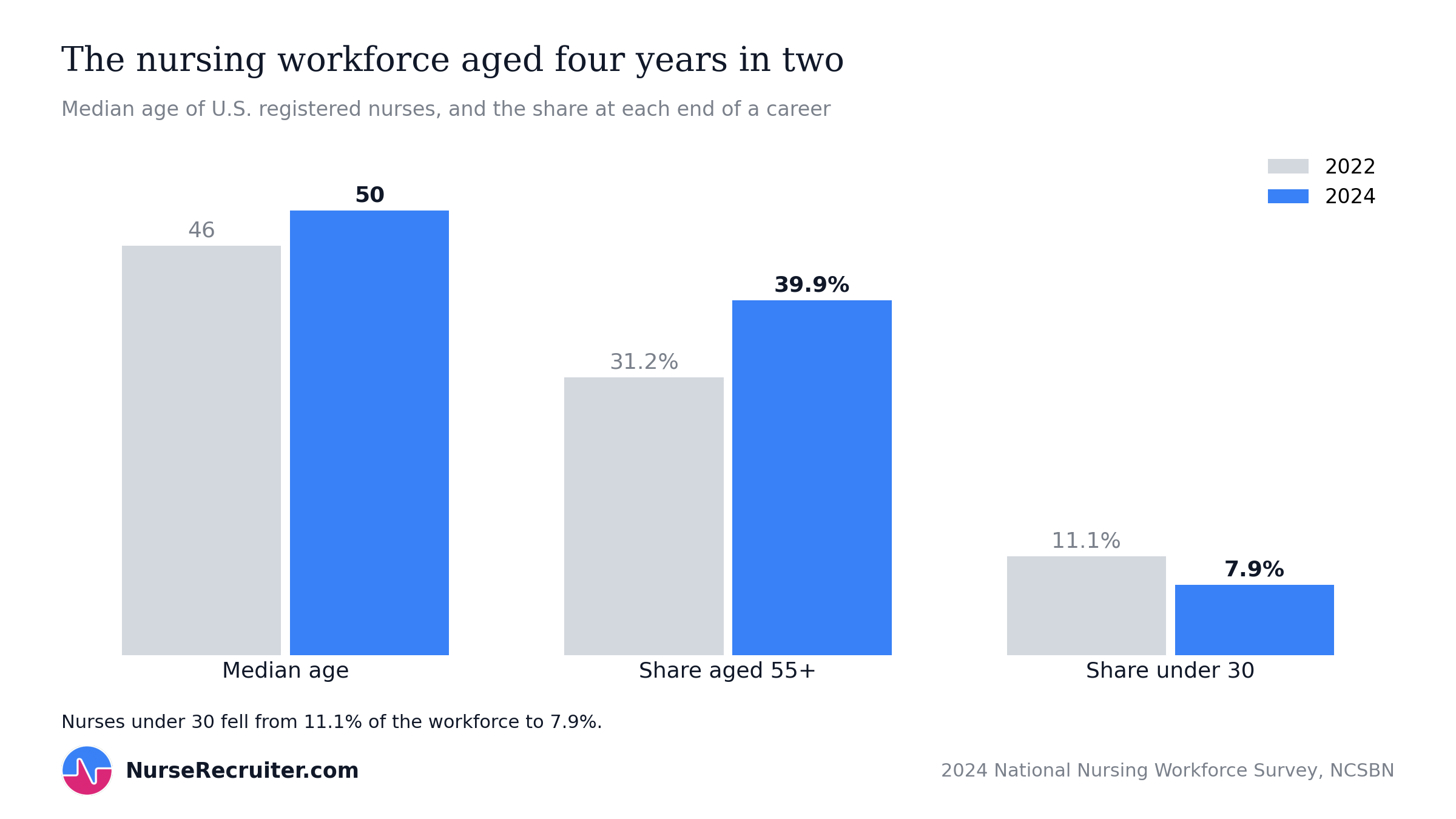
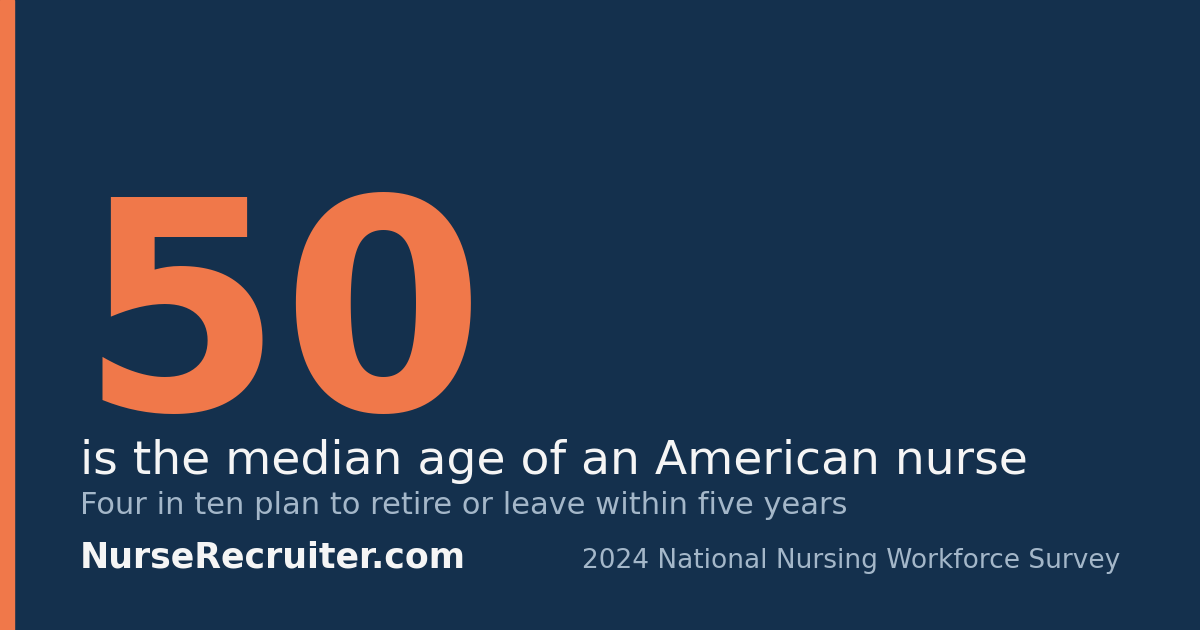
Here is where it turns. The median American registered nurse is now 50 years old. Two years ago she was 46. The workforce aged four years in two.
That is not a rounding artifact. It is the shape of who came and went. In 2022, 31.2% of nurses were 55 or older. In 2024, 39.9% were, which is roughly where the figure sat before the pandemic. The survey's own reading is that experienced nurses who stepped away during COVID have largely come back.
So the stability everyone welcomed in 2024 was substantially delivered by older nurses returning to work. The report is careful about how durable that is, and the caution is worth quoting: the return of experienced nurses "may represent a more temporary phenomenon depending on their revised retirement timelines."
Meanwhile the other end of the age curve thinned out. Nurses under 30 fell from 11.1% of the workforce to 7.9%. Nurses under 35 fell from about 24% to 18%. The share of RNs licensed ten years or less hit its second-lowest level on record, 32%, while the share licensed more than 41 years hit its highest, 13%.
Read those two movements together and you have a workforce that was rescued by its most experienced members at exactly the moment its youngest cohort got smaller.
Four in ten, with an honest asterisk
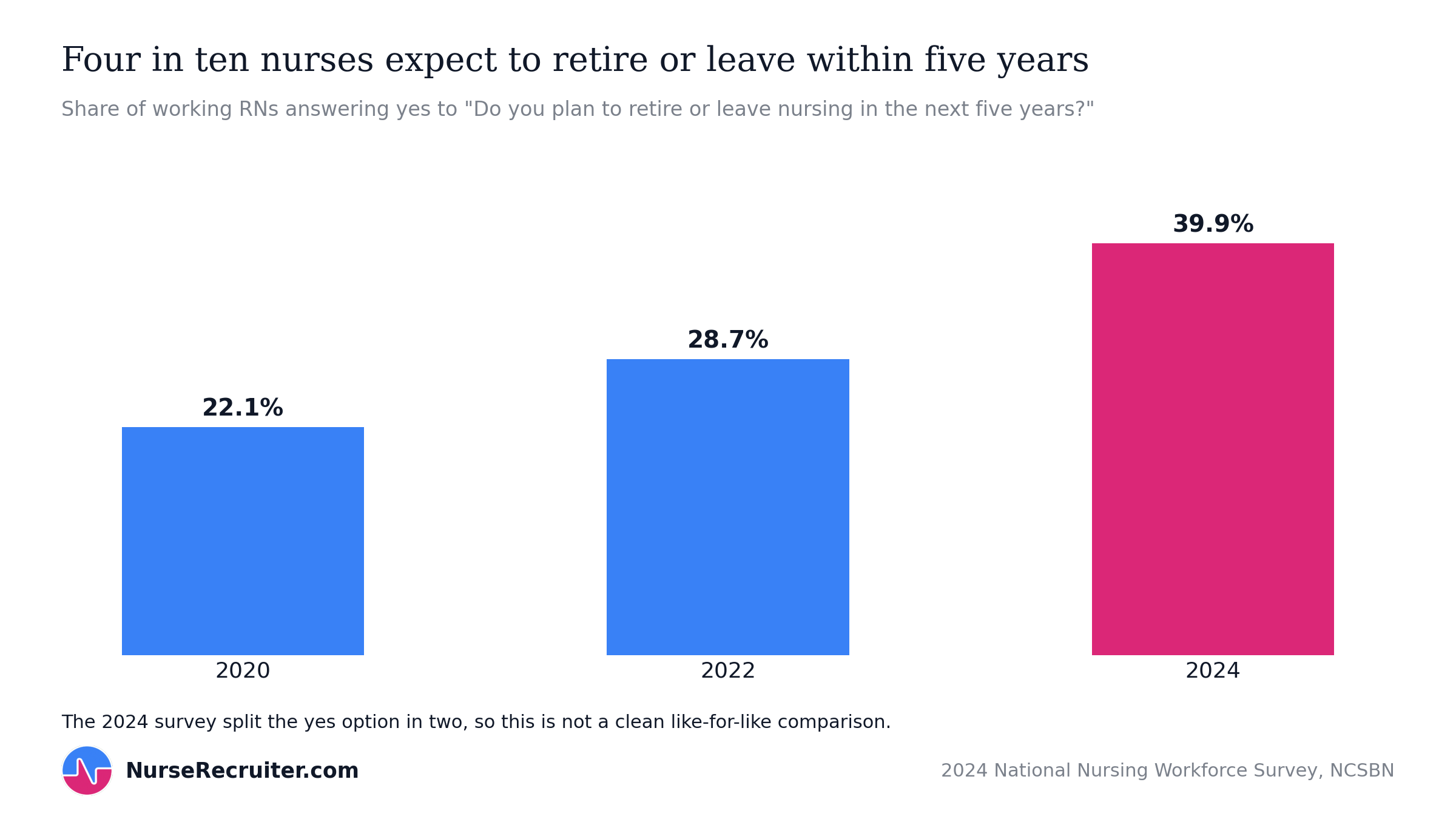
The question was: "Do you plan to retire or leave nursing in the next five years?" Of nurses actively working, 39.9% said yes. That splits into 21.9% intending to retire and 18.0% intending to leave nursing for something else.
Now the asterisk, because this number is being repeated everywhere without one. The 2024 survey changed the answer options, splitting the old single "yes" into retire-versus-leave. That means the jump from 28.7% in 2022 to 39.9% in 2024 is not a clean like-for-like comparison. The question also went only to nurses currently working in nursing, and it was not asked in Hawaii at all.
The rise is almost certainly real. It lines up with the age data, and retirement is the top reason given. But if you are putting this figure in a board paper, put the asterisk in with it. Intent to leave is also not the same thing as leaving: plenty of nurses who said this in 2020 are still on the floor today.
What people actually said was driving them out, in order: retirement (61.4%), stress and burnout (41.3%), workload (32.8%), understaffing (26.0%), and inadequate salary (21.8%). Workplace violence or bullying was named by 12.3%.
Notice the top of that list. The largest single force pulling nurses out of the profession is not something a retention committee can fix. It is arithmetic, and unlike burnout, it is entirely predictable years in advance.
Nurses are leaving the hospital faster than they are leaving nursing
One more shift that employers should read carefully. The share of RNs working in hospitals fell from 57.5% to 53.3% in two years. Direct patient care as the primary role fell from 73% to 68.3%. Ambulatory care now accounts for 11.5%, and the share teaching in schools of nursing rose from 2.1% to 3.2%.
The nurses in those numbers did not leave the profession. They left the building. For a hospital, a nurse moving to an outpatient clinic is exactly as vacant a shift as one who retired. But for the profession as a whole it is a very different problem, and conflating the two leads to the wrong fix.
The workforce also grew more diverse, if slowly. Nurses identifying as Black or African American rose from 6.3% to 8.6%, Asian from 7.4% to 7.9%, and Hispanic or Latino from 6.9% to 7.2%. Men went the other way, slipping from 11.2% to 10.4%. And education keeps climbing: 72.9% of RNs now hold a bachelor's degree or higher, up from 61% in 2015.
What to take from it
If you employ nurses: your retention plan and your recruitment plan are now the same plan, and the binding constraint is age. Pull the ages on your roster. Anyone who tells you the shortage eased in 2024 is describing a workforce propped up by people who told the government they intend to leave within five years. The staffing report we covered in April put the cost of replacing one nurse at $61,110, and the retirement wave is that number multiplied by a demographic you can already count.
There is also an opportunity buried in the retirement data that most employers miss entirely. Nurses stepping back from full-time work frequently want to keep working fewer hours, which is exactly the population our per diem hiring guide is about. The nurse retiring from your competitor's full-time roster is a candidate for your flexible one.
If you are a nurse: the numbers are on your side of the table, and they will be for years. A profession with a median age of 50, a shrinking under-30 cohort and four in ten people eyeing the exit is not a profession where employers get to be picky about pay or schedule. Know what your market pays, and know that you can ask.
And the honest bottom line: 2024 was a better year to be a nurse than 2022 was. But the recovery was borrowed from the oldest part of the workforce, and the survey is quite clear that the loan comes due. Burnout falling is the reason to believe the profession can hold on to people. The age curve is the reason it has to start now.
Source: the 2024 National Nursing Workforce Survey, conducted by the National Council of State Boards of Nursing with the National Forum of State Nursing Workforce Centers, and published in the Journal of Nursing Regulation in April 2025. Data was collected between March and December 2024 across 53 U.S. jurisdictions. Two notes on reading it. The survey's headline count of 5,641,311 is active nursing licenses rather than nurses, since one nurse can be licensed in several states. And the figures are weighted survey responses, with NCSBN noting that white, female and older nurses may be slightly overrepresented.