Blog / Workforce & Policy / Staffing Ratios & Overtime
The federal nursing home staffing rule is dead, and it cannot come back until 2034
By Diana Perez · Facebook LinkedIn Email
On 2 February the federal government formally repealed the minimum staffing rule for nursing homes. It is worth being precise about what that means, because the rule had already been struck down in court and then blocked by Congress. This was the paperwork on a death that happened some time ago.
For nurses working in long-term care, and for anyone hiring them, the practical position is now clear in a way it has not been for two years. Here is what changed and what did not.
What the rule would have required
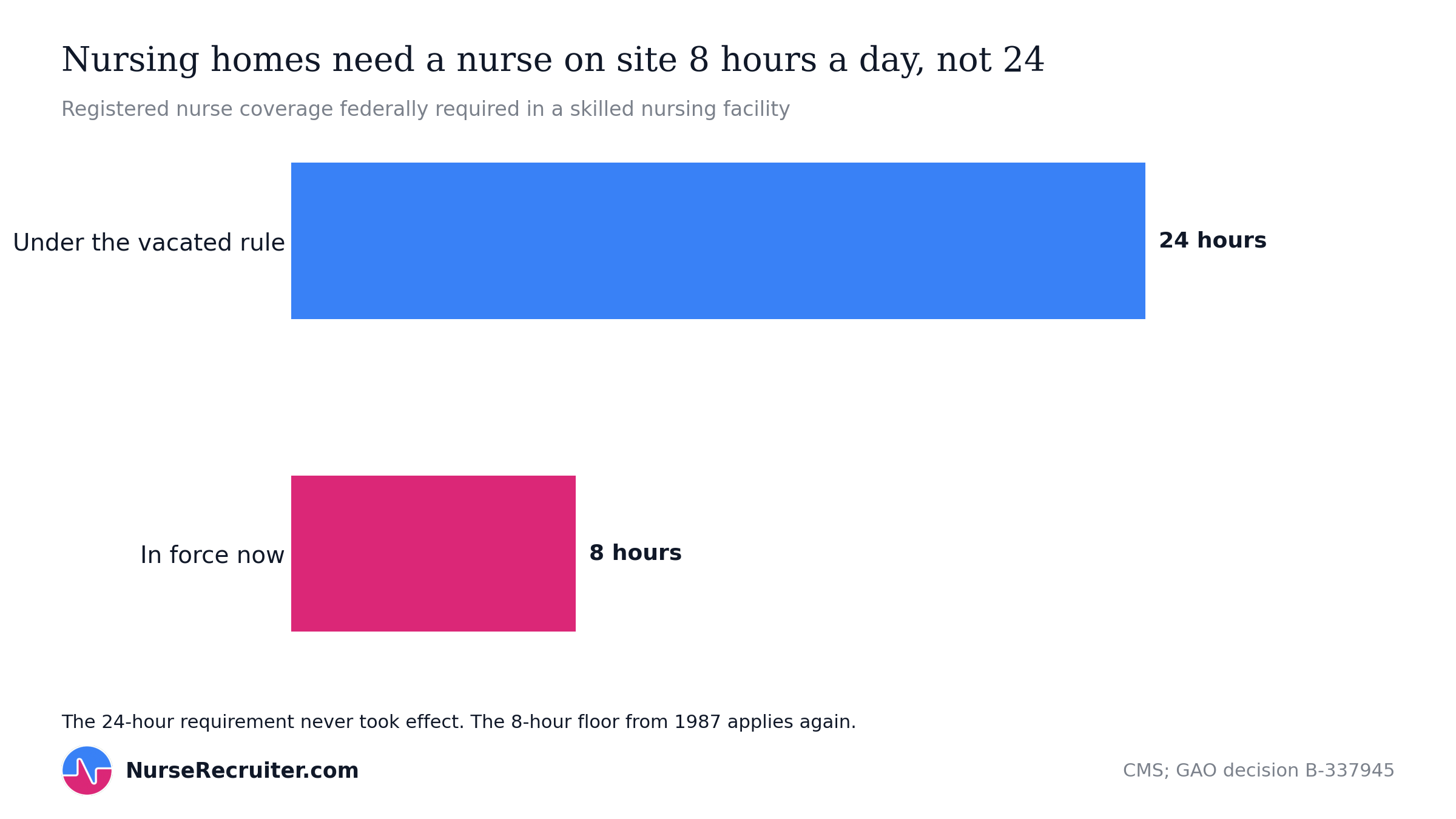
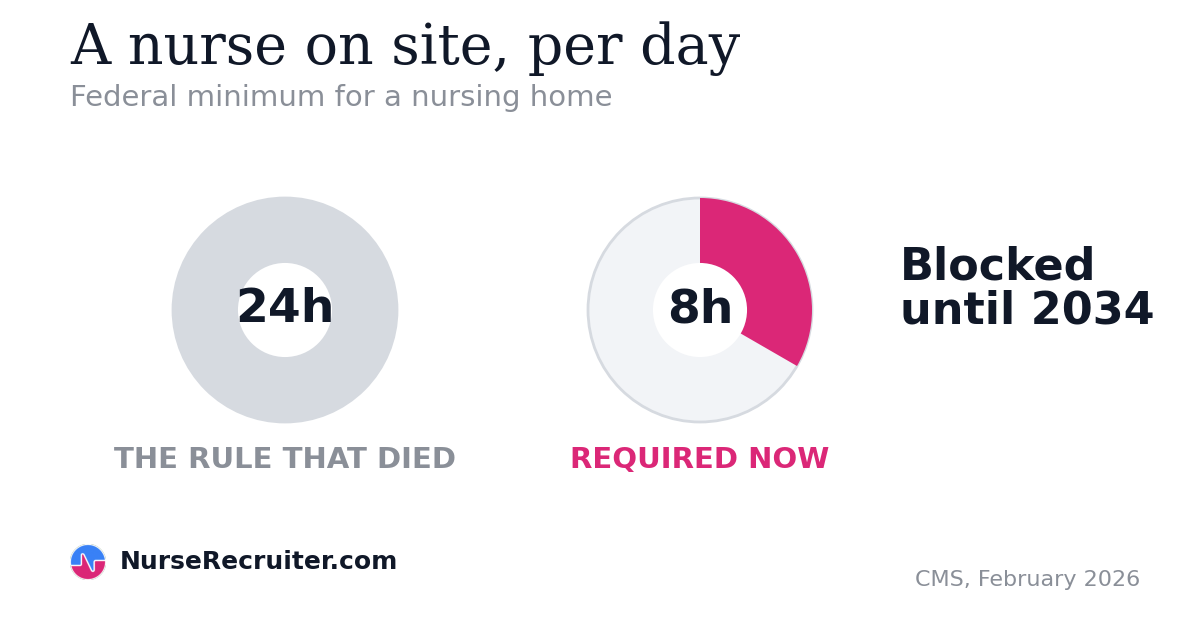
Two things, mainly. A registered nurse on site 24 hours a day, seven days a week, and a minimum of 0.55 registered nurse hours per resident per day, alongside a separate minimum for nurse aides.
Neither ever took effect. A federal court in Texas vacated the rule in April 2025. Congress then barred any similar requirement from being implemented until 2034. The repeal completes the sequence by removing the language from the regulations altogether.
What applies instead
The requirement that predates all of this, and which has been in place since 1987: a registered nurse on site eight hours a day, plus licensed nurse coverage around the clock. So overnight, a nursing home can meet federal requirements with an LPN or LVN in the building and no RN present.
That is the whole of it. There is no federal number attached to how many residents one nurse may look after in a skilled nursing facility.
State law is now the only place any firmer number exists, and states vary enormously. Some set ratios or minimum hours per resident day; others set nothing beyond the federal floor. If you work in or recruit for long-term care, your state's rule is now the only one that matters, and it is worth knowing it exactly rather than approximately.
Why it matters more than the coverage suggested
Most of the argument about this rule was conducted as a fight between the industry and the regulator. The part that got less attention is what it says about the labour market you are actually working in.
The rule was struck down partly on the grounds that it exceeded the agency's authority. But the loudest practical objection, made repeatedly by operators, was simpler. There were not enough nurses to comply. Nursing homes argued that a 24-hour RN requirement would force closures in rural areas because the nurses to fill those shifts do not exist at the wages the sector can pay.
Whatever you make of that as a legal argument, it is a revealing statement about supply. An entire sector said, in writing, that it could not staff to a modest floor.
So the repeal does not fix a staffing problem. It removes an obligation to solve one.
What this means if you hire for long-term care
Your competition is not other nursing homes. The average registered nurse now earns close to six figures, and the highest-paying settings are hospitals and outpatient care, not skilled nursing. The national workforce survey found the share of nurses working in hospitals falling as nurses move to other settings. Long-term care is competing in that same market, usually from a weaker position on pay.
The regulatory floor is not a recruiting pitch. Nurses considering a long-term care role are asking how many residents they will be responsible for on a night shift. "We meet federal requirements" is now a very low bar and candidates know it. If your actual staffing is better than the floor, say the number.
The people you need may be the ones stepping back from full-time work. Long-term care has one structural advantage over the hospital, which is more predictable hours. That matters to experienced nurses reducing their commitments, a growing group covered in our per diem hiring guide.
If you are recruiting into this setting, the reach problem is the whole problem. You can post your openings to an audience made up only of nurses, or search our database of more than half a million registered nurses and approach the ones who fit directly rather than waiting to see who applies.
And if you work in a nursing home
Nothing about your shift changed on 2 February. The staffing you had in January is the staffing you have now, because the rule that would have improved it was never in force.
What has changed is where to direct the argument. There is no federal standard coming before 2034. Any improvement in nursing home staffing over the next several years will come from state legislatures, from union contracts, or from employers deciding that a better ratio is worth paying for because they cannot otherwise keep anyone.
That last one is not naive. Turnover is expensive enough that staffing properly can be the cheaper option. The annual hospital staffing survey puts the cost of replacing a single nurse at over sixty thousand dollars, and the economics of retention do not stop at the hospital door.