Blog / Pay & Benefits / Workforce & Policy
Hospitals agreed not to compete for nurses. It just cost them $28.5 million.
By Diana Perez · Facebook LinkedIn Email
Here is a question worth sitting with. If two hospitals in your area quietly agreed not to recruit each other's nurses, how would you ever find out?
You would not, mostly. You would just notice that the offers were never quite as good as you expected, that the recruiter from across town never called, and that moving hospitals somehow did not produce the raise everyone said it would. You would probably conclude the market was just like that.
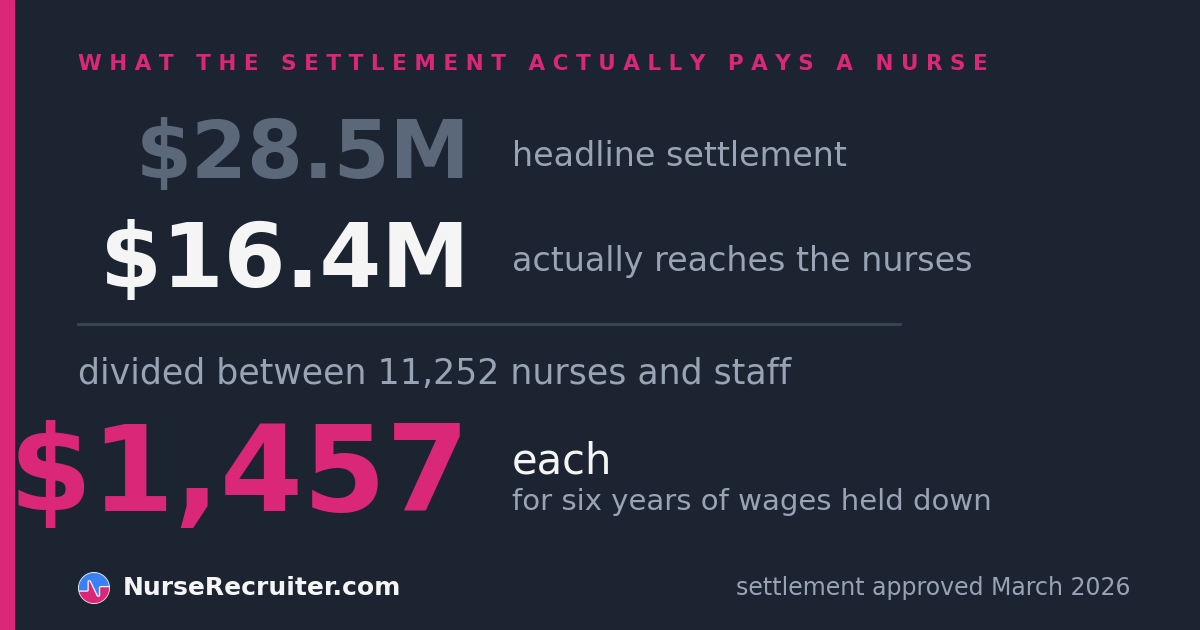
A settlement given final approval last month puts a number on one such arrangement: $28.5 million, over claims that a hospital system suppressed registered nurse wages between 2014 and 2020.
The numbers
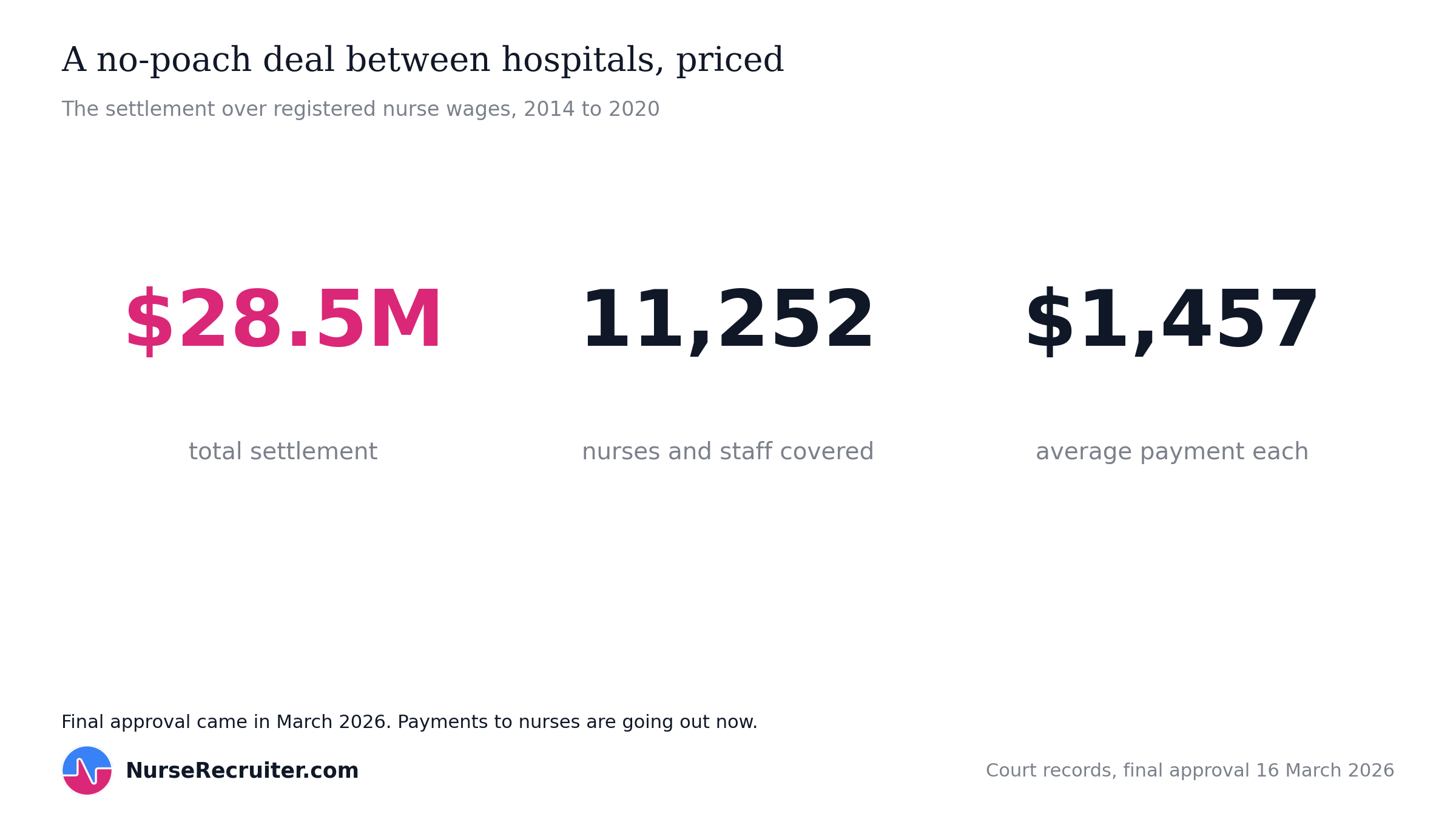
The case covered 11,252 nurses and other staff. Payments are going out now, averaging around $1,457 each.
That per-person figure is worth reading carefully, in both directions. It is real money arriving in people's accounts for something that was done to them years ago. It is also a fraction of what six years of suppressed wages would actually be worth to any individual nurse. Wage cases settle for a share of the theoretical damages, and the number that reaches each person is smaller than the wrong that produced it.
What a no-poach agreement is
The mechanics are simple. Two or more employers who ought to be competing for the same workers agree, formally or with a handshake, not to recruit from each other. Sometimes it is a clause in a contract between a hospital and a staffing agency. Sometimes it is an understanding between executives who see each other at the same conferences.
The effect is the same. A market where four employers are bidding for your skills pays better than one where four employers have agreed not to bid against each other. Take away the competing offer and you take away the leverage.
The reason it matters so much in nursing specifically is that most nurses cannot easily leave the region. Nursing licences are tied to states, hospital jobs are tied to metro areas, and people have houses and families and school districts. If the handful of large employers within commuting distance are not competing, there is no market left to speak of.
What it means for you
A quiet market is not always a natural market. If you have wondered why offers in your area cluster suspiciously close together, that is at least a question worth asking rather than a fact of life to accept.
These arrangements are illegal, and enforcement has been increasing. Agreements between employers not to compete for workers are treated as antitrust violations. A run of health care cases over recent years, this being one, has established that hospitals are not exempt from the rules that apply to everyone else.
Your best defence is a live outside offer. Not a threat, not a bluff, but an actual number from an actual employer. It is the only thing that reliably tests whether your current pay reflects a real market. If the outside offer is much higher, you have learned something. If it is not, you have also learned something, and you have lost nothing by looking.
That is the practical takeaway, and it does not require anyone to sue anybody. Know what you are worth by finding out, not by assuming. Our wage breakdown by state and metro area will tell you the going rate where you live, and there are thousands of nursing jobs to test it against.
And if you are on the hiring side
The straightforward version: do not enter into these agreements, and check whether any of your existing contracts contain one. No-poach and no-hire clauses have a way of persisting in staffing agreements and service contracts long after anyone remembers agreeing to them, and "it was in a template" is not a defence.
There is a more useful point underneath. Recruiting is competitive because nurses are scarce, and that competition is the market working as intended. The response that actually holds staff is to be the employer people want to move to, on schedule, on ratios, on the things the 2026 strike settlements were fought over. Every alternative to competing for nurses has turned out to be more expensive than competing for them, and this one came with a court order attached.
If the goal is reaching more of the right candidates rather than fewer, that is a solvable problem. Post where the audience is only nurses, or search our database of more than half a million registered nurses and approach the ones who fit.