Blog / Hiring & Job Seeking / Workforce & Policy / The Nursing Shortage
78 days to hire one nurse: the 2026 staffing numbers every nurse employer should know
By Diana Perez · Facebook LinkedIn Email
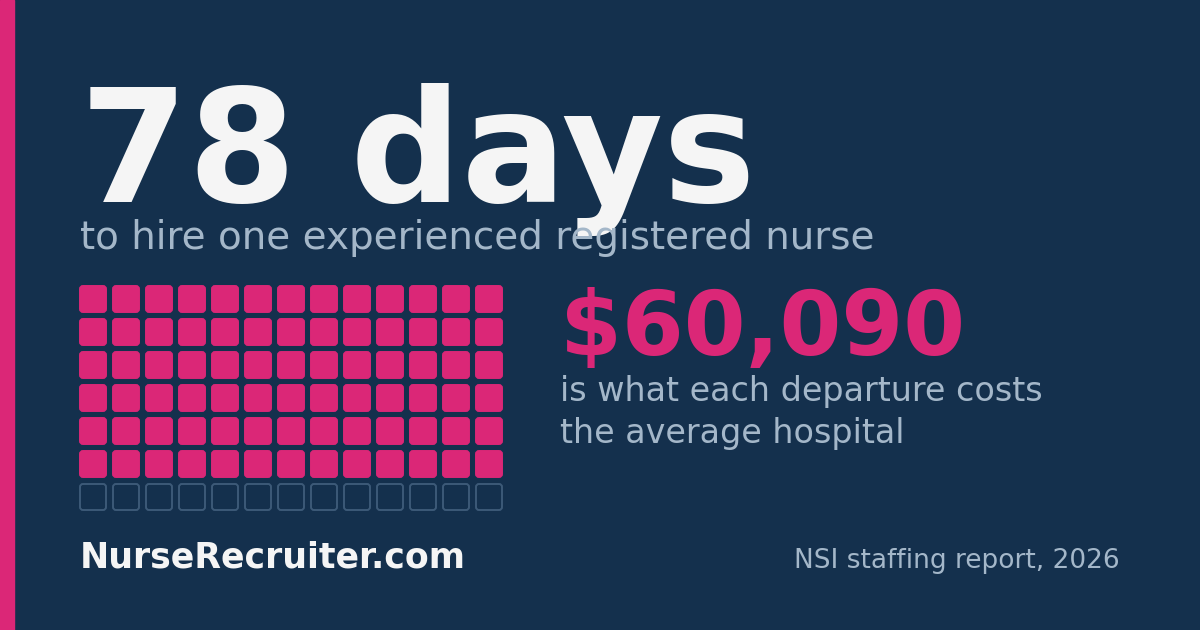
Here is a number to sit with: it now takes the average hospital seventy-eight days to hire one experienced registered nurse. Two and a half months, for one hire. And in the same year, the average hospital lost $5.19 million to nurse turnover.
Those figures come from the 2026 edition of the NSI National Health Care Retention & RN Staffing Report, published in March and covering calendar year 2025. It draws on 527 acute care hospitals across forty states, and 262,405 registered nurses. Two things are worth knowing before the numbers start. Hospitals report their own figures and choose whether to take part, and NSI is itself a nurse recruitment firm. It is still the closest thing the industry has to a scoreboard, and this year's edition tells a more complicated story than the headlines suggest.
The short version: the shortage eased a little, hiring slowed a lot, nurses started leaving again, and the teams responsible for fixing it are not getting bigger. Here is what each number means for you, and what to do about it.
1. Hiring slowed by half, and that is not good news
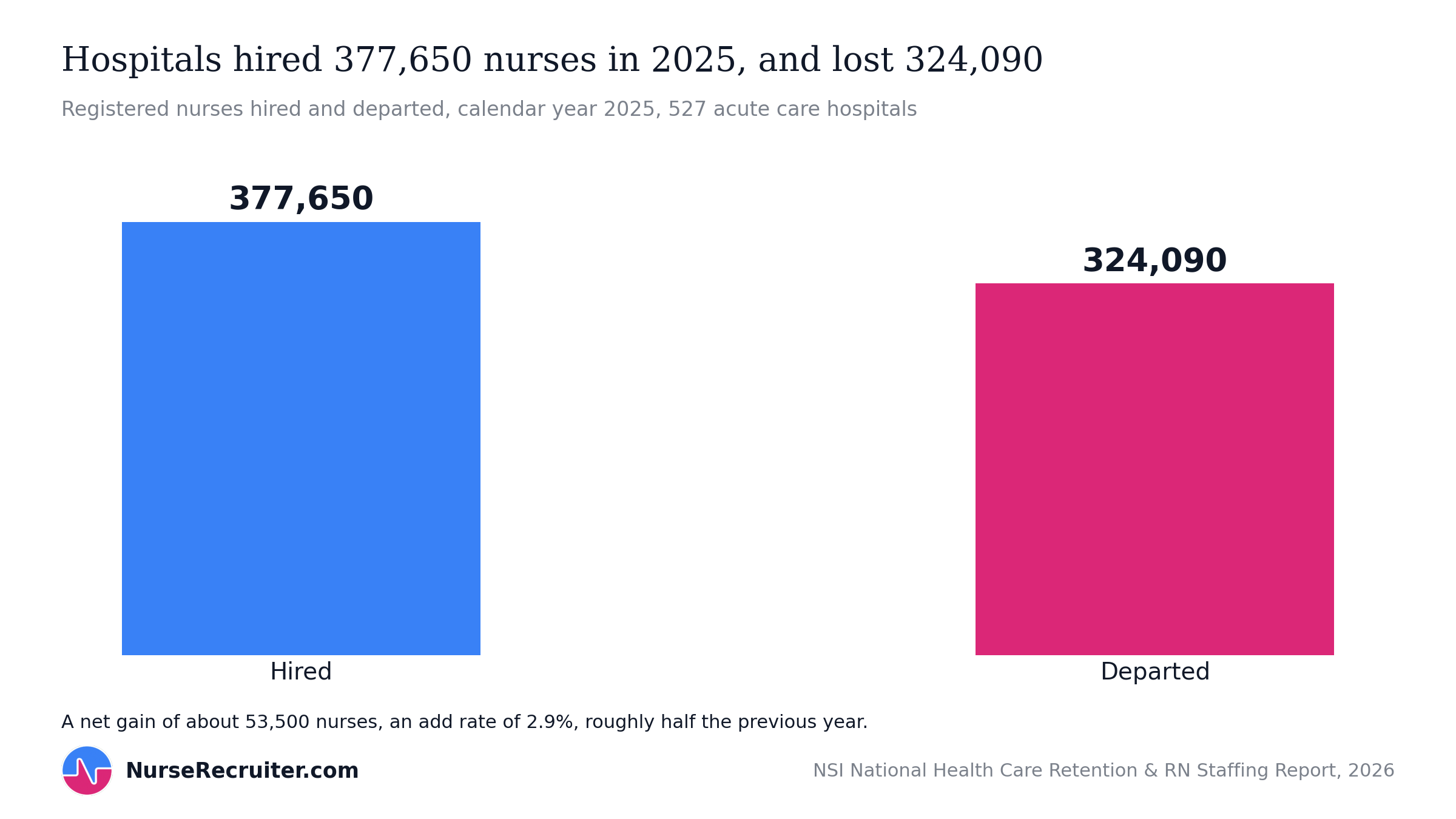
Hospitals hired 377,650 registered nurses in 2025. In the same twelve months, 324,090 walked out the door. Net gain: about 53,500 nurses, an add rate of 2.9%.
The year before, that add rate was 5.6%. So the pace of workforce growth was cut roughly in half, not because hospitals stopped needing nurses, but because hiring momentum slowed while departures stayed high. Read those two numbers together and the picture is a treadmill. For every ten nurses hired, more than eight replaced someone who left.
What to do about it: stop measuring your recruitment by hires made and start measuring it by net nurses on the floor. If your team celebrates forty hires in a year while forty-two nurses resign, the celebration is hiding a retention problem that no amount of recruiting will out-run.
2. The vacancy rate fell. The shortage didn't.
The national RN vacancy rate dropped to 8.6%, the lowest of the decade, down from 9.6%. Good news, with an asterisk. NSI changed how it calculates the figure this year, so the improvement is partly methodology.
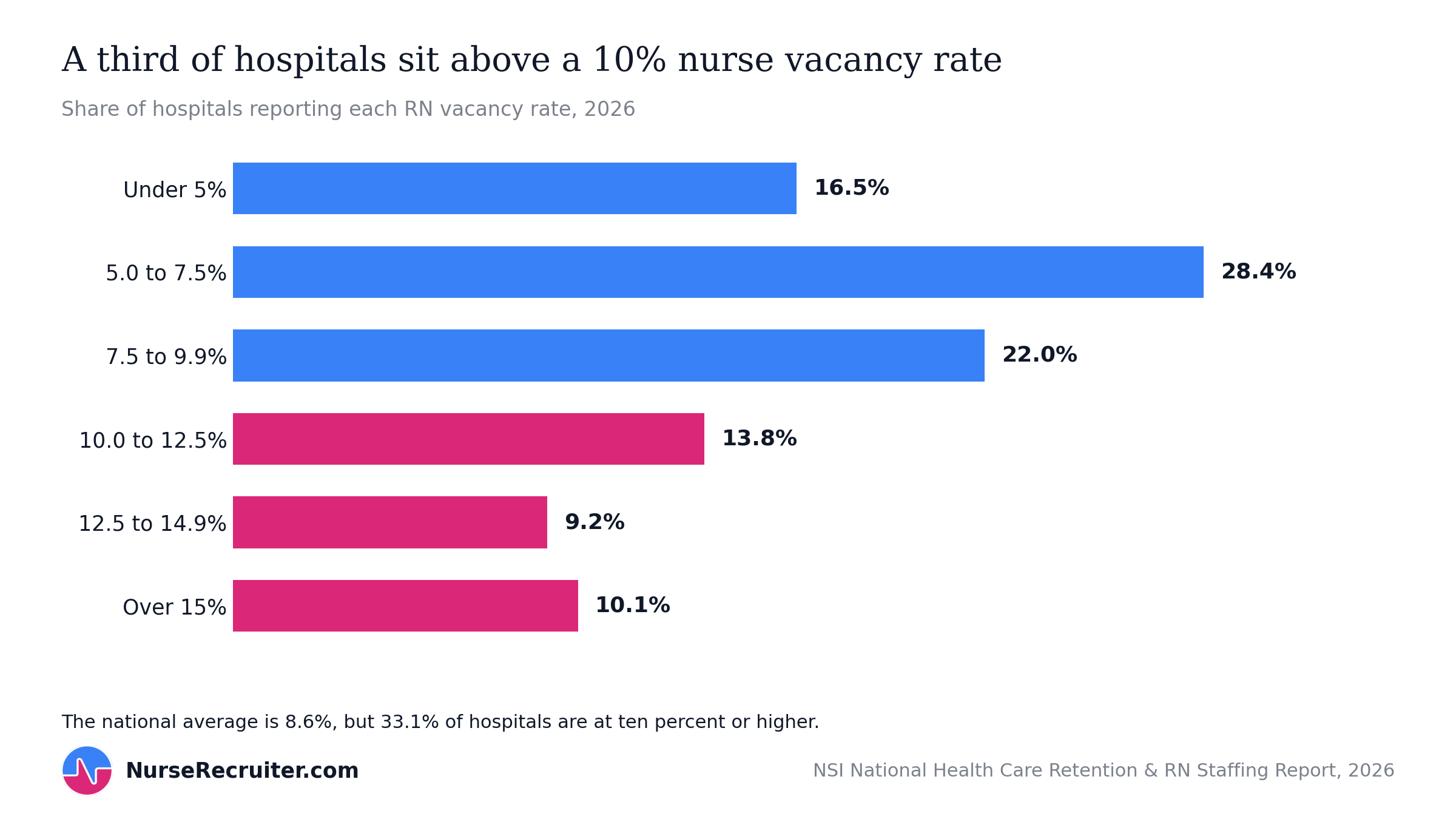
More to the point, an 8.6% average still leaves the typical hospital with forty-three unfilled RN positions, and a third of all hospitals (33.1%) are sitting at a vacancy rate of ten percent or higher. NSI puts the national shortage at 158,600 registered nurses.
An average is a poor guide to your own reality here. The spread is enormous: 16.5% of hospitals are under 5% vacancy, while 10.1% are above 15%. If you are in that second group, the national trend line is not describing your building.
3. Turnover went back up, and retirement is now the third reason nurses quit
RN turnover rose to 17.6%, up 1.2 points. Over the past five years, the average hospital has turned over 102% of its nursing staff. Its entire nursing staff, replaced, once, in five years.
The reasons nurses gave for resigning are worth reading closely: personal issues, relocation, retirement, career advancement, and scheduling conflicts. Retirement has been climbing steadily and now sits third. Salary comes in seventh, behind education.
That ranking is worth sitting with. Most employers answer a resignation with money, and pay did not make the top five. Read it carefully, though. The survey counts how often a reason was named, not how heavily it weighed, so treat it as a prompt to check your assumptions rather than proof that pay does not matter. Scheduling conflict is fixable. Commute is fixable by recruiting closer to home. Retirement is not preventable, but it is predictable, and it is the one you can see coming years in advance if you bother to look at the ages on your roster.
None of this should be a surprise. The national workforce survey we covered last year found the median American nurse had reached fifty years old, with four in ten saying they expected to retire or leave nursing within five years. This is that forecast starting to arrive.
What to do about it: the retirement wave is also a recruiting opportunity, and most employers miss it. Nurses stepping back from full-time work often want to keep working on reduced hours. We wrote about how to reach retired and semi-retired nurses in our per diem hiring guide. The same people leaving your competitor's full-time roster are candidates for your flexible ones.
4. Almost a quarter of your new nurses will leave within a year
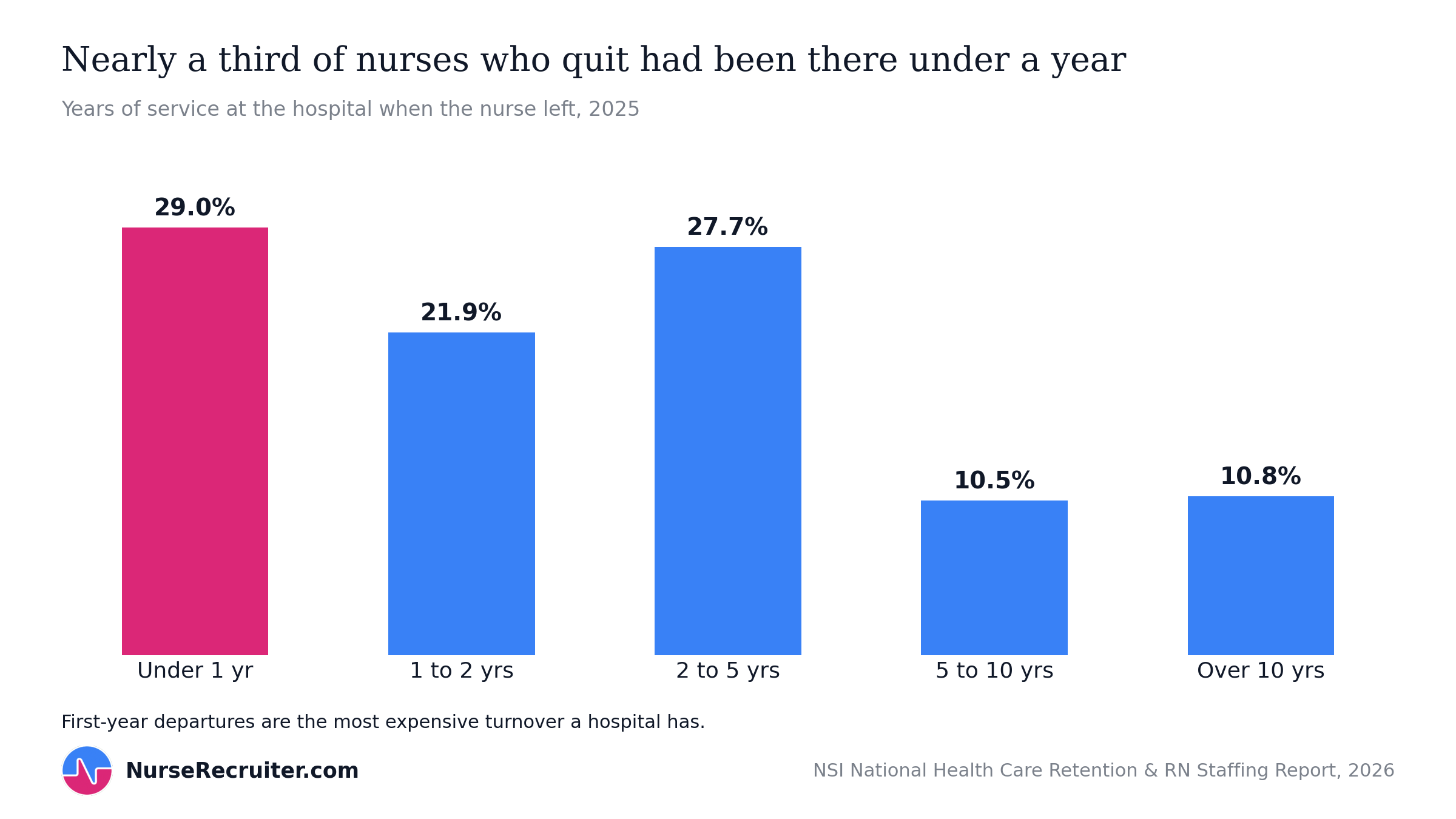
This is the number that should stop you: 22.7% of newly hired RNs left within their first year. First-year turnover accounted for 29% of all RN separations.
Now put that next to the cost. Each RN turnover costs the average hospital $60,090. Each percentage point of RN turnover is worth $295,000 a year to your budget, in either direction. The 1.2-point rise cost the average hospital an extra $360,000 last year alone.
So: seventy-eight days and real money to fill a role, and better than one in five of those hires is gone before the anniversary. You are not hiring a nurse. You are, a fair share of the time, buying the right to run the same search again next year.
What to do about it: the first ninety days are where the money is. Three-quarters of hospitals (74%) now have a formal retention strategy, and most of those specifically protect new hires. Nurse residency programs rate a 3.9 out of 5 for effectiveness among the hospitals running them. But there is a step even earlier: a bad-fit hire is a first-year departure waiting to happen. Screening for what the nurse actually wants from the role, on schedule, unit and growth, is cheaper than replacing them in month eight.
5. You are expected to hire more nurses with the same recruiting team
Here is the squeeze, in three numbers from the same survey:
- 71.8% of hospitals expect to grow their RN workforce this year.
- 26.7% expect to increase their recruitment budget.
- 6.8% expect to add recruitment staff.
Hospitals currently run 0.26 recruitment employees per 100 workers. Nearly three-quarters plan to hire more nurses; fewer than one in fourteen plan to add anyone to do it.
If you are the person on the receiving end of that math, you already know how it feels. The only ways out are leverage and reach, meaning tools that put your openings in front of more of the right nurses without adding hours to your week.
What to do about it: posting your nursing jobs on NurseRecruiter takes minutes, and it reaches an audience of nurses only. But the bigger lever is not waiting for applications at all. Search our nurse database of more than half a million nurses who registered here because they were looking for work, and contact the ones you want directly. One unlock gets you their email, phone and resume, and it is yours to keep.
Better still, set the search up once and let it run. A Search Agent delivers every matching nurse to your inbox the moment they register. When your recruiting team is not growing but your hiring target is, that is the difference between chasing candidates and having them arrive.
6. Travel nurses cost $66,081 more per nurse per year
Seventy percent of hospitals (70.7%) say they want to reduce their reliance on travel and agency staff. Travel and agency staffing remains one of the most common responses when a unit runs short.
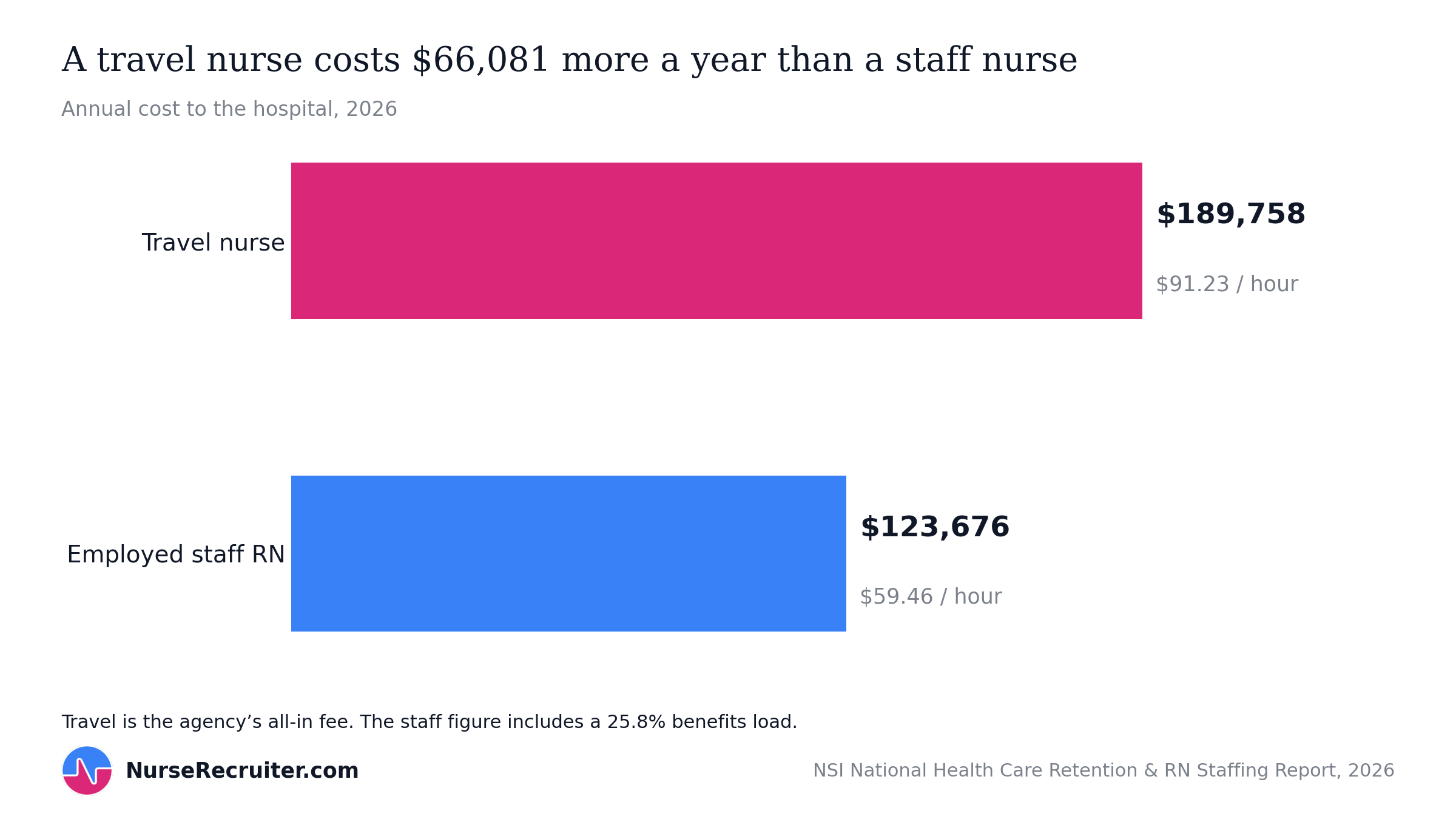
The gap between saying and doing has a price tag. Hospitals pay an average travel nurse fee of $91.23 an hour, or $189,758 a year. An employed RN, including 25.8% for benefits, costs $59.46 an hour, or $123,676. That is a difference of $66,081 per nurse, per year. Replace twenty travel nurses with employed ones and the average hospital saves roughly $1.32 million.
That gap has actually been narrowing, because travel rates have come down a long way from their 2022 peak. It has not closed, and it is not going to.
The uncomfortable conclusion: for most hospitals, the cost of recruiting harder is smaller than the cost of not recruiting. Every dollar you decline to spend on filling a permanent role, you spend twice on covering it.
7. Your specialty and your region change the whole picture
National averages flatten real differences. Some of the ones worth knowing:
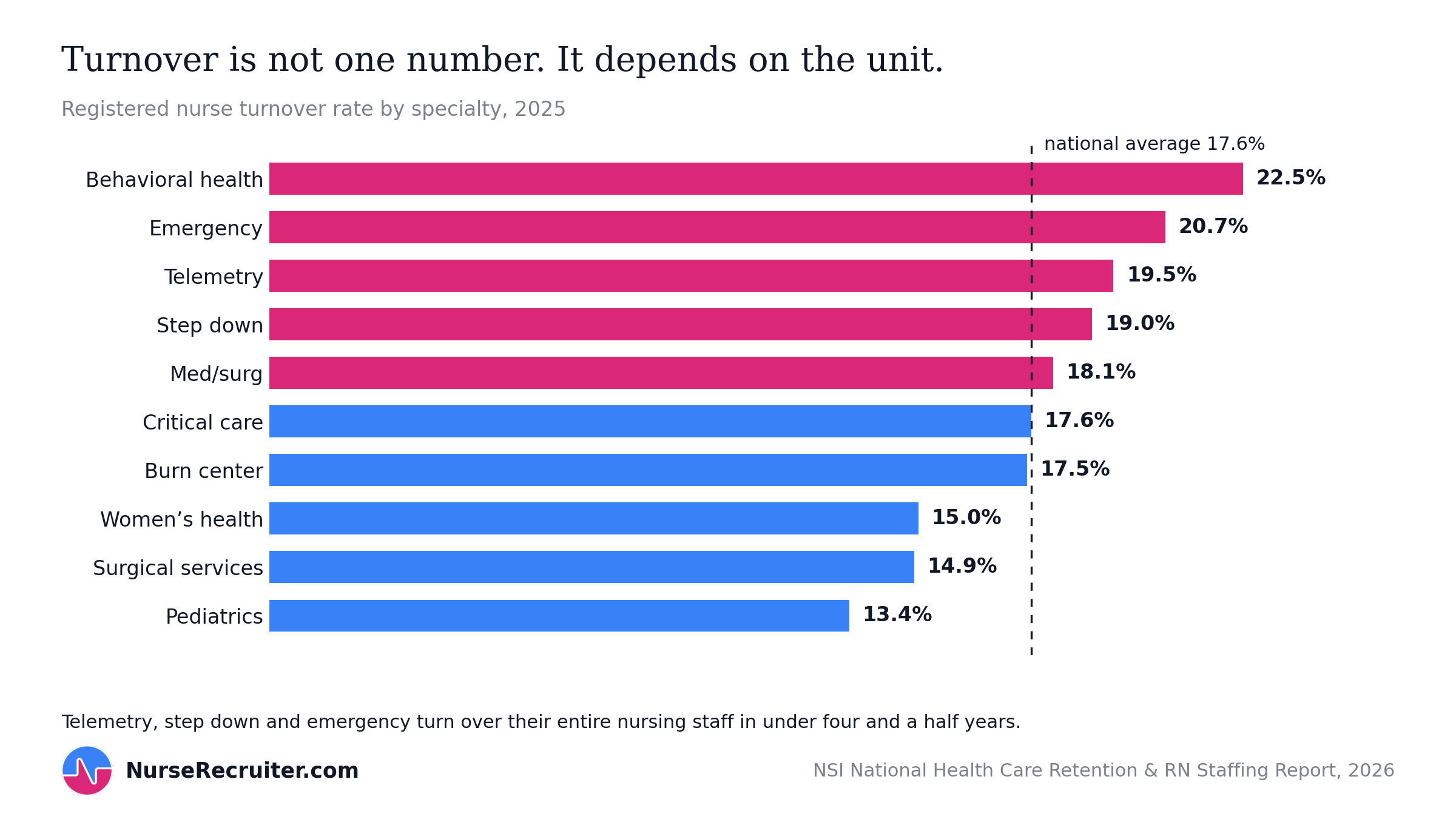
By specialty. Behavioral health leads at 22.5%, followed by emergency at 20.7%, telemetry at 19.5%, and step down at 19.0%. At the other end, pediatrics sits at 13.4% and surgical services at 14.9%. Over five years, telemetry, step down and emergency departments turn over their entire nursing staff in under four and a half years.
By time to fill. Telemetry nurses are the hardest to recruit at 87 days, with med/surg also above the national average. Even ER, the fastest, takes 70 days. The full range across specialties runs from 56 to 102 days.
By region. Turnover rose almost everywhere. The North-East saw the sharpest jump, up 3.3 points to 17.9%. The West rose 2.3 points to 18.4%, the South-East 1.4 points to 18.7%. Only the South-Central region improved, down 0.9 points. On speed, the West (70 days) and South-Central (74 days) fill roles fastest; the North-Central is slowest at 82.
What to do about it: benchmark against your specialty and your region, not the national line. A 19% turnover rate on a telemetry unit is ordinary. The same rate in pediatrics is a fire.
The bottom line
Strip the 2026 report down and it says four things. Hiring is slower than it was. Nurses are leaving slightly faster than they were. Retirement is a bigger driver than most employers have planned for. And the people responsible for fixing all of it are not getting reinforcements.
None of that is a reason for gloom, and it is not really a shortage story either. 377,650 nurses were hired last year, so nurses are available and moving. It is a competition story. The employers who win these hires are the ones who reach nurses before a posting goes stale, who screen for fit rather than filling a seat, and who treat the first year on the job as part of recruitment rather than someone else's problem.
If your recruiting team is smaller than your hiring target, and by the survey's own numbers it probably is, the fastest thing you can change is your reach. Post your nursing jobs where only nurses are looking, search half a million nurses and start the conversation yourself, or set up real-time leads so matching candidates land in your inbox the day they register. No contracts, and your money back if you don't get candidates.