Blog / Hiring & Job Seeking / Workforce & Policy / The Nursing Shortage / Staffing Ratios & Overtime / Retention & Turnover
$61,110 per lost nurse: the 2025 staffing numbers every nurse employer should know
By Diana Perez · Facebook LinkedIn Email
For the first time since the pandemic, most of the numbers in nursing's annual scoreboard are moving in the right direction. Turnover fell for the third year running. Hospitals added nearly a hundred thousand nurses to their payrolls. Even the time it takes to fill a vacancy shrank, by three whole days.
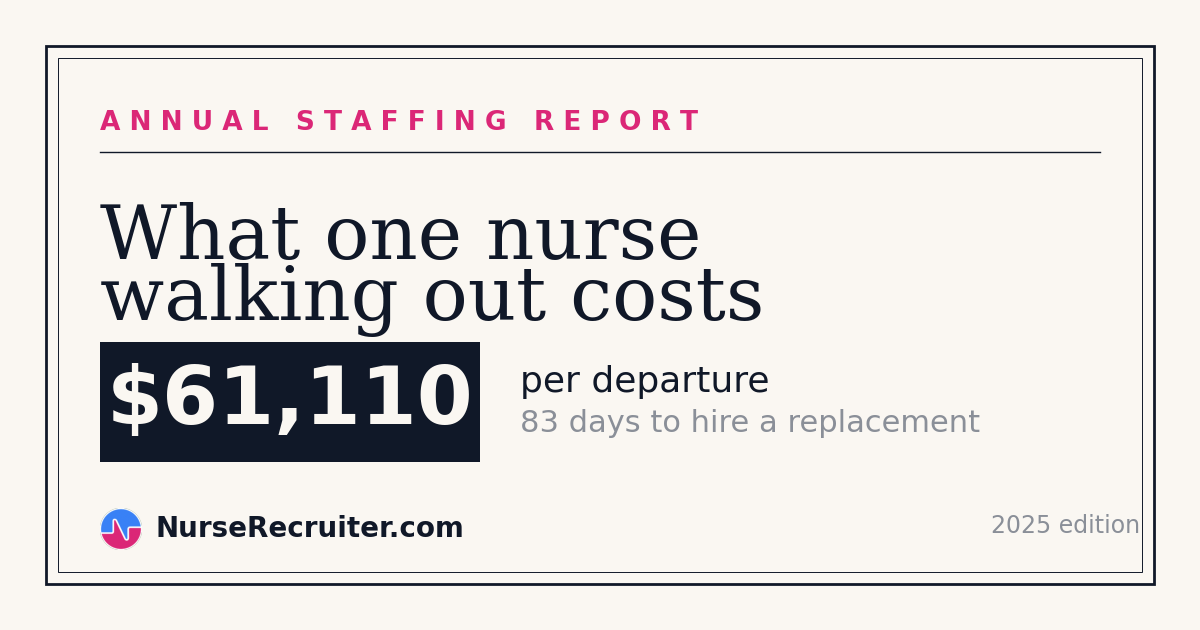
And every one of those improvements arrives with a price tag attached. The cost of losing a single staff nurse jumped 8.6% in one year, to $61,110. Fewer nurses are leaving, but each one who does costs more than ever.
The figures come from the 2025 edition of the NSI National Health Care Retention & RN Staffing Report, published in March and covering calendar year 2024. It draws on 450 acute care hospitals across 37 states, and 218,626 registered nurses. Two things are worth knowing before the numbers start. Hospitals report their own figures and choose whether to take part, and NSI is itself a nurse recruitment firm. It is still the closest thing the industry has to a scoreboard. Here is what this year's edition says, and what to do about it.
1. Hospitals added nearly 98,000 nurses, so the recovery is real
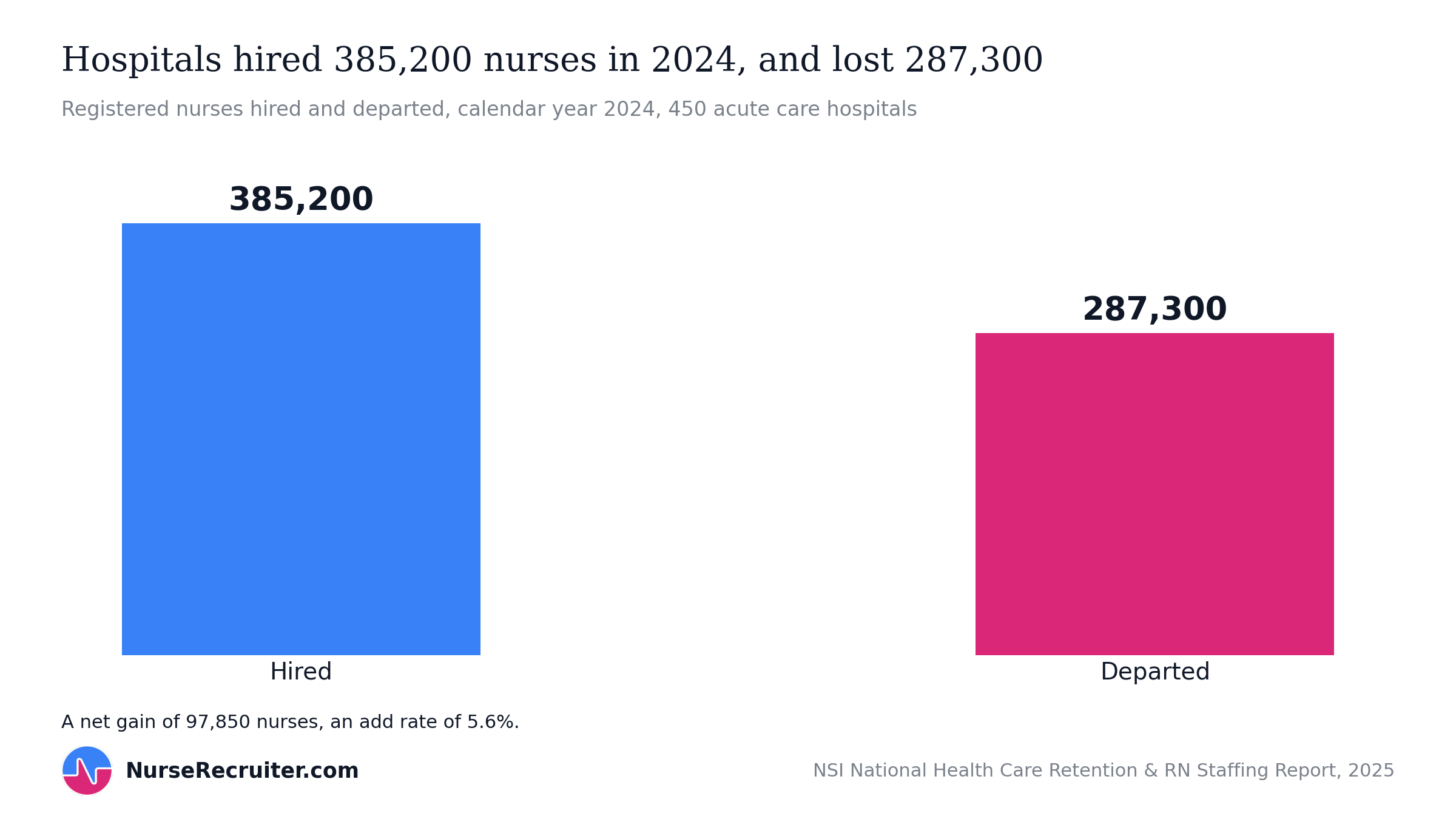
Hospitals hired 385,200 registered nurses in 2024. In the same twelve months, 287,300 left. That is a net gain of 97,850 nurses, a 5.6% add rate, bringing hospital RN employment to about 1.75 million.
Read that hiring number again, though. For every four nurses hired, three replaced someone who walked out the door. The recovery is real, but it is running on a treadmill. The growth came from hiring at enormous volume, not from holding on to the nurses already on staff.
What to do about it: treat the add rate, not the hire count, as your scoreboard. A recruiting team that celebrates gross hires while the back door stands open is winning the wrong game.
2. Turnover fell to 16.4%, but the five-year math is still brutal
The national staff RN turnover rate dropped to 16.4%, down two full points from 2023 and a long way from the pandemic peak of 27.1%. That is the third consecutive annual decline.
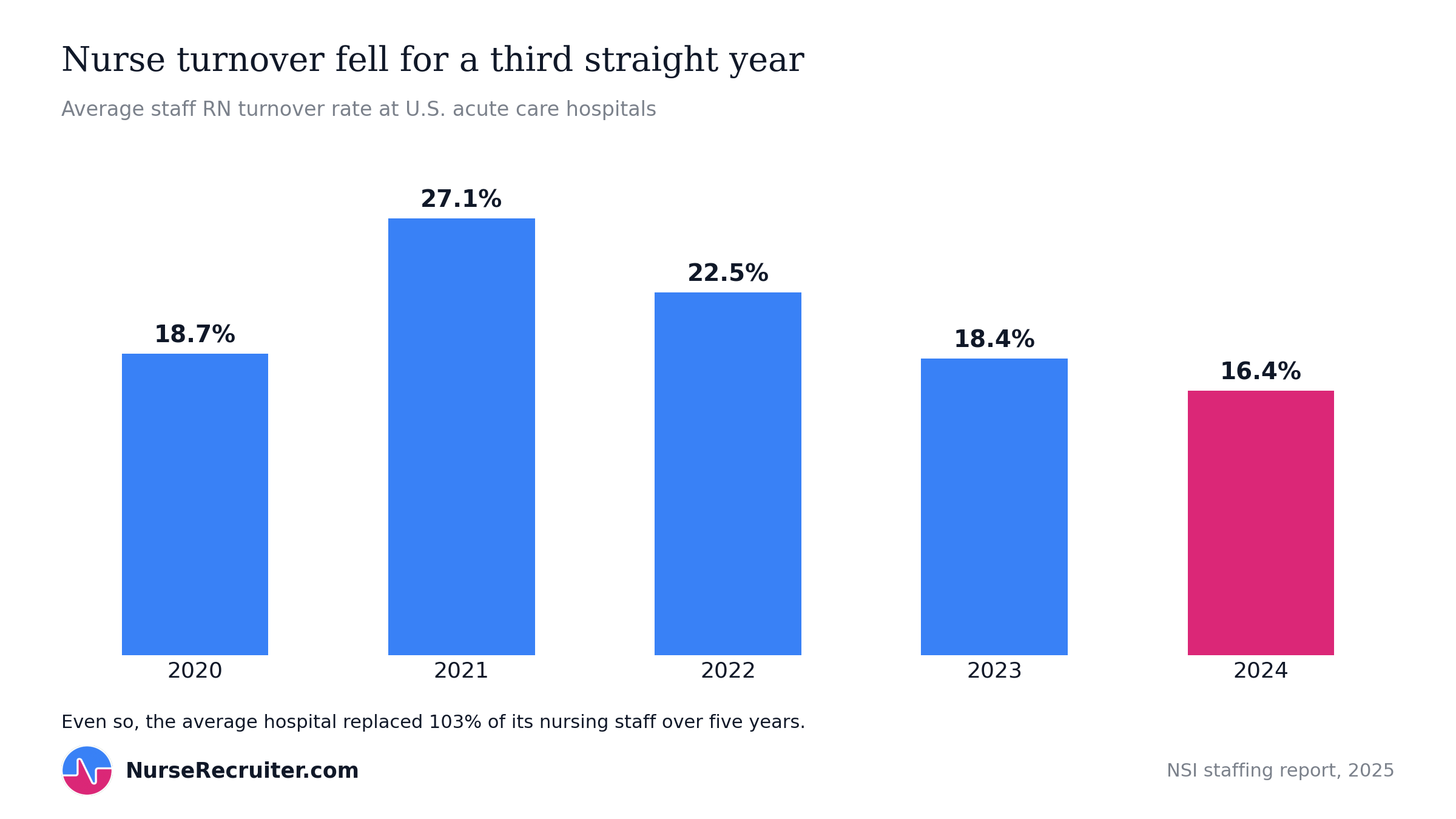
Zoom out and the celebration gets quieter. Over the past five years the average hospital still turned over 103% of its registered nursing staff. Its entire nursing roster, replaced, once. And the average hides an enormous spread. The best-performing decile of hospitals holds RN turnover at 11.5% or below, while the bottom decile sits at 24.3% and above. Between those two hospitals lies a completely different daily reality.
The reasons nurses gave for resigning are worth a close read: personal reasons, career advancement, relocation, retirement, and scheduling conflict top the list. Salary comes in eighth. Note retirement sitting there in fourth. About a third of working RNs are Baby Boomers, and every one of them reaches retirement age by 2030. That line on the resignation survey is going to grow.
What to do about it: benchmark against the percentiles rather than the average. And pull the ages on your roster, because retirement is the one resignation reason you can see coming years in advance.
3. Each departure now costs $61,110
Here is the number that moved the wrong way. The average cost of turning over one bedside RN rose 8.6% in a year, to $61,110. That covers overtime to fill the empty shifts, critical staffing pay, agency fees, and the salary escalation it takes to refill the role. The average hospital lost $4.75 million to RN turnover in 2024.
Put differently: every percentage point of RN turnover now costs, or saves, the average hospital $289,000 a year. Yet fewer than half of hospitals (42.9%) even track the cost of turnover, and a quarter (25.1%) have not set a measurable goal for reducing it.
What to do about it: if you track one new metric this year, make it this one. A retention programme that costs $100,000 and prevents four departures pays for itself twice over. You cannot make that case to your finance director if nobody is counting.
4. More than one in five new nurses is gone within a year
Of the RNs hospitals hired, 22.3% left within their first year, and first-year nurses accounted for 31.9% of all RN departures. Widen the lens to everyone with less than two years of service and you have accounted for a majority of all hospital separations (61.4%).
Hospitals know this is where the leak is. Four in five (80.9%) now run a programme specifically to protect newly hired nurses, most often a nurse residency, and the hospitals running them rate their effectiveness at 3.8 out of 5. But only 59.3% have a formal retention strategy at all, and just 54.2% have any strategy for keeping their tenured nurses, the same ones carrying the institutional knowledge that walks out with them.
What to do about it: the cheapest fix comes before the hire. A nurse who wanted a different schedule, unit, or commute all along is a first-year departure you paid $61,110 to postpone. Screening for what the candidate actually wants costs nothing next to that.
5. Filling a vacancy still takes almost three months
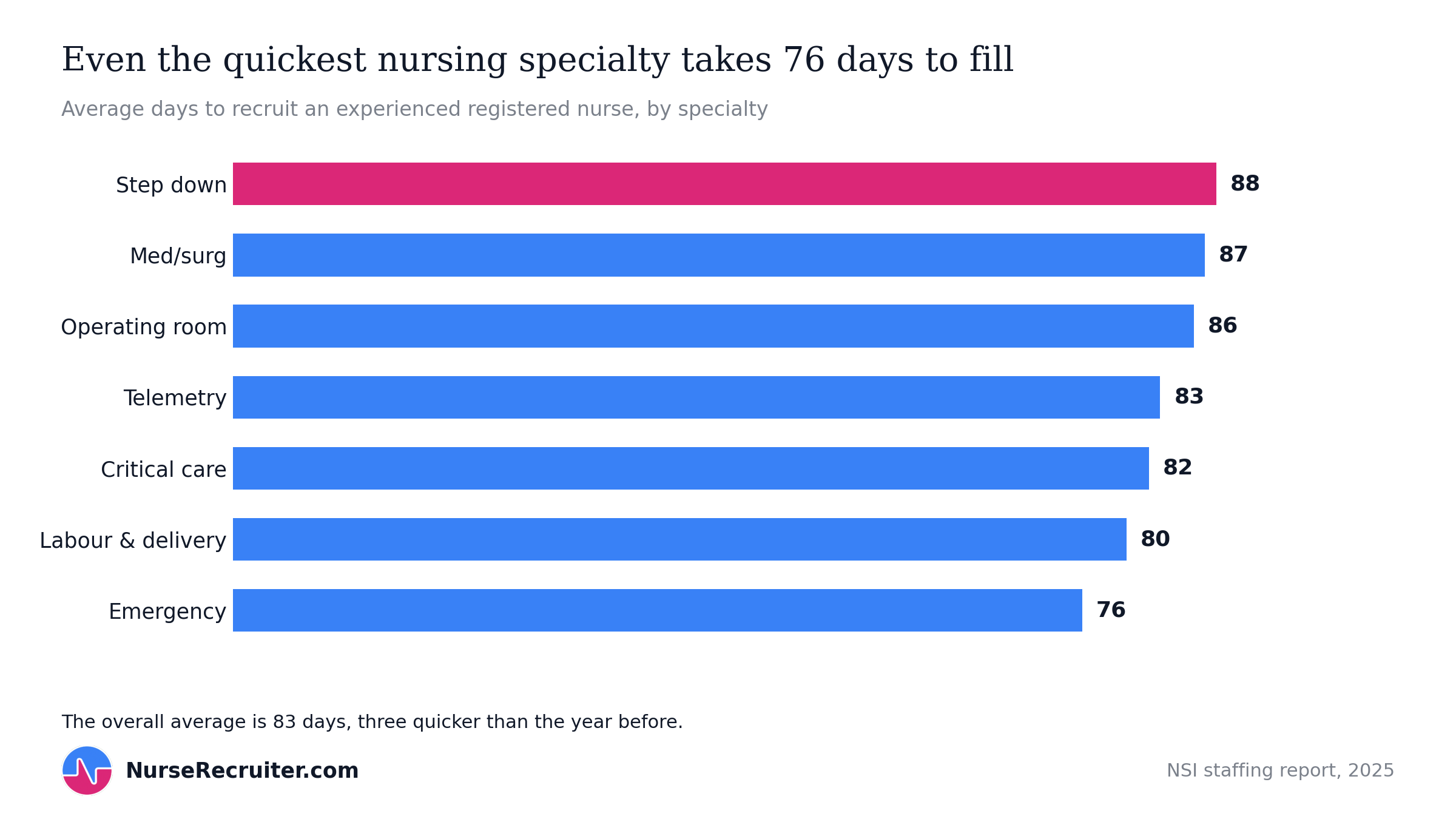
The average time to recruit an experienced RN is 83 days, three days faster than last year and still nearly a quarter of a year per hire. Step down units wait the longest at 88 days on average, with med/surg and the operating room close behind. Even the emergency department, the fastest specialty, sits vacant for 76 days. Depending on specialty and region, the range runs from 62 to 103 days.
Meanwhile the national RN vacancy rate edged down to 9.6%, which still means the average hospital is carrying 47 open RN positions, and more than four in ten hospitals report a vacancy rate above ten percent. An open position that takes three months to fill is not just a recruiting statistic. It is a quarter of a year of overtime, floating, and agency coverage for the unit working around the hole.
What to do about it: the 83 days start when you open the search, so the only way to beat the index is to have candidates before the vacancy exists. That is precisely what a Search Agent does. You define the nurse you will inevitably need, and every matching candidate lands in your inbox the moment they register, whether or not you have a posting open.
6. Everyone wants to quit travel nurses. Nobody has the staff to do it.
The gap between intention and arithmetic runs right through this year's report. Nearly three-quarters of hospitals (73.5%) plan to cut their use of travel and agency nurses, and travel staffing remains the single most common response when a unit runs short. Last year, 80% said the same thing, and it stayed the most common response then too.
The reason the intention keeps losing is capacity. While 72% of hospitals expect to grow their RN workforce this year, only 38% plan to increase the recruitment budget and just 17% plan to add recruitment staff. Hospitals currently run 0.25 recruitment staff per 100 employees, a ratio that fell again this year. The hiring targets are growing; the teams responsible for hitting them are not.
And so the expensive gap stays open. The average travel nurse costs $93.81 an hour, or $195,125 a year, against $55.79 an hour, or $116,035, for an employed RN including benefits. That is $79,090 per nurse, per year, being spent on not recruiting.
What to do about it: if you cannot add recruiters, add reach. Posting your nursing jobs here takes minutes and reaches an audience made up entirely of nurses. Better, go find them yourself. Our nurse database holds more than half a million nurses who registered because they were looking for work, and one unlock gets you a candidate's email, phone, and resume, yours to keep. Every travel contract you replace with a permanent hire returns that $79,090 gap to your budget, every year.
The bottom line
The 2025 report is, on balance, good news. Turnover is down for a third straight year, there is a real net gain in nurses at the bedside, and vacancies are inching down. But the structure underneath has not changed. New hires still leave in their first year at alarming rates, each departure costs more than ever, a vacancy still takes a quarter of a year to fill, and recruiting teams are being asked to grow the workforce without growing themselves.
The employers who come out ahead in that environment are not the ones with the biggest budgets. They are the ones who reach nurses first, screen for fit instead of filling seats, and keep counting. At $289,000 a point, retention is the highest-yield line item in the building. If your hiring target went up this year and your recruiting team did not, put your jobs where only nurses will see them, search the database, or set up real-time leads and let the candidates come to you. No contracts, and your money back if you don't get candidates.