Blog / Licensure & Credentials / Travel Nursing
One license, 40 states: where the Nurse Licensure Compact stands after a big year
By Diana Perez · Facebook LinkedIn Email
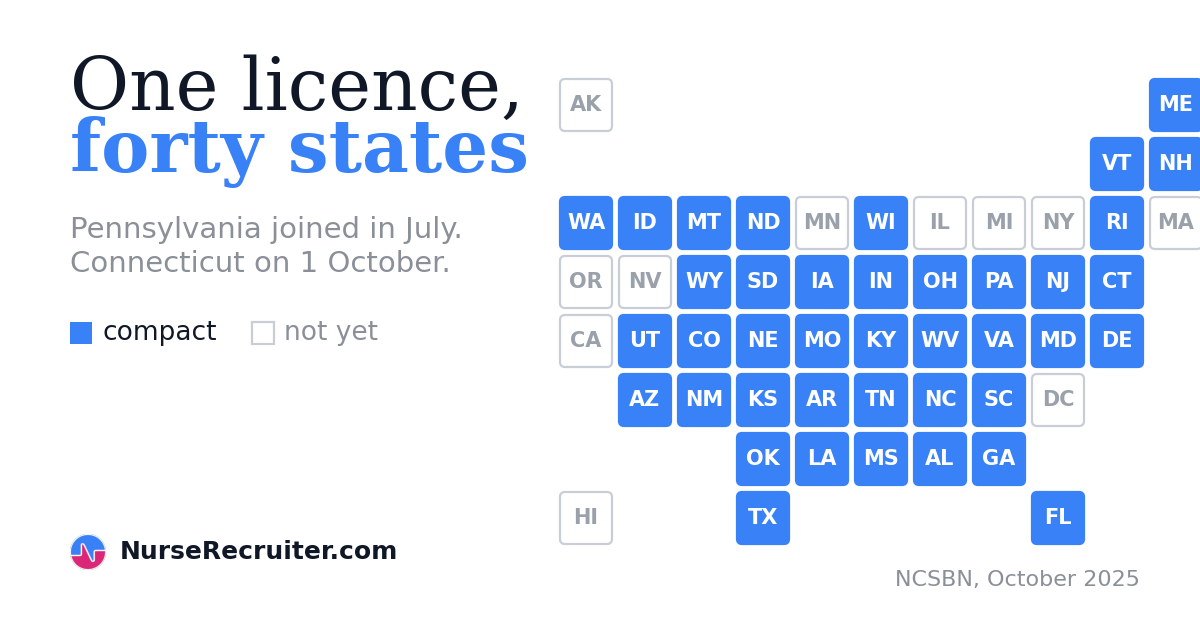
Two weeks ago, on 1 October, Connecticut switched on the Nurse Licensure Compact. In July, Pennsylvania did the same. That makes 40 states where one multistate nursing license lets you work, the biggest single year of expansion since the compact was rebuilt in 2018.
If you have been waiting for this thing to reach a state you care about, it is worth an update. And if you already hold a multistate license, there is a rule that changed recently which catches people out. More on that at the end.
Where it stands right now
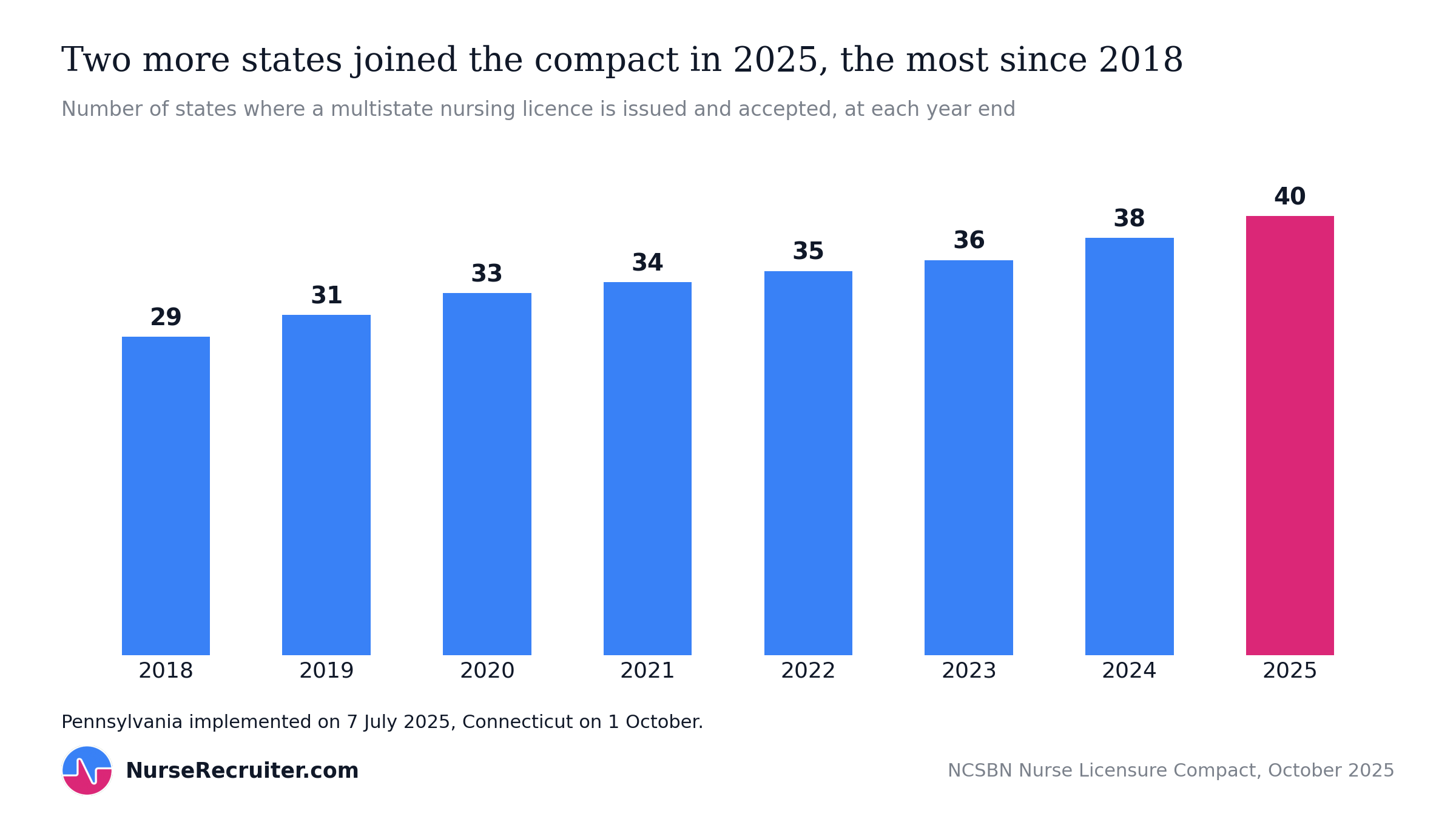
Twenty-nine states came in together when the enhanced compact went live in January 2018. Progress since then has been a state here, a state there: Kansas and Louisiana in 2019, Alabama and Indiana in 2020, New Jersey in 2021, Vermont in 2022, Ohio in 2023, then Rhode Island and Washington in January 2024.
This year brought two more, and both are substantial. Pennsylvania fully implemented on 7 July 2025. Connecticut followed on 1 October 2025.
Pennsylvania is the one worth dwelling on, because it finishes a story we started back in 2023. The state had been in partial implementation for two years. Nurses from other compact states could already come and work in Pennsylvania, but Pennsylvania's own nurses could not get a multistate license. It was a one-way door. As of July, it swings both ways, and a nurse living in Philadelphia or Pittsburgh can now hold one license and work across 39 other states.
"Enacted" and "implemented" are not the same word
This trips up more nurses than anything else about the compact, and it has cost people assignments.
Enacted means the legislature passed a bill and the governor signed it. Implemented means the board of nursing has actually built the thing, connected to the national licensure database, run the criminal background checks, changed its systems, and multistate licenses are being issued and honoured. The gap between the two runs anywhere from a few months to years.
Connecticut is the clean example. Signed into law in May 2024, live on 1 October 2025. Nearly seventeen months in between, during which a Connecticut nurse's license was still just a Connecticut license.
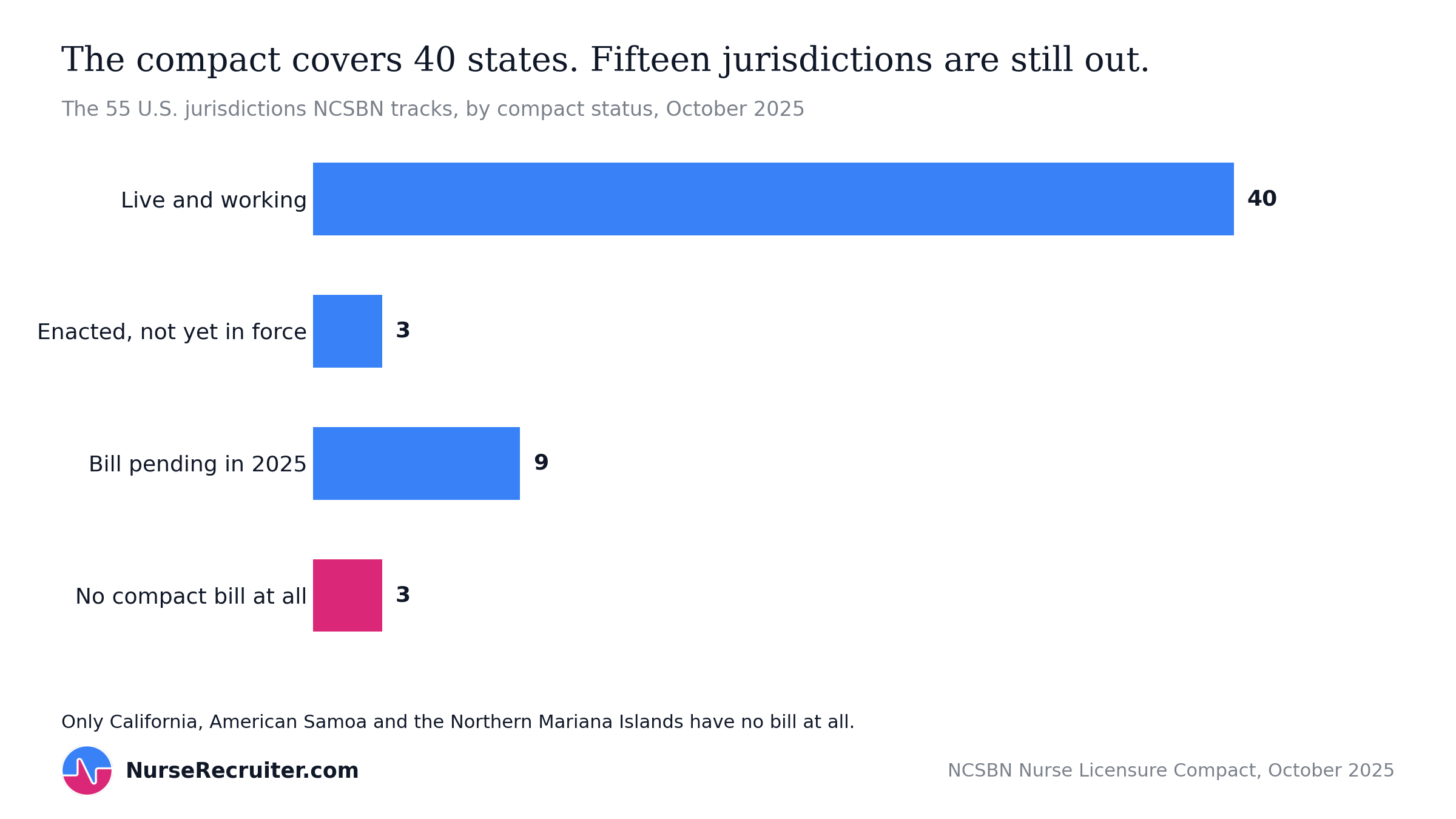
So across the 55 U.S. jurisdictions the boards of nursing track, here is the real state of play:
- 40 states where it is live and working.
- 3 jurisdictions have enacted it but have not switched it on: Massachusetts, the U.S. Virgin Islands, and Guam. None has published an implementation date. Guam is a half-case, because nurses from other compact states may practise there but Guam residents cannot yet obtain a multistate license, the same position Pennsylvania was in until July.
- 9 jurisdictions have bills pending: Alaska, the District of Columbia, Hawaii, Illinois, Michigan, Minnesota, Nevada, New York and Oregon. None passed during the 2025 sessions.
- 3 have no compact bill at all: American Samoa, the Northern Mariana Islands, and California.
Yes, California. The state that pays registered nurses more than anywhere else in the country remains the most conspicuous holdout, with not so much as a bill filed. If you want to work there, you need a California license, and there is no sign of that changing.
Counting jurisdictions rather than states, 43 have enacted the compact. That figure includes Guam and the U.S. Virgin Islands, which is why you will see "43 states" written in places where "43 jurisdictions" is what is meant. Only 41 states have enacted, and 40 of those have implemented.
The 60-day rule, which is newer than most nurses realise
Here is the practical bit. Since January 2024 there has been a rule that a multistate licensee who moves their primary residence to another compact state must apply for a multistate license in the new state within 60 days. Miss the window and your multistate privilege can lapse.
The word doing the work is residence. A thirteen-week assignment is not a change of residence, and it does not trigger this. Your primary state of residence is where you pay federal income tax, where you vote, or where your driver's licence is issued, so travel nurses working out of a home base are unaffected. Nurses who genuinely relocate are the ones who need the calendar reminder.
Two more limits worth knowing:
- The compact covers RNs and LPN/LVNs only. Nurse practitioners and other advanced practice nurses still need a licence in each state they practise in. There is a separate APRN compact, and it is not operational.
- Your multistate licence comes from your home state. You cannot shop for a friendlier one. It is issued where you live, and if you live in a non-compact state you cannot hold one at all, no matter how many compact states you work in.
To qualify, you need the standard set of requirements the compact applies everywhere: a licence in good standing from your home state, graduation from an approved nursing programme, a passed NCLEX, a state and federal fingerprint-based criminal background check, no felony convictions, no nursing-related misdemeanour convictions, no current participation in an alternative-to-discipline programme, and a valid Social Security number.
What this changes for you
For a travel nurse, each new state is one fewer licence application, one fewer fee, and several fewer weeks of waiting between contracts. Pennsylvania and Connecticut coming online means the entire Northeast corridor is now easier to work than it was in June, a genuine change for anyone who has watched good assignments expire while a licence application sat in a queue.
It matters more now than it did during the boom. With travel rates settled well below their 2022 peak, as we worked through in August, the weeks you lose to paperwork are a bigger share of what you earn. Licensure friction used to be an annoyance. On today's rates it is real money.
For employers, the compact is a recruiting radius. A hospital in a compact state can hire a nurse living in any of the other 39 and have them working immediately rather than months from now, which is worth knowing when the average vacancy already takes about three months to fill.
Nine more jurisdictions have bills in front of them, and legislative sessions resume in the new year. Illinois, Michigan and Minnesota are the big ones to watch. Meanwhile there are already more compact states than most nurses realise, and if you hold a multistate licence, all 40 of them are open to you right now. Have a look at what is available on the road.
Status as of October 2025, from the compact's own published map and status data. Requirements and implementation dates change, so check with your own board of nursing before relying on any of this for an assignment.