
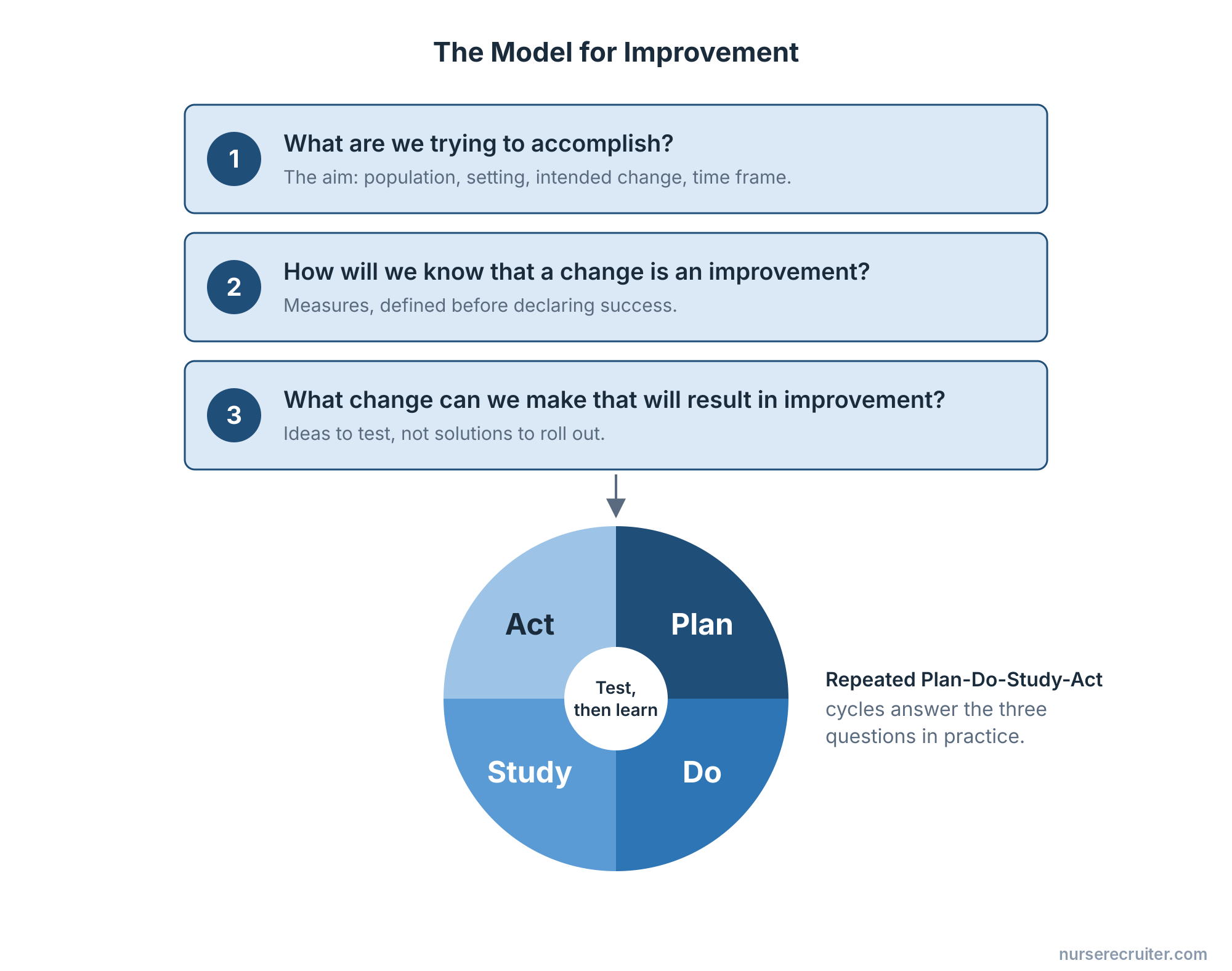
The Model for Improvement connects an improvement goal with measurement and practical testing. Developed by Associates in Process Improvement and used by the Institute for Healthcare Improvement, it asks a team to clarify the result it wants, how it will recognize improvement and what changes might produce that result. The team then learns through repeated Plan-Do-Study-Act cycles.
Start with the result
A project name such as “new handoff form” begins with a solution. The underlying goal could be more reliable transfer of information when patients move between units. Starting there leaves room to discover that the form is adequate but the receiving nurse cannot access it, or that nobody knows who is responsible for resolving missing information.
An aim should specify the population, setting, intended change and time frame. For a real project, the target and deadline need to reflect the local baseline, available resources and the importance of the problem. They are not numbers to borrow from another hospital simply because its project succeeded.
Choose measures before declaring success
Imagine a team introducing a designated handoff contact for transfers. This is an illustrative example. Counting the number of staff who received the announcement would show the reach of communication, but would not answer whether transfers improved.
The team could consider whether a receiving clinician was reached, whether necessary information was available and whether the new arrangement caused delays or interruptions elsewhere. It would need precise definitions and an agreed collection method before comparing results.
Staff and patients may value different aspects of the process. A transfer that is faster on paper could still leave a patient unsure where they are going. Include the people affected when deciding what a useful result looks like.
Test an idea before building around it
The model's testing component is the PDSA cycle. A small test can help answer a narrow practical question. It is not permission to experiment outside clinical or organizational safeguards.
For the handoff example, an approved trial on one transfer could reveal that the contact's phone is not carried during a break. That result is useful even if the proposal initially appeared straightforward. The next version might need a backup role or a different communication route.
Record the prediction, what actually happened and what the team will change next. Repeating an activity without examining the result is not the same as learning from a test.
What the framework cannot decide
The model does not identify the correct clinical intervention, determine whether a project requires research review, or establish that a change caused an observed outcome. Those questions need relevant evidence and expertise. Its role is to organize improvement work so a team can connect intentions with observations rather than simply roll out a preferred solution.
The related pages on aim statements and selecting measures cover two common starting points.
Ask what else could change when the team tests its idea; balancing measures can help track those effects.
Sources
- IHI — Model for Improvement (accessed 2026-09-17).
- IHI — Testing Changes (accessed 2026-09-17).
- IHI — Setting Aims (accessed 2026-09-17).
- IHI — Establishing Measures (accessed 2026-09-17).
- HHS OHRP — Quality Improvement Activities FAQs (accessed 2026-09-17).