
Plan-Do-Study-Act, usually shortened to PDSA, is a method for learning from a deliberate test of change. A team states a question and prediction, tries the change within an agreed scope, studies what happened and decides what to do next. The next cycle should reflect that learning rather than repeat the first test unchanged.
What belongs in a cycle
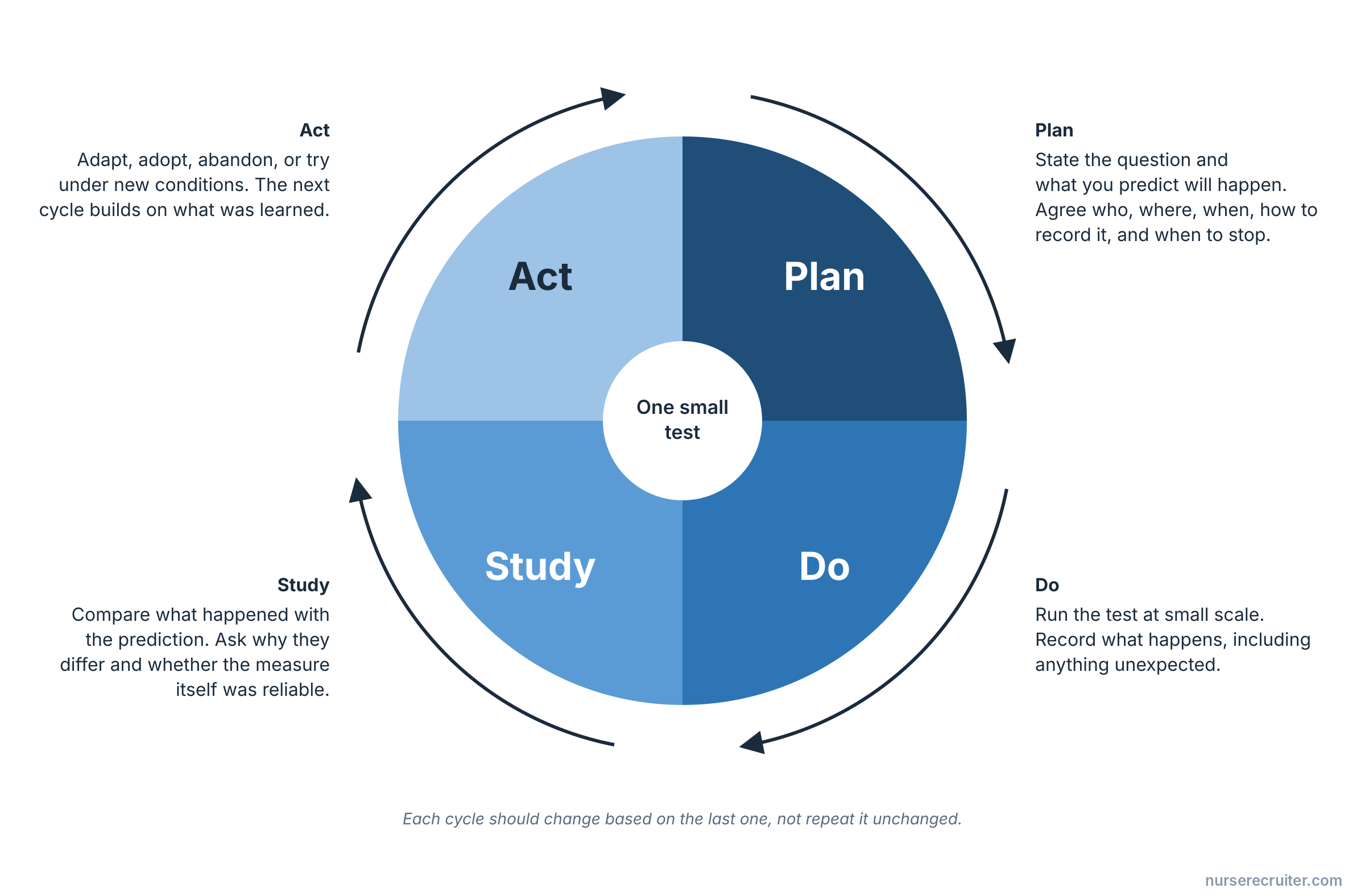
The plan needs a question small enough to answer. “Will a new discharge process improve care?” is too broad for a first test. “Can the evening nurse find the approved education material without calling another department?” is a practical question that could help a larger project.
The test also needs an owner, a time and place, a method of recording observations and any necessary clinical or operational approval. State what would make the team stop the test. A small scale does not excuse exposing patients or staff to an avoidable risk.
During the test, record unexpected events as well as the intended measure. A process that succeeds only because its designer stays beside the nurse may not be ready for ordinary use.
An illustrative nursing example
Suppose a unit has approval to test a clearer location for an existing supply list. The question is whether nurses unfamiliar with the new location can find the information during routine work. The prediction might be that each participating nurse can locate it without additional directions.
In the test, two nurses find the list and one opens an obsolete copy saved on another screen. The important finding is not simply a two-out-of-three success rate. The test exposed a competing information source. The next cycle could address version control before adding more participants.
These numbers are hypothetical. They illustrate how an observation can change the plan; they do not establish a target or expected result for a real unit.
Study before expanding
The “study” step compares observations with the prediction. Consider why the result differed, what information is missing and whether the original question was useful. A test can reveal that the measure itself is unreliable: different observers might have interpreted “found the list” differently.
The “act” decision could be to adapt the change, try it under different conditions, abandon it or prepare for a broader test. A single successful attempt does not show that a process will work across all shifts, locations or patient groups.
Keep a usable record
A short cycle log is often more useful than a retrospective account written at the project's end. Record the question, prediction, test conditions, observations and next decision while they are clear. Distinguish what the team observed from what it inferred.
PDSA sits within the Model for Improvement. For the differences between a limited test and making a change routine, see small tests of change and sustaining practice changes.
When planning what to observe, include a measure of possible unintended effects.
Sources
- IHI — Testing Changes (accessed 2026-09-17).
- IHI — Model for Improvement (accessed 2026-09-17).