
A small test of change is a deliberately limited opportunity to learn how a proposed change works in a local setting. The scope might be restricted by participants, location, time, or number of opportunities. IHI recommends keeping early tests as small as possible, then refining the change and testing it under different conditions before broader implementation.
The Plan-Do-Study-Act cycle provides the learning structure. Choosing the size of a test is a separate practical decision: the test needs to answer a useful question while keeping the work manageable and its boundaries clear.
Choose the smallest useful question
Instead of asking whether a new process should be adopted everywhere, identify what is uncertain now. Can a user find the new field? Does information reach the intended role? Can the receiving team understand the request without clarification? These questions may require different tests.
As a planning exercise, write down the exact version of the change, where it applies, who participates, and when the test ends. Identify who can stop the test and what should happen if a problem appears. Confirm the applicable local permissions and safeguards before trying a change in actual care. Calling an activity small does not itself authorize it.
When the initial question concerns usability, consider whether a walkthrough or rehearsal can answer it before using a live process. Keep the claim limited to what that exercise observes. Successfully locating a field in a rehearsal does not demonstrate reliable use during routine work.
Expand according to learning
IHI recommends linked tests, useful qualitative or quantitative observations, reflection on unexpected effects, and testing under varied conditions. A test that does not lead toward improvement may need to be stopped or redesigned. An unfavorable result can identify what the next version must address.
Before expanding, ask which uncertainty was resolved and which remains. Adding participants without changing the learning question may produce more activity without answering whether the process works on a different shift or with a different type of request. Document why the next setting was chosen.
Illustrative progression
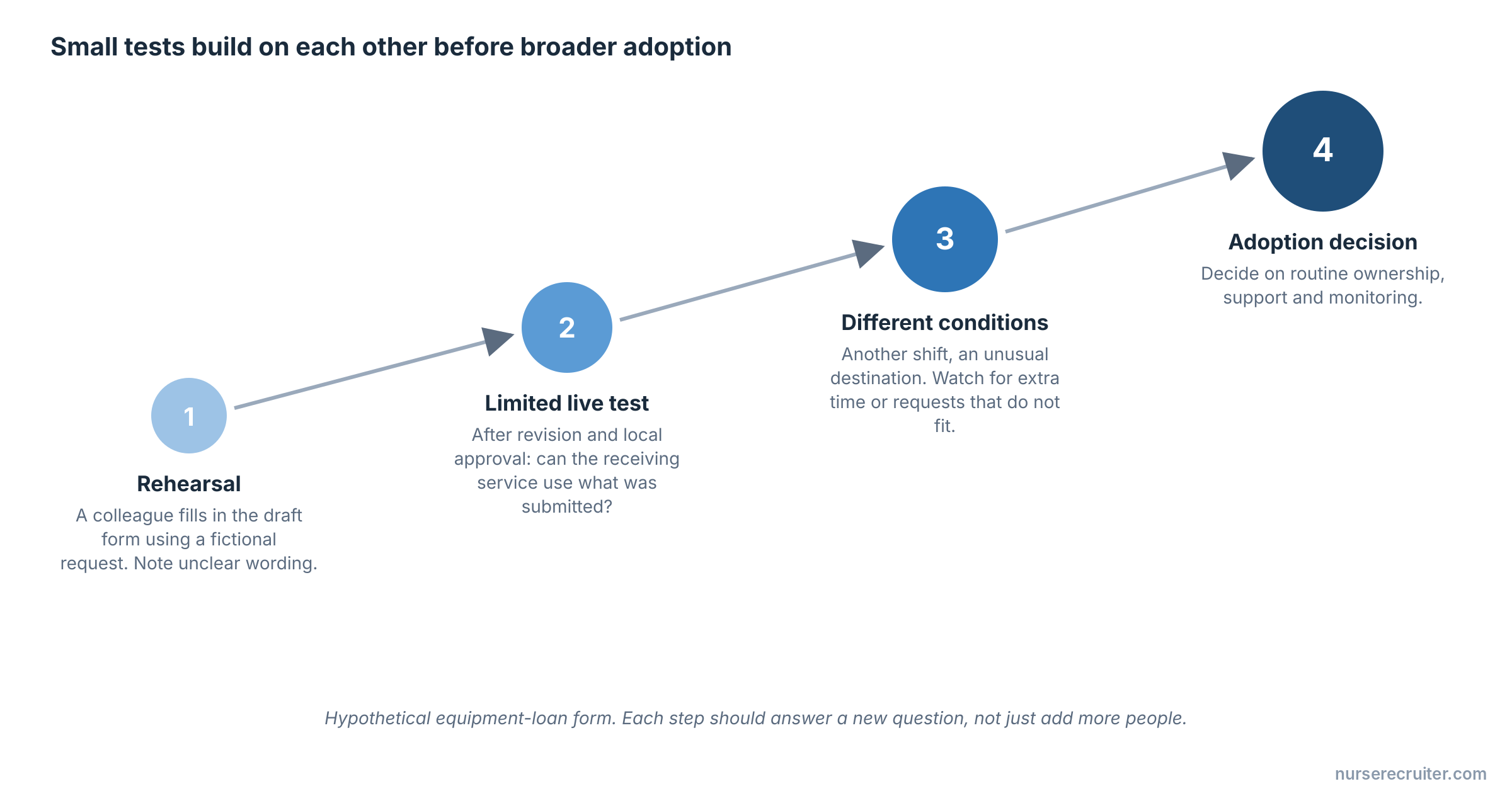
Suppose a nursing team proposes a clearer equipment-loan request form. In this hypothetical example, the first exercise could ask a colleague to complete the draft using a fictional request. The observer could note unclear wording and whether the destination is recognizable. No improvement outcome is assumed.
After revision and any needed local authorization, a limited live test could examine whether the receiving service can use the submitted information. A subsequent test might include a different shift or an unusual destination. The team could also watch for additional completion time or requests that cannot fit the available options.
If the form works only with its designer present, that observation should shape the next test. Broader adoption needs a decision about routine ownership, support, and monitoring. Do not describe a promising first trial as sustained improvement; sustaining a practice change asks whether the process continues to function after the initial testing effort ends.
Alongside the intended result, choose a balancing measure to detect an unwanted effect.
Sources
- IHI: Testing Changes (accessed 2026-09-17).