
A balancing measure checks whether a change intended to improve one part of care creates a problem elsewhere. It broadens the definition of success. A process can become faster while increasing errors, or reduce work in one department by transferring it to another.
Ask what could get worse
Start with the proposed change and follow its effects through the workflow. Who gains time? Who receives a new task? Which patients could find the process harder to use? What information or safeguard could be lost?
The Institute for Healthcare Improvement distinguishes balancing measures from outcome and process measures. The outcome describes the intended result; a process measure examines an important step; a balancing measure looks for a consequence that could make the apparent improvement less worthwhile.
These categories reflect the purpose of the measure in the project. A measure is not permanently a “balancing measure” regardless of the question being asked.
A nursing example
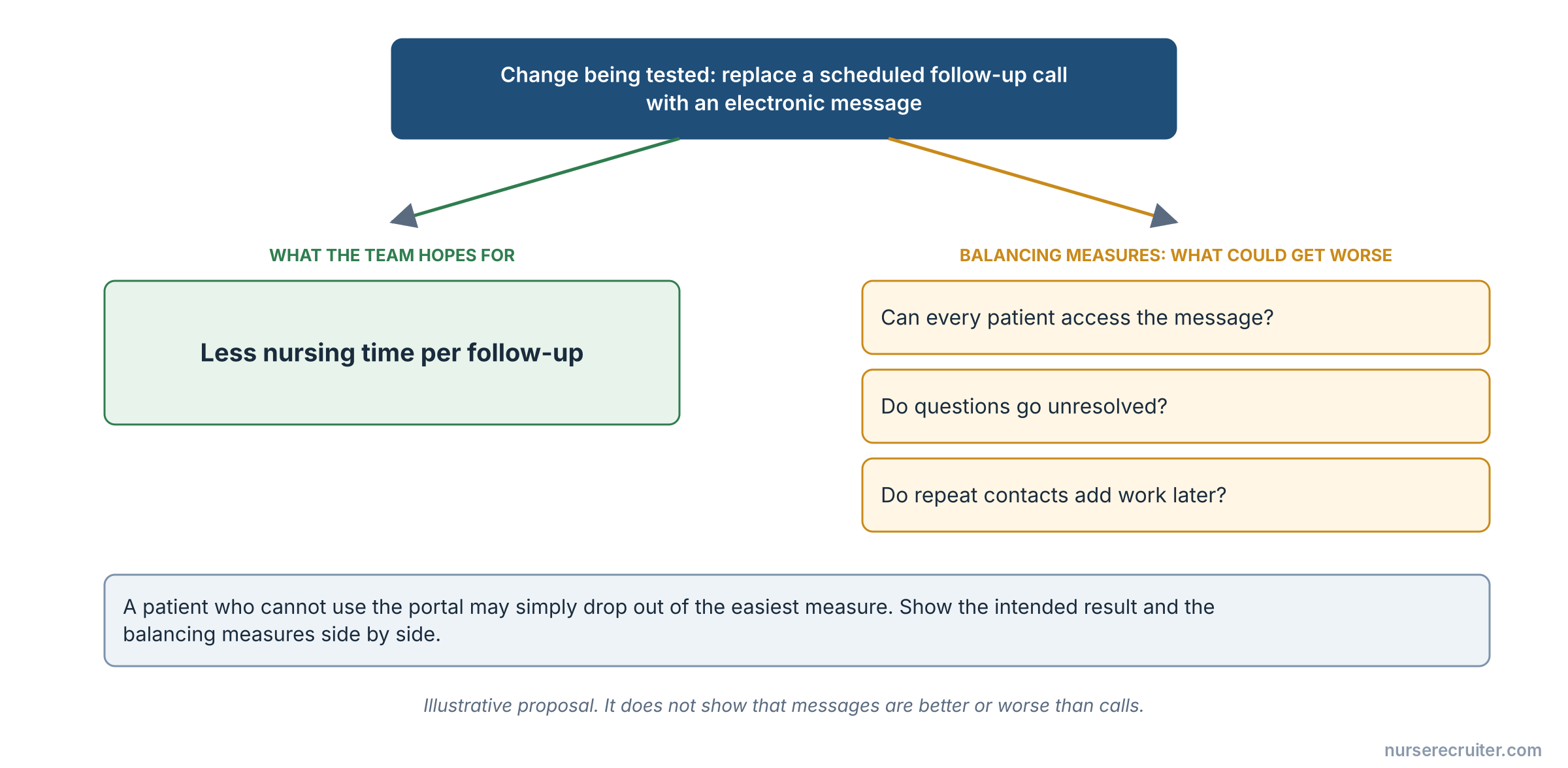
Imagine a clinic replacing a scheduled follow-up call with an electronic message. This is an illustrative proposal. The team may hope to reduce nursing time per follow-up. It should also examine whether patients can access the message, whether questions remain unresolved and whether repeated contacts create additional work later.
An average reduction in call time would not settle those questions. A patient who cannot use the portal may disappear from the most convenient measurement rather than receive an equivalent service. The team should consider that possibility before deciding the new process is better.
The right measures depend on the clinic's purpose and population. The example does not establish that electronic follow-up is either better or worse than a call.
Keep measurement proportionate
A balancing measure should address a plausible consequence of the change. Collecting every available number can bury the few observations that would actually change the decision.
Specify how the team will notice a problem and who will review it. Some concerns may be captured through a defined numerical measure; others may first appear in patient or staff feedback. Preserve those reports rather than dismissing them because they are absent from a dashboard.
If a numerical threshold is used to pause or revise a project, document who selected it and why. An arbitrary threshold can make a project look controlled without establishing that the boundary is meaningful.
Review the whole result
When presenting the project, show the intended outcome alongside its balancing measures. Do not place a favorable efficiency figure in the headline while leaving a worsening access problem in an appendix.
If a trade-off remains, name it clearly. The team may decide to adapt the process, provide an alternative route or collect more evidence before expanding it. That decision belongs in the record of the project.
See selecting measures and equity in measurement.
Use the project aim to identify which tradeoffs would matter to the team and its patients.
Sources
- IHI — Establishing Measures (accessed 2026-09-17).
- AHRQ — Types of Health Care Quality Measures (accessed 2026-09-17).