
An aim statement defines what an improvement project intends to accomplish, for whom, where and by when. It gives the team a shared target and a way to recognize when the project has wandered beyond its original scope. The Institute for Healthcare Improvement recommends an aim that is measurable, time-bound and clear about the population and setting.
Describe a result, not an activity
“Train all nurses on the new form” is a training target. It does not explain the problem the form should solve. “Improve communication” names a desirable direction but gives the team little guidance about where to start.
A more useful draft might identify missing discharge contact information on a particular unit. The team could then decide whether the problem is incomplete documentation, outdated information or patients not knowing which number to use. Those are related but different problems, and they may need different measures.
Avoid choosing the intervention so early that the aim becomes a defense of it. If the project is named after a form, a training session or a software feature, ask what outcome would justify that investment.
Build the statement from local information
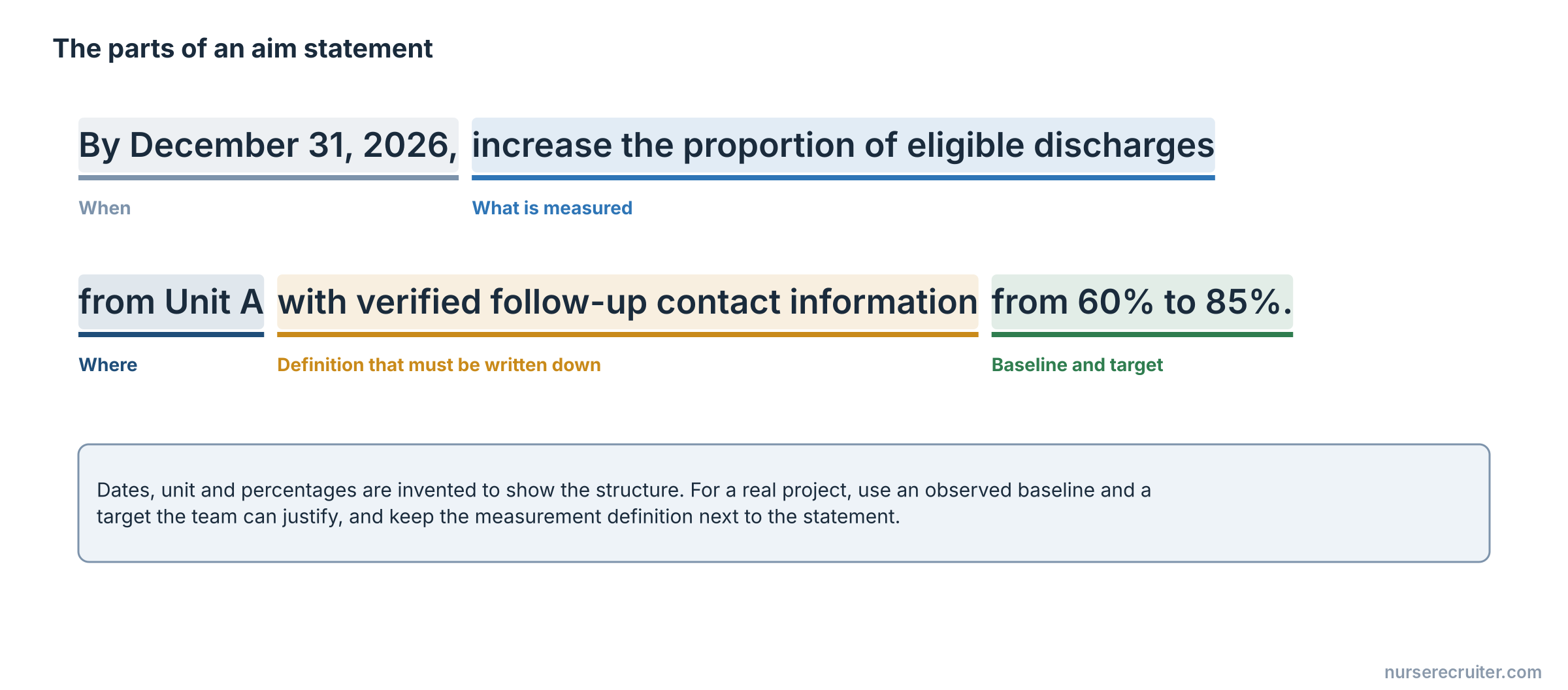
Before selecting a numerical target, establish what the baseline represents. Does “complete contact information” require a name, number, hours of service and an alternative outside those hours? Which discharges are included? Who checks the record? A target becomes difficult to interpret if its definition changes during the project.
A fully specified fictional aim could read: “By December 31, 2026, increase the proportion of eligible discharges from Unit A with verified follow-up contact information from 60% to 85%.” The date, unit and percentages are invented to demonstrate the structure, not suggested benchmarks.
For a real project, replace this example with an observed baseline and a justified target agreed by the team. Keep the measurement definition alongside the statement, including which patients are eligible and what verification requires. A precise sentence is useful only when its numbers have a defensible meaning.
Test the scope with the people affected
Ask whether the aim covers the patients most likely to encounter the problem. A project could appear successful by measuring only weekday discharges or only people who use an English-language handout. The team should explain relevant exclusions and examine whether they hide the very problem it wants to address.
Also ask whether the proposed result depends on another department. If pharmacy, transport or an external clinic controls a necessary step, include that dependency in the plan rather than leave bedside nurses accountable for an outcome they cannot produce alone.
Revise transparently
An aim may need revision as a team learns more. Record the reason and keep the earlier version. Quietly lowering the target after seeing disappointing results makes the project difficult to assess.
The aim works with measures and a theory of change. It does not replace either one.
Once observations accumulate, a run chart can show the sequence behind a before-and-after comparison.
Sources
- IHI — Setting Aims (accessed 2026-09-17).
- IHI — Establishing Measures (accessed 2026-09-17).