
Statistical significance concerns a result's relationship to a statistical model and a chosen decision threshold. Clinical significance concerns whether the size and nature of a difference matter for care. The two questions are related but not interchangeable. A small effect can produce a small p-value in a large study, while an imprecisely estimated important effect may not cross a conventional threshold.
A p-value is not the probability that the study's conclusion is true. It is calculated under a specified null hypothesis and other model assumptions, describing how incompatible the observed data are with that model through a chosen test statistic.
Read the magnitude first
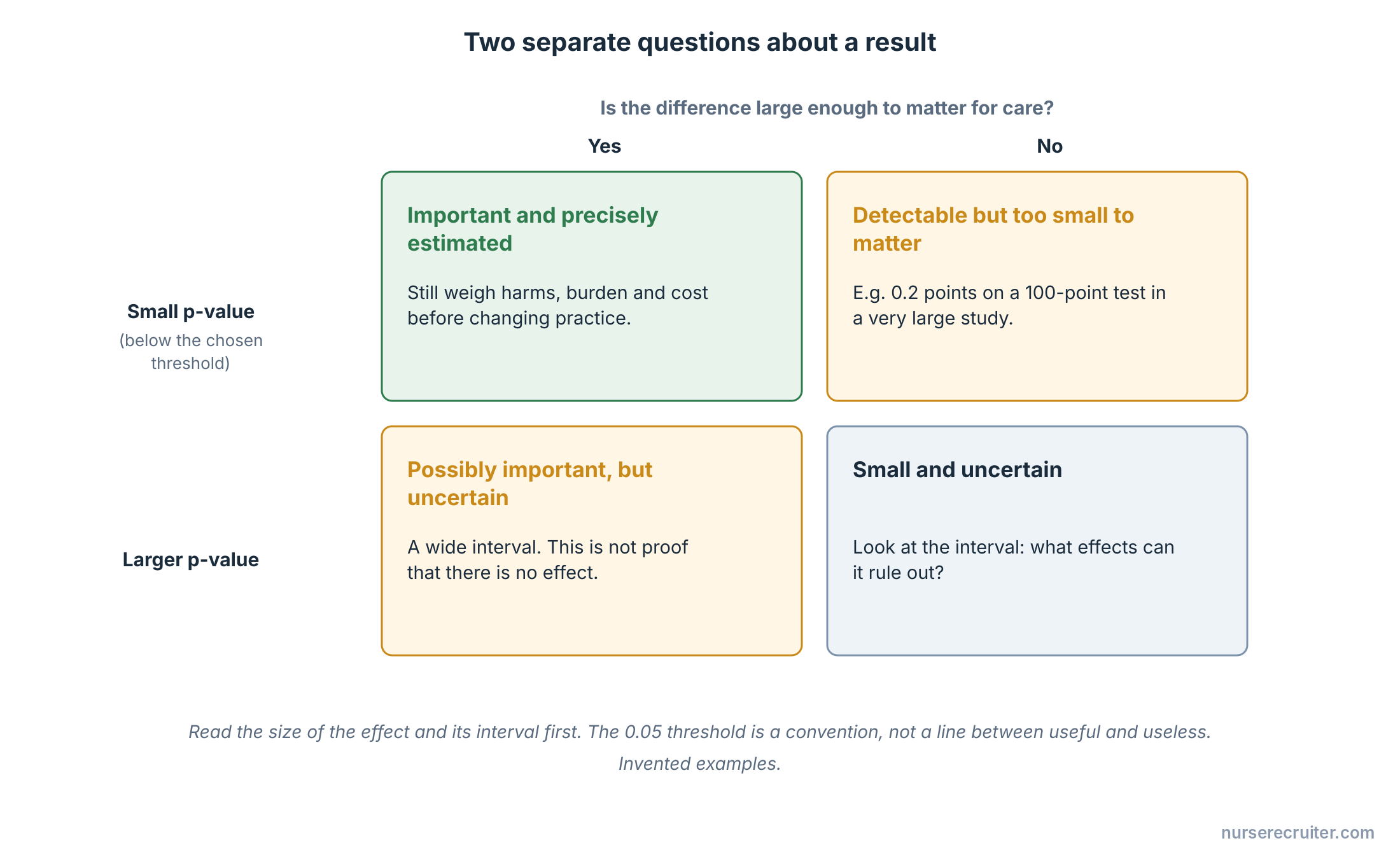
These boxes illustrate possible results. Judge precision from the width of the confidence interval. A small p-value alone cannot tell you whether the estimate is precise or the effect matters to patients.
Find the effect estimate in understandable units. For an outcome score, ask what the scale measures and how much change is meaningful. For an event, inspect absolute as well as relative differences. Then read the confidence interval to see how precisely the effect is estimated.
The usual 0.05 threshold is a convention, not a boundary between useful and useless evidence. Cochrane recommends avoiding conclusions based primarily on dividing results into significant and nonsignificant categories.
An illustrative decision
Imagine a study of two educational formats reports an average difference of 0.2 points on a 100-point knowledge assessment with a very small p-value. Before changing a program, an educator would need to know whether that difference reflects a meaningful improvement, how dependable the assessment is, and what additional time or resources the format requires.
Now imagine a smaller study estimates a larger difference but has a wide interval including both little benefit and substantial benefit. The result is uncertain, not proof that the formats are equivalent. These are invented examples; neither describes evidence supporting a particular education method.
Define importance before seeing the result
Where possible, clarify which outcomes and differences would influence the decision before examining findings. A meaningful threshold should be justified for the measure, population, and setting. It should not be selected afterward merely to make the observed result look favorable.
Patients and clinicians may value benefits and burdens differently. An improvement in a questionnaire score can matter, but it should not be silently substituted for fewer complications, better function, or another unmeasured outcome.
Avoid overstating negative findings
A large p-value does not establish that an intervention has no effect. Equivalence and noninferiority questions require designs and analyses built for those purposes. A conventional comparison that fails to reject no difference is not automatically an equivalence study.
For a practical summary, state the outcome, estimated magnitude, uncertainty, and reason the effect would or would not matter. Include important harms and implementation burdens rather than treating the statistical result as the entire decision.
See absolute and relative risk and confidence intervals for nurses for the numerical foundations.
For a decision involving a different group of patients, consider whether the effect applies to that population.
Sources
- Cochrane Handbook, Chapter 15: Interpreting results and drawing conclusions (accessed 2026-09-17).
- NIST: Confidence Limits for the Mean (accessed 2026-09-17).