
A confidence interval accompanies an estimate with a range expressing statistical uncertainty under the method's assumptions. A point estimate might be a mean, a risk difference, or a ratio. Reading the estimate and interval together is more informative than looking only for a label such as “significant.”
A narrow interval indicates greater precision than a wide interval on the same scale. Precision is not the same as freedom from bias or relevance to a different patient population.
What 95% means
For a conventional frequentist 95% confidence interval, the confidence level describes the interval-producing method: across repeated samples under its assumptions, about 95% of the intervals would contain the true parameter. It does not mean that 95% of patients have values inside the interval. Nor is it a statement that there is a 95% probability that the fixed true parameter lies within this particular calculated interval.
Those distinctions matter when a confidence interval around a mean is confused with the range of individual patient experiences.
An illustrative interpretation
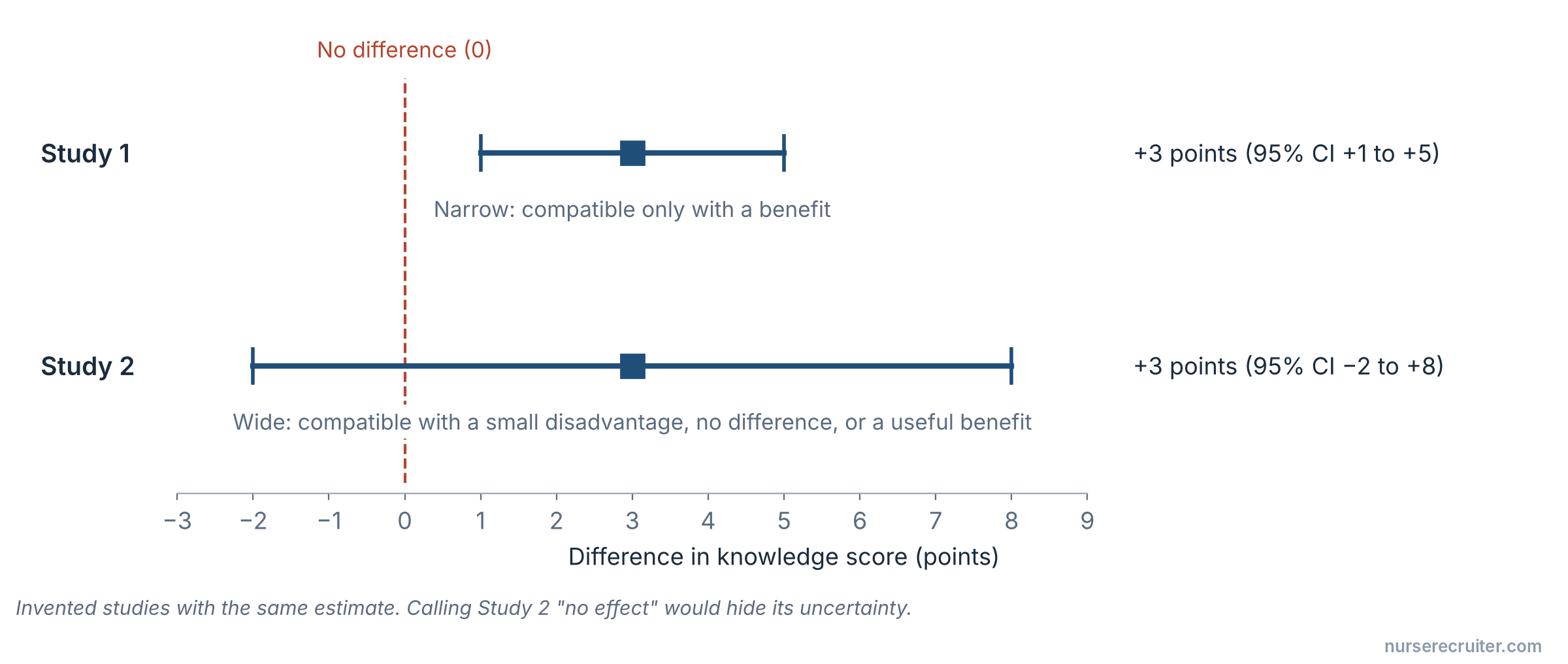
Suppose an invented study estimates that a teaching session improves a knowledge score by 3 points, with a 95% confidence interval from 1 to 5 points. The estimate is a difference between groups, not a promise that every participant gains 3 points.
If a second hypothetical study estimates the same 3-point difference with an interval from minus 2 to plus 8, it gives a less precise picture. Its results are compatible with a small disadvantage, no difference, and a potentially useful advantage under the analysis assumptions. Calling it “no effect” would conceal that uncertainty.
Neither example establishes what change on the score is meaningful to patients. That requires information about the measure and decision.
Find the no-difference value
For a difference, such as a mean difference or risk difference, the no-difference value is zero. For a ratio, such as a risk ratio or odds ratio, it is one. Identify the measure before interpreting where the interval sits.
Then look beyond that reference value. Does the interval include effects too small to matter? Does it include a clinically important benefit or harm? A result can be precise enough to exclude no difference while still being too small to justify a burdensome change.
Keep uncertainty in the summary
Record the units, comparator, follow-up period, and confidence level. Do not compare interval widths across different scales as though they were directly equivalent. If methods or missing data create serious concerns, mention those alongside statistical uncertainty.
A helpful reading note states the estimated difference, the interval, and what important possibilities remain. See statistical and clinical significance for connecting those possibilities to a practical decision.
For the distinction between uncertainty and effect size, compare absolute and relative risk.
Sources
- NIST: Confidence Limits for the Mean (accessed 2026-09-17).
- CDC Field Epidemiology Manual: Analyzing and Interpreting Data (accessed 2026-09-17).