
Generalizability asks how far findings can reasonably extend beyond the people and conditions studied. Applicability asks whether evidence fits a particular decision. These terms overlap, but both require more than checking whether a paper involved nurses or patients with a familiar diagnosis.
A well-conducted study can answer its own question convincingly while providing indirect evidence for another population, intervention, or setting. Conversely, a study that closely resembles local practice can still have serious internal validity problems.
Compare the important features
Read the eligibility rules and actual participant characteristics. Then compare the intervention, comparator, outcomes, follow-up, and setting with the intended use. Focus on differences that could plausibly change the benefit, harm, feasibility, or interpretation of the result.
Context can include staff expertise, available support, language, resources, competing priorities, and the way an intervention is delivered. Cochrane's discussion of applicability explicitly recognizes variation in context and adherence. A highly supported trial may not reproduce the conditions of routine care.
An illustrative transfer question
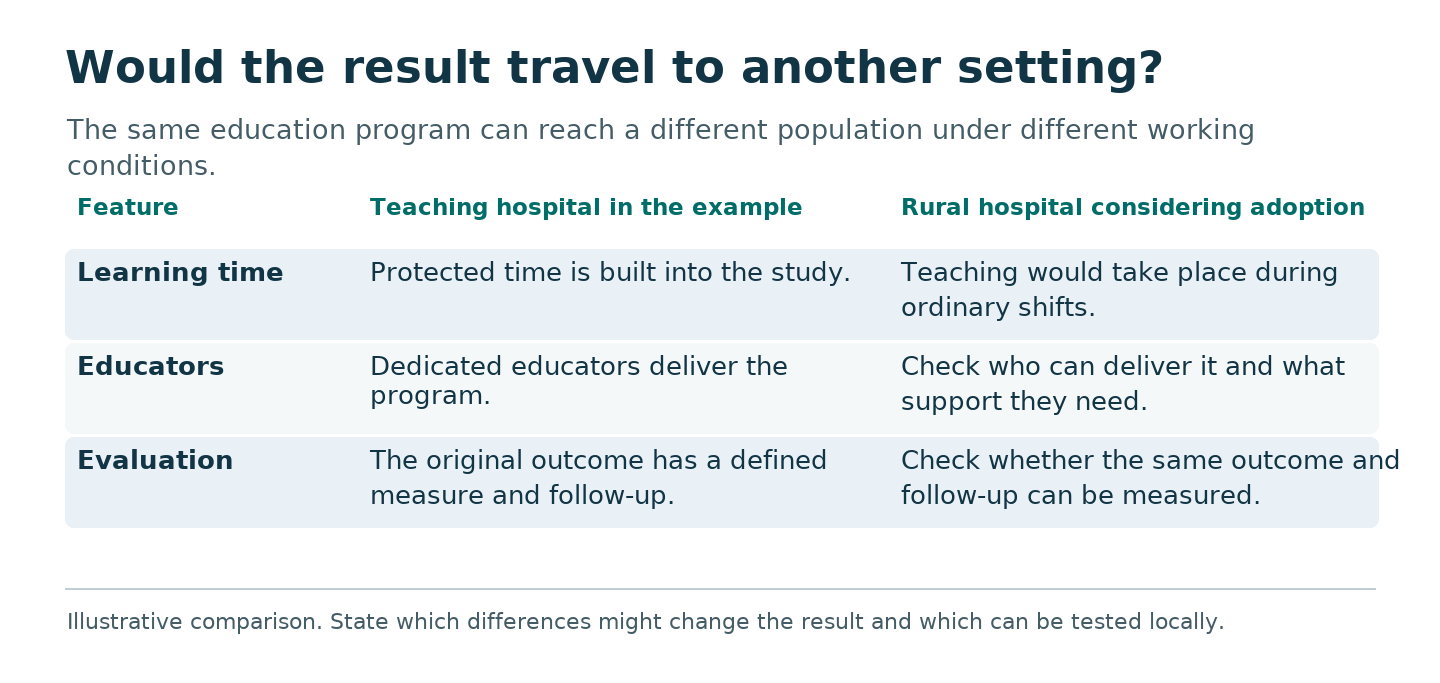
Imagine a study tests an education program in a large teaching hospital with protected learning time and dedicated educators. A small rural hospital considers adopting it during normal shifts. The patient or nurse population may appear similar, but the delivery conditions differ.
The rural team could identify the program's essential components, available support, time demands, and measures used in the study. It could then state which components it can reproduce and which would change. This invented example does not imply that either setting is better or that the program will fail outside its original site.
A useful conclusion might be that the evidence supports further local assessment but does not establish the effect of the altered version.
Do not demand an exact duplicate
No study matches every future patient or workplace. Requiring perfect similarity would make most evidence unusable. Instead, explain why a difference matters. A demographic difference may be relevant to one intervention and less relevant to another; a delivery difference may be decisive even when demographics match.
Avoid treating a subgroup analysis as definitive merely because the subgroup resembles the intended population. Ask whether it was planned, how much evidence supports it, and how uncertain the estimate is.
Record the transfer assumptions
An evidence table can include three short entries: what matches, what differs, and why the difference could matter. Add the practical information still needed. This is more useful than labeling a whole paper “not generalizable” without explanation.
If the team adapts the intervention, describe the adaptation and evaluate it as delivered. Do not claim the original study proved the adapted program's effectiveness.
See implementing evidence in nursing practice for moving from an applicability judgment to a monitored local change.
When considering how participants got into a study, review sampling and representativeness.
Sources
- Cochrane Handbook, Chapter 15: Interpreting results and drawing conclusions (accessed 2026-09-17).
- Cochrane Handbook, Chapter 3: Defining the criteria for including studies and how they will be grouped for the synthesis (accessed 2026-09-17).
- AHRQ Methods Guide: Assessing the Applicability of Studies When Comparing Medical Interventions (accessed 2026-09-17).