
Functional nursing divides work by task. A staff member may carry out an authorized type of activity for several patients, while other colleagues perform different parts of their care.
In her historical account, primary nursing pioneer Marie Manthey describes functional nursing through this division of activities. The account helps explain the term; it should not be treated as evidence that every contemporary task-based arrangement operates identically. Manthey's account
Distinguish a task from a plan
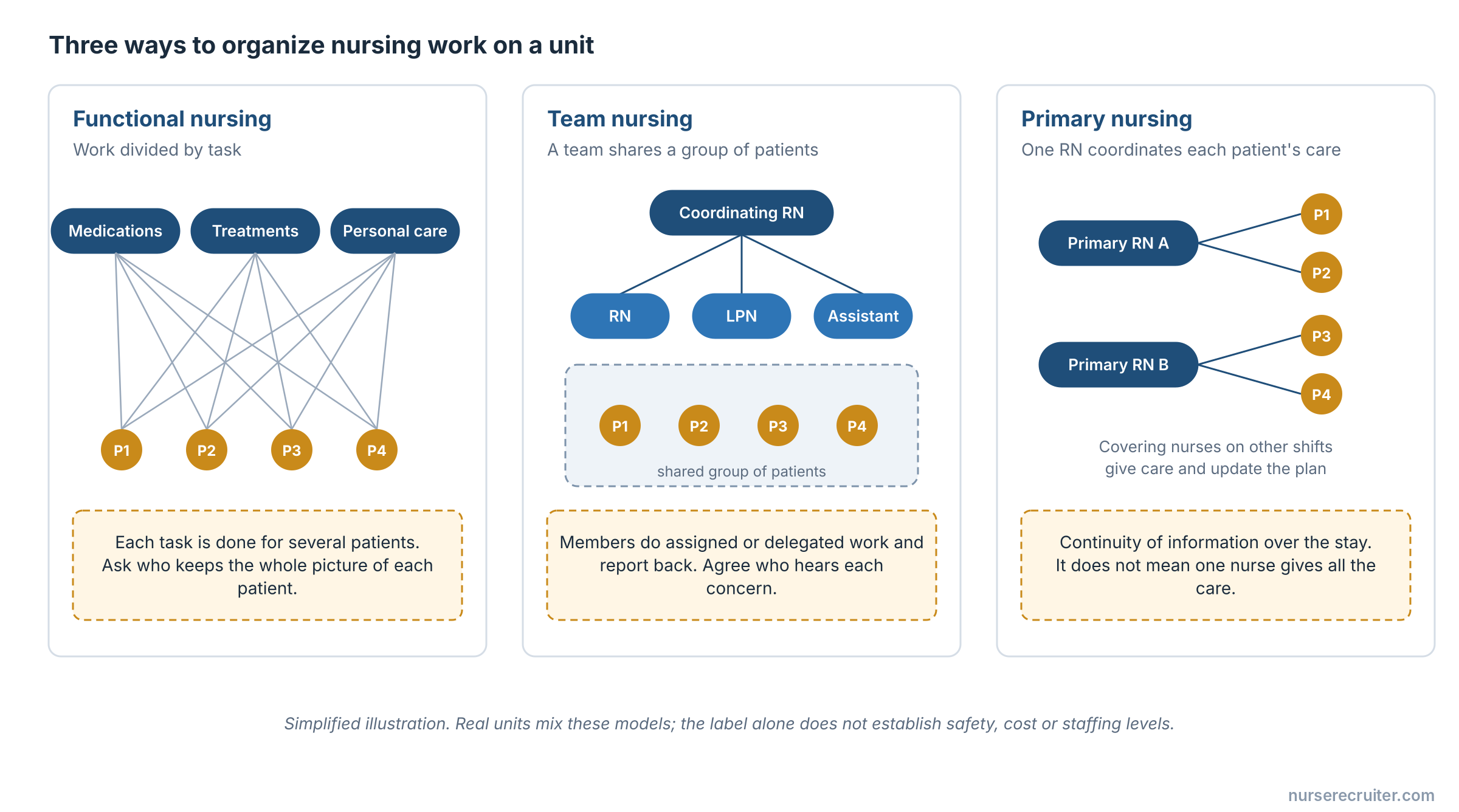
A list of activities says what needs doing. It does not, by itself, explain the patient's overall nursing needs, priorities or response to care.
When work is distributed by function, ask who maintains that wider view. Identify who evaluates new information, who updates the plan and who coordinates work that depends on another activity being completed.
The question applies even when individual tasks are recorded accurately. Completion of separate activities and coordination of a person's care are different responsibilities.
Check authority and competence
NCSBN emphasizes that delegation involves responsibilities at several levels and that the governing rules vary among jurisdictions. NCSBN delegation guidance
A functional assignment does not establish permission to perform an activity. Check applicable scope, demonstrated competence, employer policy and the relevant assignment or delegation process.
Avoid treating “the medication person,” “the treatment person” or another informal label as a substitute for a defined professional role. Be clear about who can answer questions and provide supervision where required.
Connect observations with decisions
When a team member encounters an unexpected finding or cannot complete planned work, the next step must be clear. Identify the person to contact and the route for urgent concerns.
For a fictional example, a colleague assigned an activity learns that the patient has a new concern affecting participation. The colleague reports through the agreed process so the responsible clinician can assess what should happen next.
The task should not simply be marked incomplete with no explanation. Nor should the colleague assume someone else has already passed on the concern.
Watch the handoffs between functions
Ask where one person's work depends on another's. Check how changes in timing, patient availability or priorities become visible to the rest of the team.
Use the approved record and communication methods. Avoid creating informal duplicate lists that disagree about what has happened or who remains responsible.
In a team review, trace a real workflow from the patient's perspective: whom did the patient meet, what information was repeated, and which questions remained unanswered?
Evaluate the actual arrangement
A task-based model should be judged through its implementation, staffing and care processes. The historical label alone does not establish its safety, cost or suitability for a particular population.
Review unresolved concerns, missed connections and staff feedback. If responsibilities cannot be explained clearly, seek clarification through the appropriate leader before assuming the division of work is sufficient.
Unlike primary nursing, dividing work by task does not itself identify one nurse to coordinate a patient’s care.
Related
team nursing · primary nursing · skill mix.
Sources
- Primary Nursing: Person-Centered Care Delivery System Design, excerpt (accessed 2026-09-17) — Susan Wessel and Marie Manthey, 2015; historical description.
- Delegation (accessed 2026-09-17) — NCSBN.