
In team nursing, several members of the nursing team coordinate their assigned work. The Wisconsin Nurses Association describes teams that may include registered nurses, practical nurses and nursing assistants, with communication and delegation central to the arrangement. WNA model overview
The label does not tell you the exact staffing numbers, responsibilities or support on a particular unit. Ask how the team works before interpreting what the model means for an assignment.
Begin with patient responsibility
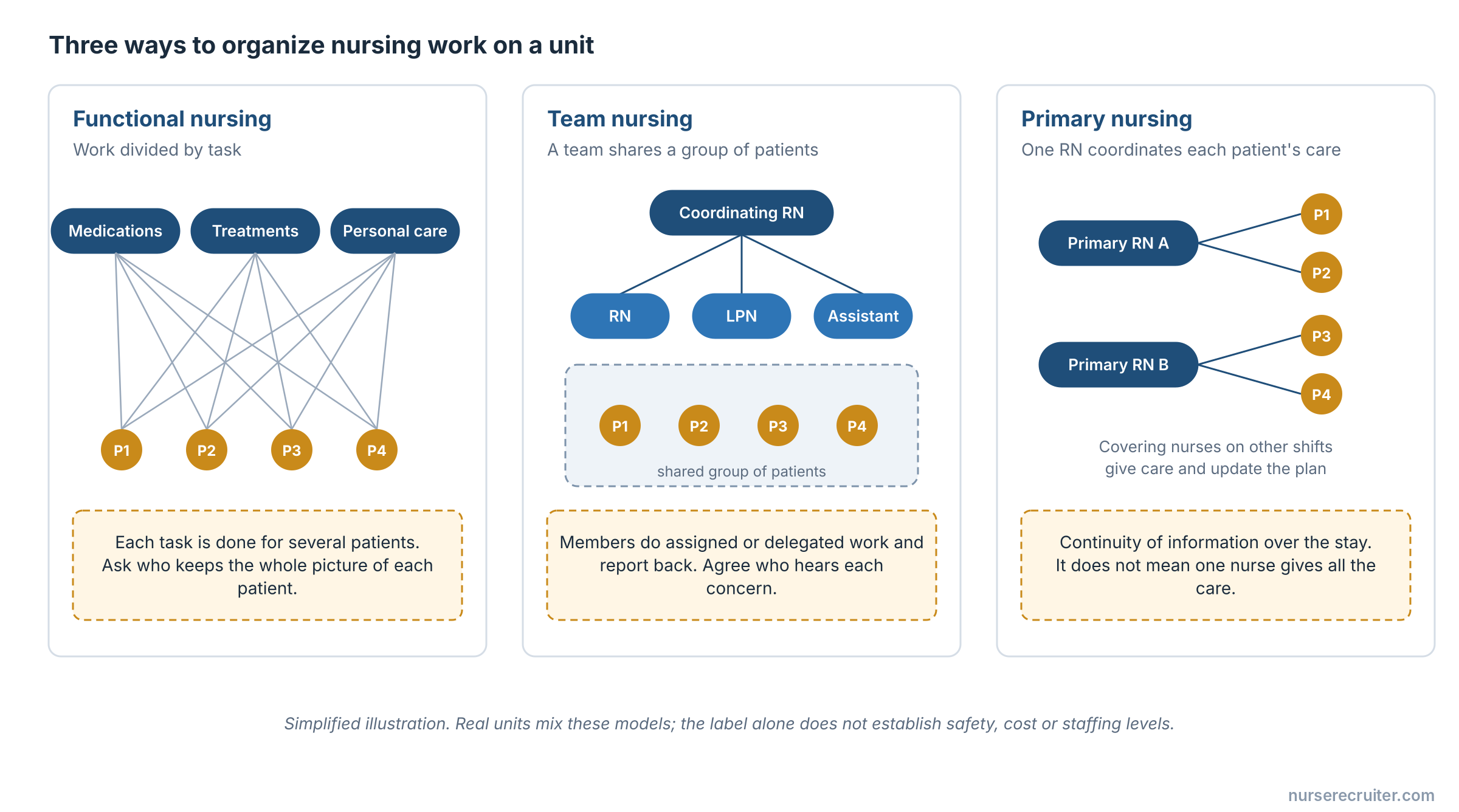
Identify who maintains the overall view of each patient's nursing needs and who coordinates the team's work. Make that responsibility clear to colleagues and patients.
Then establish who performs the planned activities, how they communicate findings and who reassesses the plan when needs change. A shared assignment should not leave a concern with no identifiable recipient.
Consider how the team obtains help if its coordinating nurse is occupied with an urgent situation.
Distinguish assignment from delegation
NCSBN's delegation guidelines separate the responsibilities of the employer, nurse leader, licensed nurse and person receiving delegated work. They also emphasize differences among jurisdictions. NCSBN guidelines
The guidelines connect a delegation decision with patient needs, the recipient's demonstrated competence, available supervision and applicable law and policy. A job title or completed task list alone is not an adequate basis for that decision.
Ask which responsibilities can be assigned or delegated in the actual setting. Do not use a general wiki description as a national list of tasks that every practical nurse or assistant may perform.
Agree on the communication loop
Before work begins, clarify what information the team member needs and when to report back. Include what to do if the activity cannot be completed or the patient's situation changes.
Make room for the receiving person to ask questions and identify a limitation. Confirm who is available to respond.
At a handoff, communicate unfinished work and significant changes as well as completed tasks. Avoid assuming that information passed to one teammate has reached everyone who needs it.
Test the arrangement against workload
In a fictional planning discussion, a unit proposes a team with several staff who are new to the setting. The relevant question is not simply whether the headcount matches the schedule.
Ask who can supervise, answer questions and coordinate care while meeting their own responsibilities. Identify what support is available and what happens if the expected workload exceeds the team's capacity.
This is a planning example, not a suggested staffing ratio.
Evaluate what happens in practice
Review whether responsibilities remain clear during admissions, breaks, handoffs and unexpected changes. Invite feedback from each role and examine concerns through the appropriate quality process.
Do not assume team nursing is automatically safer, cheaper or less demanding than another arrangement. Any claim about results needs evidence about the particular implementation and population.
Check the skill mix: who can perform each assigned task, who supervises and who reassesses the patient?
Related
skill mix · nursing huddles · workload beyond patient counts.
Sources
- Team-Based Care and Nurses (accessed 2026-09-17) — Wisconsin Nurses Association, 2024.
- National Guidelines for Nursing Delegation (accessed 2026-09-17) — NCSBN.