
Skill mix describes which roles and capabilities make up a care team. When reading a staffing report, first identify how the term is measured; when planning care, examine what the people present are authorized and prepared to do.
ANA's published staffing measures describe role-based skill mix as the proportions of productive nursing hours supplied by RNs, LPNs/LVNs and unlicensed assistive personnel. The percentage supplied by contract or agency staff is a separate measure that can overlap those role categories. ANA staffing measures
Read the denominator
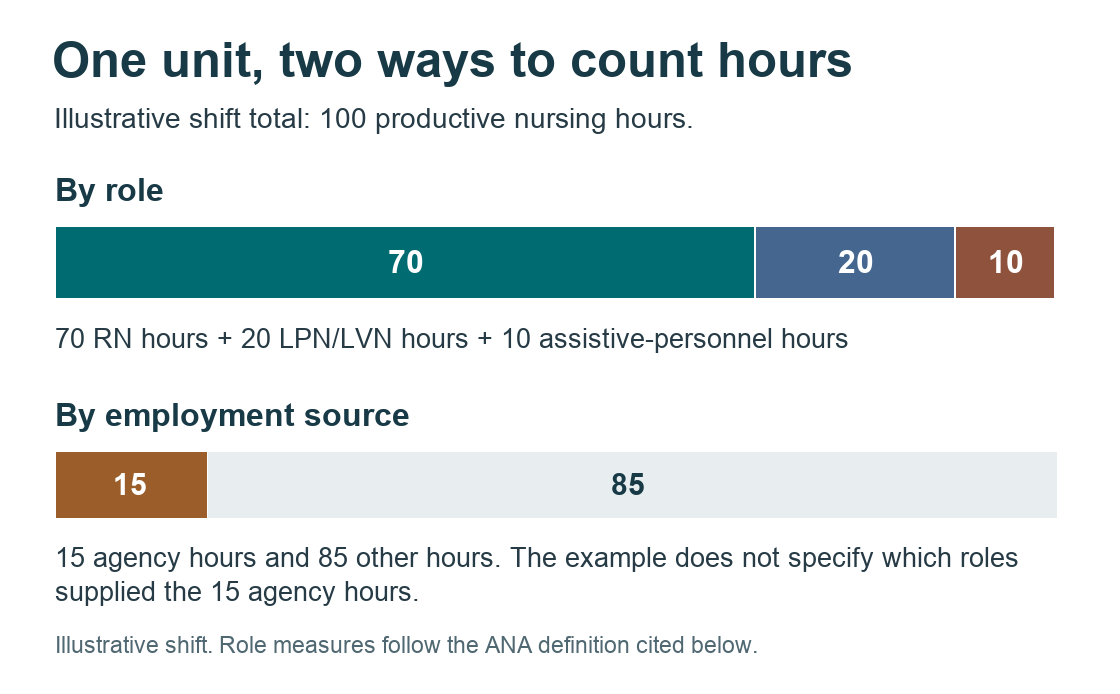
Agency hours are already inside the role totals. Adding them again would count some work twice.
Check whether a report uses hours, people or another unit. A proportion of hours is not necessarily the same as a proportion of staff headcount.
For a hypothetical total of 100 productive hours, 70 RN hours, 20 LPN/LVN hours and 10 assistive-personnel hours form a 70/20/10 percent role distribution. If 15 of those hours were supplied by agency employees, the agency proportion is 15 percent; it is not a fourth role category to add to the other three.
State the setting and time period before comparing results. Different definitions can produce different numbers without a real change in staffing.
Look beyond the role label
A license or job title does not describe every individual's preparation for a particular setting. Review orientation, demonstrated competence and access to supervision or consultation.
A team may include experienced nurses, nurses new to the specialty, learners and support personnel. Describe the actual support each assignment requires without assuming that employment status establishes ability.
Agency employment, for example, identifies an employment arrangement rather than an additional nursing license category.
Clarify assignment and delegation
NCSBN's delegation guidance emphasizes patient needs, staff competence, supervision and applicable jurisdictional rules. Its framework assigns responsibilities to the employer, the licensed nurse and the person receiving delegated work. NCSBN guidelines
A staffing model does not create legal permission for an activity. Check the relevant scope, policies and delegation process before transferring work.
Identify who evaluates patient information, who receives reports of changes and who can respond when the original arrangement is no longer suitable.
Assess the whole workflow
For a fictional example, adding a support role may change who performs certain authorized activities while leaving assessment, coordination and supervision needs with the licensed nurse.
Ask whether the work distribution is clear and whether the nurse has time to provide the required oversight. Avoid treating every hour from different roles as interchangeable.
Include the resources needed for communication, equipment access and orientation when considering a proposed model.
Evaluate the result
Review patient needs, unresolved care concerns and the experience of staff using the arrangement. Compare like periods with clear definitions.
A lower labor cost or a changed role percentage does not alone establish that the model is effective. State which outcomes were assessed and what remains uncertain.
In team nursing, a count of people on duty cannot show which assessments, delegated tasks or supervision each person can take on.
Related
team nursing · functional nursing · workload beyond patient counts.
Sources
- Nurse Staffing Measures (accessed 2026-09-17) — ANA; measure definitions.
- National Guidelines for Nursing Delegation (accessed 2026-09-17) — NCSBN, 2016; apply with current jurisdictional rules.