
A nursing huddle reassesses a care plan when conditions change. Its value depends on whether the people doing the work leave with the same understanding of what happens next.
In TeamSTEPPS, AHRQ describes a huddle as a way to communicate changes to an existing care plan. Any team member who notices a relevant change can convene one; the tool is not reserved for the person with the most senior title. AHRQ huddle tool
Identify the reason to meet
Before calling a huddle, be able to complete this sentence: “We need to reconsider the plan because…”
Possible local triggers include a change in available staff, an unexpected concentration of work or a coordination problem involving several team members. These are examples for discussion, not a required trigger list.
An urgent patient concern needs the appropriate immediate response. Do not wait for everyone to assemble before activating the required escalation process. A huddle can support subsequent coordination without becoming a barrier to action.
Distinguish the purpose
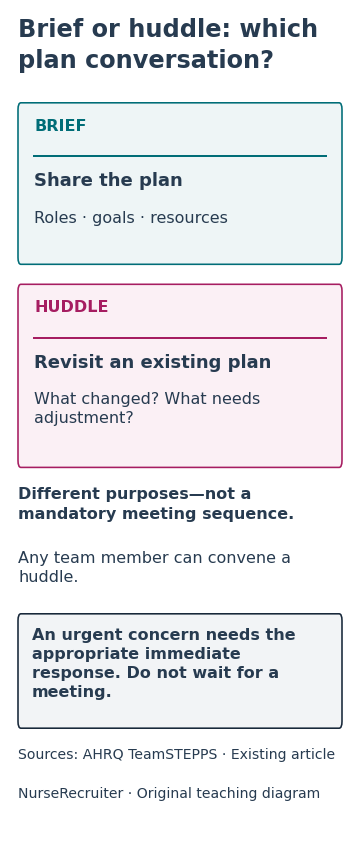
Use the conversation that fits the coordination need. Neither diagram nor meeting replaces the immediate response to an urgent concern.
A start-of-shift planning conversation, a patient handoff and a huddle can all involve nurses, but their purposes should be clear.
AHRQ's brief tool emphasizes establishing team roles, goals, care plans and available resources. A huddle revisits a plan already underway. AHRQ brief tool
Decide what this particular discussion must accomplish. If a team needs a detailed handoff, preserve its required information and responsibility transfer rather than assuming a quick group meeting covers it.
Make a workable adjustment
For a fictional example, several planned discharges are delayed while new admissions are expected. The team gathers to identify which work is waiting, what support is available and who has authority to change assignments.
Ask each affected colleague to describe the constraint they can see. Avoid treating silence as agreement, especially when a proposed change affects work outside the room.
Finish by identifying the agreed action, the responsible person and when the team will reassess. If a resource request remains unresolved, name who will raise it and how the answer will reach the team.
Include people who need the update
Choose a location and communication method that protect patient information and allow essential participation. Arrange coverage so attendance does not leave immediate care needs unanswered.
When someone cannot attend, decide who will convey relevant changes. A revised plan understood only by meeting participants is an incomplete communication process.
Use approved documentation and communication channels for decisions that need to remain visible after the conversation.
Evaluate follow-through
A practical local review can ask whether the huddle identified a specific problem, produced an actionable response and communicated the outcome to affected staff.
Meeting frequency alone does not show that coordination improved. Ask staff which recurring issues need a larger staffing, workflow or equipment decision.
Use a brief to agree on the initial plan; call a huddle when that plan needs to change.
Related
briefings and debriefings · workload beyond patient counts.
Sources
- Monitoring and Modifying the Plan: Huddle (accessed 2026-09-17) — AHRQ TeamSTEPPS.
- Sharing the Care Plan: Brief (accessed 2026-09-17) — AHRQ TeamSTEPPS.