
In primary nursing, a registered nurse coordinates a patient’s nursing care over time. It is different from “primary care,” which refers to a type of healthcare service.
The Wisconsin Nurses Association describes the primary nurse as coordinating care through the hospital stay while working with other professionals. UC Davis Health describes its primary nursing approach through relationships, responsibility, accountability and professional authority. WNA model overview; UC Davis practice model
Clarify the role locally
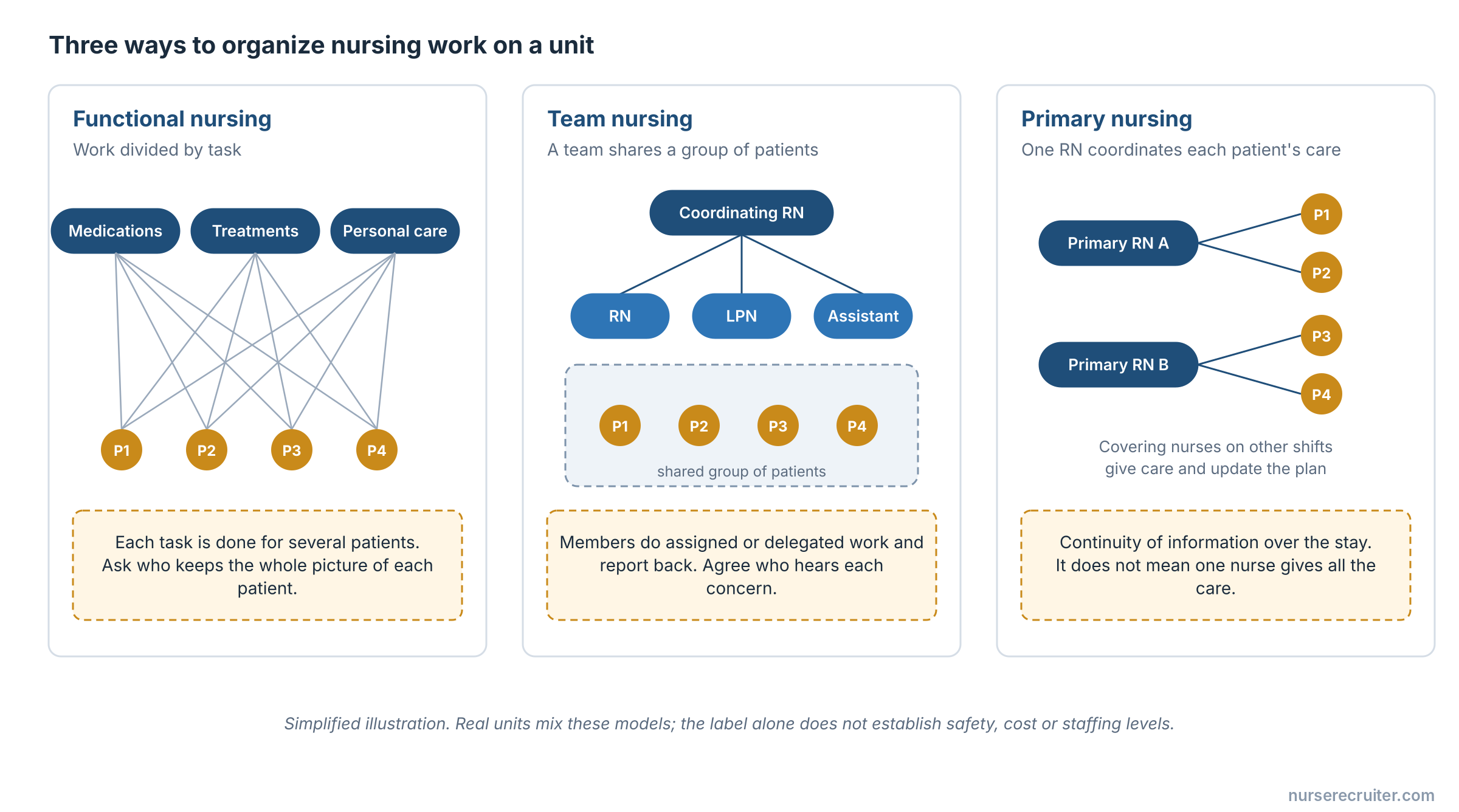
Ask what designation as a primary nurse means in the organization. Which planning, coordination and communication responsibilities come with it? How is the nurse introduced to the patient and family?
Identify where the role is recorded and how colleagues find that information. A name on a board is not enough if the team cannot explain who follows unresolved questions or updates the plan.
Avoid assuming that the model means one nurse personally delivers every element of care or is continuously available outside work.
Make continuity practical
At the start of an episode, establish what matters to the patient and what communication support is needed. Connect that information with the agreed plan and the appropriate team members.
When the primary nurse is away, the nurse providing current care needs usable information and a clear route for clinical decisions. Specify coverage through the organization's assignment and handoff processes.
Ask how new findings return to the longer-term plan. Continuity should not depend on someone remembering to find a particular colleague several days later.
Preserve each nurse's responsibilities
The label should not be used to suggest that the primary nurse takes over every colleague's professional responsibility. Clarify the responsibilities of the clinician delivering care now, the person coordinating the plan and the leader supporting the unit.
If the patient's needs change, use the relevant clinical escalation process. Do not delay assessment or communication while waiting for the designated primary nurse to return.
Review the arrangement against applicable scope, policies and resources rather than treating the model as permission to bypass them.
Examine an example
In this fictional scenario, a patient expects a support person to attend an important care discussion. The primary nurse records that preference and coordinates with the team.
On another shift, the covering nurse learns that the support person's availability has changed. The covering nurse follows the current communication process and updates the plan so the information is available to everyone involved.
The point is continuity of information and responsibility. The example does not establish that the model necessarily improves outcomes.
Evaluate implementation
When considering a unit using primary nursing, ask how assignments maintain continuity, how coverage works and how staff resolve unclear responsibilities.
Seek examples from nurses and patients. Separate the organization's intended approach from evidence that it is consistently available.
Compare this with functional nursing, which allocates particular tasks across several patients.
Related
team nursing · functional nursing · professional practice models.
Sources
- Team-Based Care and Nurses (accessed 2026-09-17) — Wisconsin Nurses Association, 2024.
- Professional Practice Model (accessed 2026-09-17) — UC Davis Health.