
A fishbone diagram organizes possible explanations for a defined problem. Also called a cause-and-effect or Ishikawa diagram, it places the effect at one end and groups contributing factors along branches. IHI describes the tool as a way to explore relationships and identify areas for improvement.
Its usefulness is organizational. A completed diagram shows what a team has considered; it does not establish that every item caused the problem. Treat a new branch as a proposition to examine, particularly when it rests on a single recollection or an assumption about another department.
Define the effect clearly
IHI's instructions begin with writing the effect in a box, then adding a main line and labeled categories. Its example categories include materials, methods, equipment, environment, and people. Teams can choose categories appropriate to the question rather than forcing every observation into an unsuitable label.
For a practical session, start with a problem statement that describes an observable condition. “Request status is unclear at shift change” leaves room to explore the process. “Staff do not communicate” embeds an explanation before the discussion starts. Agree on the setting and boundaries so that contributors are discussing the same problem.
Ask participants to describe work as they encounter it. Include perspectives from the beginning and end of a handoff. When a contribution names a person, ask which information, tools, responsibilities, or circumstances are relevant. Avoid making the people branch a list of judgments about motivation.
Develop and check branches
IHI recommends adding subcauses and asking why until the description is specific enough to support a testable change. The Five Whys can help explore a branch, but several branches may need attention.
Keep an accompanying evidence list. For each candidate explanation, note whether it came from observation, records, an interview, or brainstorming. Then identify what would support or challenge it. For example, a claim that instructions are difficult to locate could be explored by asking users to demonstrate how they find the current instructions.
Illustrative diagram discussion
Suppose a team is examining missing equipment-return information. In this hypothetical example, possible branches include a form without a return field, several storage locations, unclear ownership after handoff, and a screen that hides older requests. None should be labeled a confirmed cause simply because the team agreed to include it.
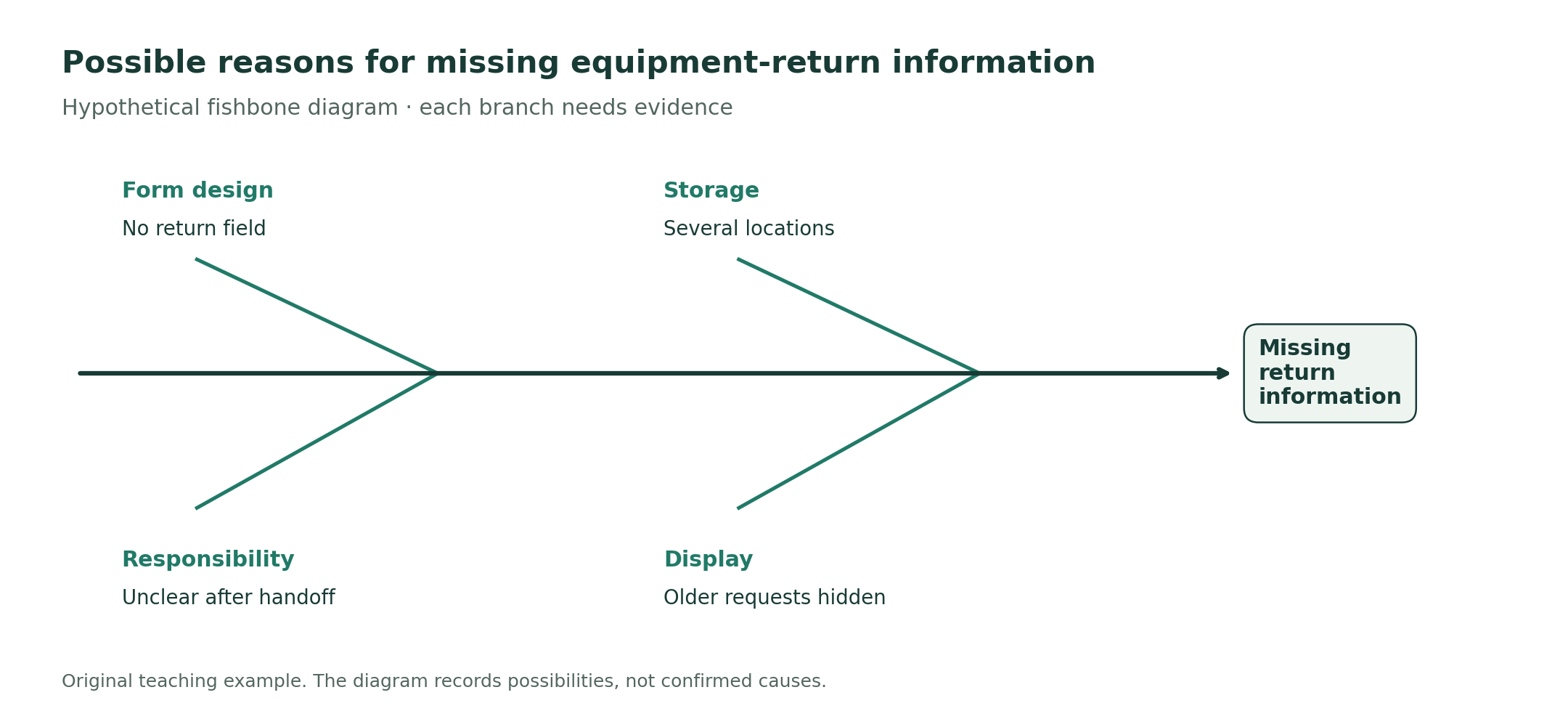
The branches above organize the four possibilities; they do not rank them. An accompanying evidence log could look like this:
| Branch | Possibility to check | An observation that could challenge it |
|---|---|---|
| Form design | The form has no return field. | The field exists and is completed on unresolved requests. |
| Storage | Several storage locations make information harder to find. | Requests using a single location have the same problem. |
| Responsibility | Ownership becomes unclear after handoff. | An owner is consistently identified and can explain the next step. |
| Display | Older requests are hidden from the usual view. | Users can find the older requests in their normal workflow. |
The next step could be to follow a small set of requests through the process and compare observations with those possibilities. If some requests have complete information but remain unresolved, the team should revisit its explanation rather than discard the conflicting cases.
Use the diagram to choose investigation questions and candidate changes. Preserve alternatives that have not been checked, and record why a branch was supported or rejected. For a serious event requiring a formal investigation, the diagram can contribute to Root Cause Analysis; it should not stand in for the broader review and corrective-action process.
For anticipating failures in a proposed process rather than explaining a past event, compare failure mode and effects analysis.
Sources
- IHI: Cause and Effect Diagram (accessed 2026-09-17).
- IHI: Root Cause Analyses and Actions (accessed 2026-09-17).