
Root cause analysis, or RCA, is a structured investigation of how an adverse event occurred and what changes could reduce the chance of recurrence. AHRQ's Patient Safety Network describes it as a systems approach: the investigation examines the conditions surrounding actions, including weaknesses that may have existed long before the event.
The name can suggest that every event has one hidden cause. Healthcare investigations may instead identify several interacting factors. A useful RCA explains those relationships and leads to corrective action; identifying a person who made an error does not complete the analysis.
Reconstruct the event before explaining it
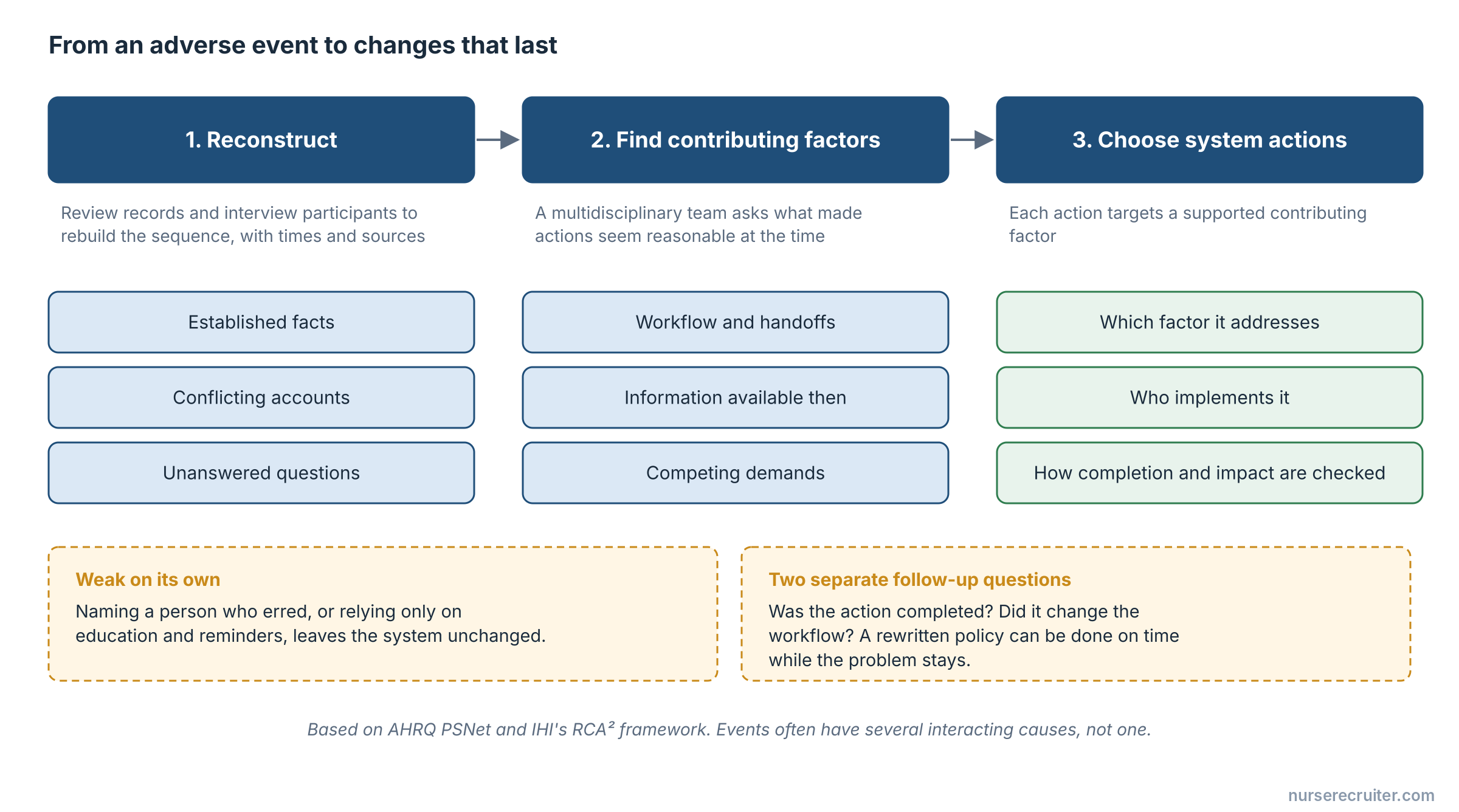
PSNet describes reviewing records and interviewing participants to reconstruct the sequence of events. A multidisciplinary team then examines contributing factors. Nurses can contribute knowledge about actual workflow, competing demands, handoffs, and the information available at a particular moment.
For a practical review, separate three kinds of notes: established facts, conflicting accounts, and unanswered questions. Put times and information sources beside important events. Avoid filling a gap in the record with an explanation that merely sounds plausible. When accounts differ, identify what additional record, observation, or conversation could clarify the difference.
Ask what made an action seem reasonable under the circumstances. For example, distinguish a staff member's failure to find information from the availability, location, and clarity of that information. This does not mean declaring every explanation correct. It means investigating the conditions before drawing a conclusion.
Turn findings into actions
IHI's Root Cause Analyses and Actions framework, called RCA2, emphasizes sustainable changes to systems and explicitly connects investigation with corrective action. PSNet cautions that reviews can rely too heavily on education or reminders without addressing underlying vulnerabilities.
For each proposed action, identify the contributing factor it addresses, who will implement it, and how completion and impact will be assessed. A rewritten policy may be completed on schedule while the problematic workflow remains unchanged. Keep those two questions separate in the follow-up record.
A fishbone diagram can organize possible factors, but the diagram is not the investigation's evidence. Likewise, a list of recommendations should not be treated as proof that recurrence has been prevented.
Illustrative investigation question
Consider a hypothetical delay in locating a transport request. A preliminary account says that a nurse failed to check a queue. The review could examine where requests appeared, who could see them, how responsibility transferred between shifts, and whether the queue displayed a current status. These are questions to investigate, not findings about a real event.
If evidence supports a problem with request visibility, the team could evaluate a change to routing or status display. Follow-up might examine whether requests reach the intended role and whether duplicate requests increase. The proposed action should follow the supported explanation, rather than a decision made before the investigation began. Failure Mode and Effects Analysis offers a complementary way to examine potential failures before introducing a new process.
For looking beyond one person’s action to the conditions in which it occurred, see human factors in healthcare.
Sources
- AHRQ PSNet: Root Cause Analysis (accessed 2026-09-17).
- IHI: Root Cause Analyses and Actions (accessed 2026-09-17).