
Failure mode and effects analysis, usually abbreviated FMEA, examines how a process could fail before those failures occur. IHI describes it as a proactive analysis performed by people representing the parts of the process being reviewed. It can be used when considering a new process or a change to an existing one.
Its starting question differs from Root Cause Analysis. RCA investigates an event that has occurred. FMEA anticipates possible problems and considers safeguards before implementation. Neither method guarantees that every vulnerability will be found.
Keep the process manageable
IHI recommends choosing a process with a manageable scope, assembling a multidisciplinary team, and agreeing on its ordered steps. A broad system may need several separate analyses. Process mapping can help the team establish what happens and where responsibility changes.
For each step, distinguish the failure mode, its possible causes, and its effects. A failure mode describes what goes wrong; a cause explains how that might happen; an effect describes the consequence. Keeping them separate helps avoid recording the same vague phrase in every column.
As a preparation exercise, invite someone who performs each relevant handoff to review the map. Ask what happens outside the usual hours and how exceptions are handled. Mark assumptions the team has not yet checked. A tidy map should not be mistaken for a verified description of every working condition.
Interpret ratings carefully
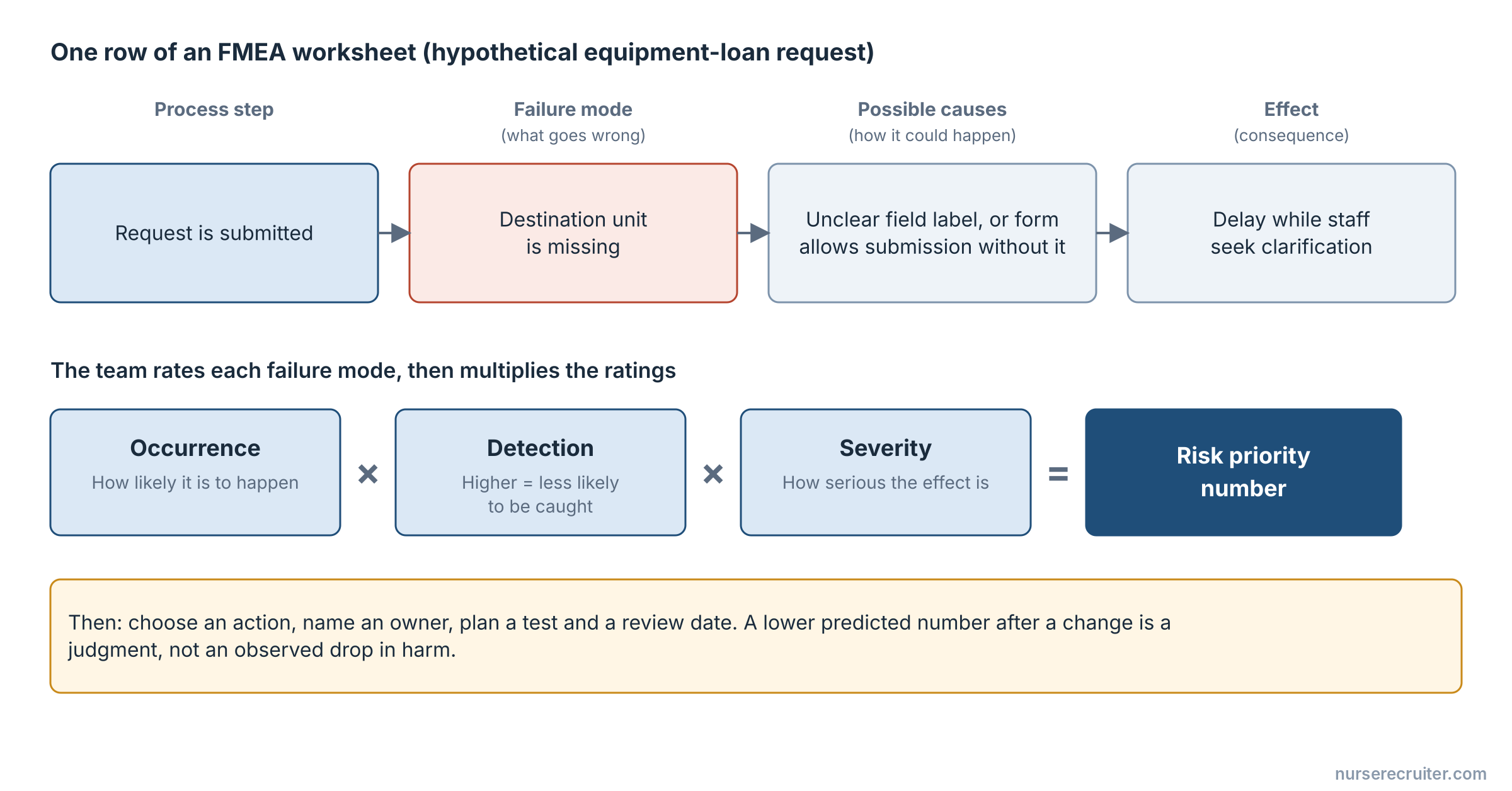
IHI's worksheet uses ratings for occurrence, difficulty of detection, and severity, combining them into a risk priority number. In its detection scale, a higher score means the failure is less likely to be detected. Teams should make the direction and definitions of their chosen scales explicit before assigning ratings.
Treat the numbers as a record of a team's structured judgments. A lower predicted score after a proposed change is not an observed reduction in patient harm. Preserve the explanation behind each rating so that later reviewers can see which assumptions require testing.
Illustrative prospective review
Imagine a hypothetical change to an equipment-loan request process. At the request step, a possible failure mode is that the destination unit is missing. Possible causes include an unclear field label or a form that allows submission without a destination. A possible effect is delay while staff seek clarification. These are proposed possibilities, not findings from an actual service.
The team could examine clearer wording or a required destination field. Before selecting either, it could consider unusual requests that do not fit the normal options. A safeguard that blocks valid requests would create another problem to investigate.
Record the selected action, responsible owner, test plan, and review date. After a permitted trial, compare actual problems with the anticipated failure modes and revise the analysis. The value of the exercise lies in examining the process and following through on its vulnerabilities, rather than producing a high-scoring worksheet and filing it away.
When discussing how a failure could occur, examine the interaction between people, tools and working conditions.
Sources
- IHI: Failure Modes and Effects Analysis (accessed 2026-09-17).
- AHRQ PSNet: Root Cause Analysis (accessed 2026-09-17).