
The Five Whys is a questioning technique that follows an initial explanation with further questions about why the problem occurred. IHI presents it as a way to move beyond a surface symptom and better understand a recurring problem. The technique is most useful when the questions lead to more precise investigation rather than a more elaborate guess.
Despite the name, reaching the fifth answer does not certify a cause. IHI acknowledges that a problem may have multiple root causes and that people who see different parts of a system may answer differently. Preserve those different accounts instead of forcing the discussion into one agreed chain.
Start with a neutral description
IHI recommends involving people from different professions who know the problem and defining it clearly. In preparation, describe what happened and the pattern being examined. Avoid placing an accusation inside the question. “Why was the request unavailable?” invites exploration; “Why did the nurse ignore it?” assumes both availability and intent.
For each answer, ask what evidence supports it. If the answer is uncertain, write it as a possibility and identify how it could be checked. A useful working record can have three columns: explanation proposed, supporting information, and next question. This is an original discussion aid, not a standardized or validated scoring instrument.
Follow branches without inventing links
One answer may generate several further questions. An unavailable item could involve ordering, storage, labeling, or access. Follow the relevant branches separately. A fishbone diagram may help keep those possibilities visible when a single vertical chain becomes misleading.
Be cautious with explanations such as “lack of training” or “poor communication.” Ask which task, information, timing, or support was missing. Do not assume that a proposed training session will solve a problem simply because the discussion ended with a training label. IHI's broader RCA2 framework directs attention to system vulnerabilities and corrective actions.
Illustrative questioning sequence
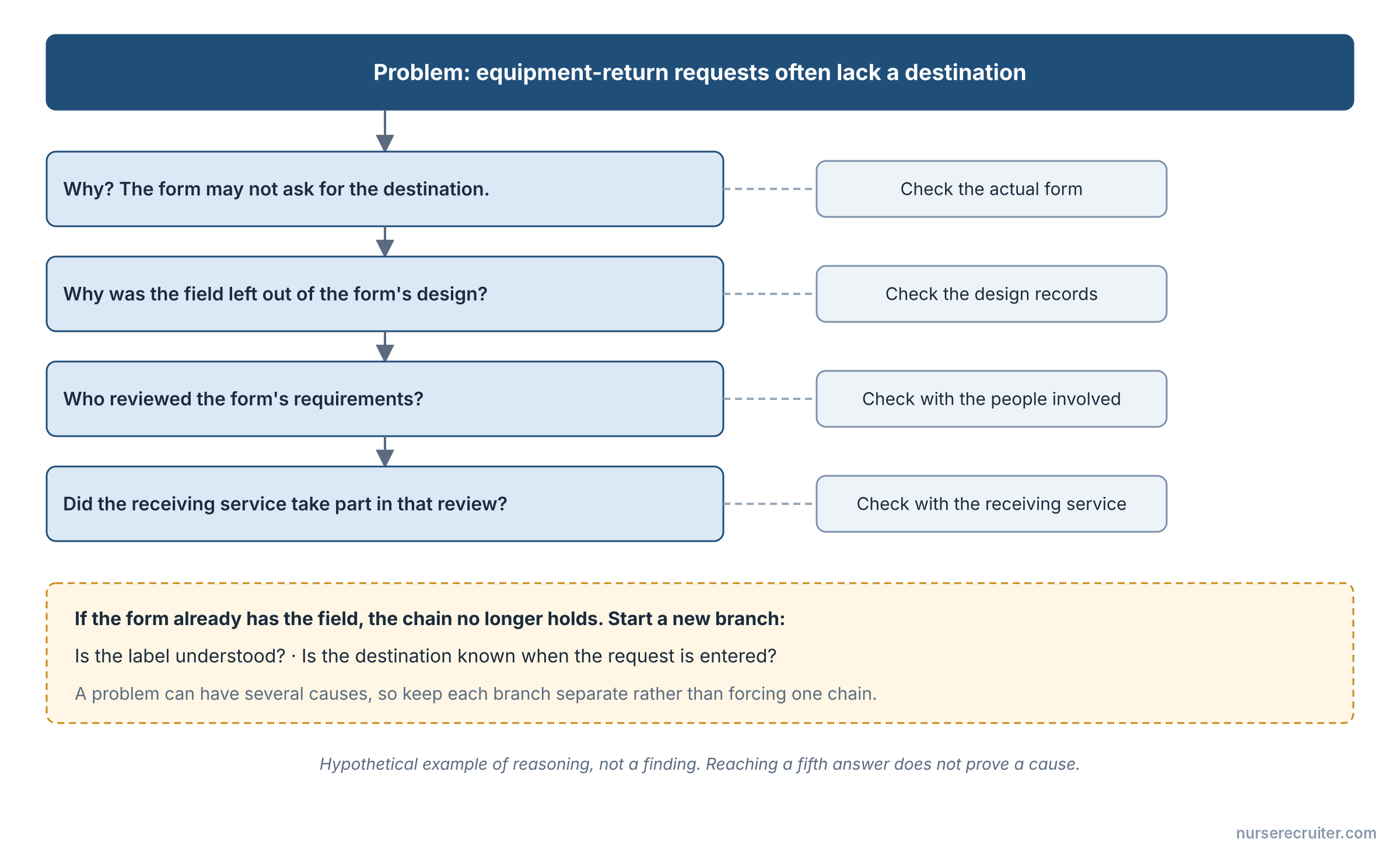
Consider a hypothetical pattern of incomplete equipment-return requests. A team might ask why requests lack a destination. One proposed answer is that the form does not ask for it. The next question could be why the form's design omitted the field, followed by who reviewed the requirements and whether the receiving service participated.
Each statement would need checking against the actual form, design records, and accounts of the people involved. If the field is present, the initial chain no longer holds. The investigation would need another question, such as whether the label is understood or the destination is known when the request is entered. This example illustrates reasoning, not a discovered organizational failure.
For a consequential safety event, use the organization's formal investigation process. IHI directs readers needing a more comprehensive approach to RCA2. The Five Whys can support that work, but a plausible sequence of answers cannot replace evidence gathering, assessment of alternatives, or follow-up on actions described in Root Cause Analysis.
Before settling on an explanation based on individual behavior, examine the surrounding working conditions and system design.
Sources
- IHI: Five Whys (accessed 2026-09-17).
- IHI: Root Cause Analyses and Actions (accessed 2026-09-17).