
A cross-sectional study measures characteristics or outcomes during a defined observation period rather than following participants to observe new events. Surveys of current working conditions, attitudes, or symptoms often use this design. They can describe how common a response is among the people represented by the sample, but generally cannot establish which of two simultaneously measured factors came first.
Cross-sectional describes timing. It does not tell you whether the sample is representative, whether the questions are valid, or whether the findings apply to all nurses.
Preserve the denominator
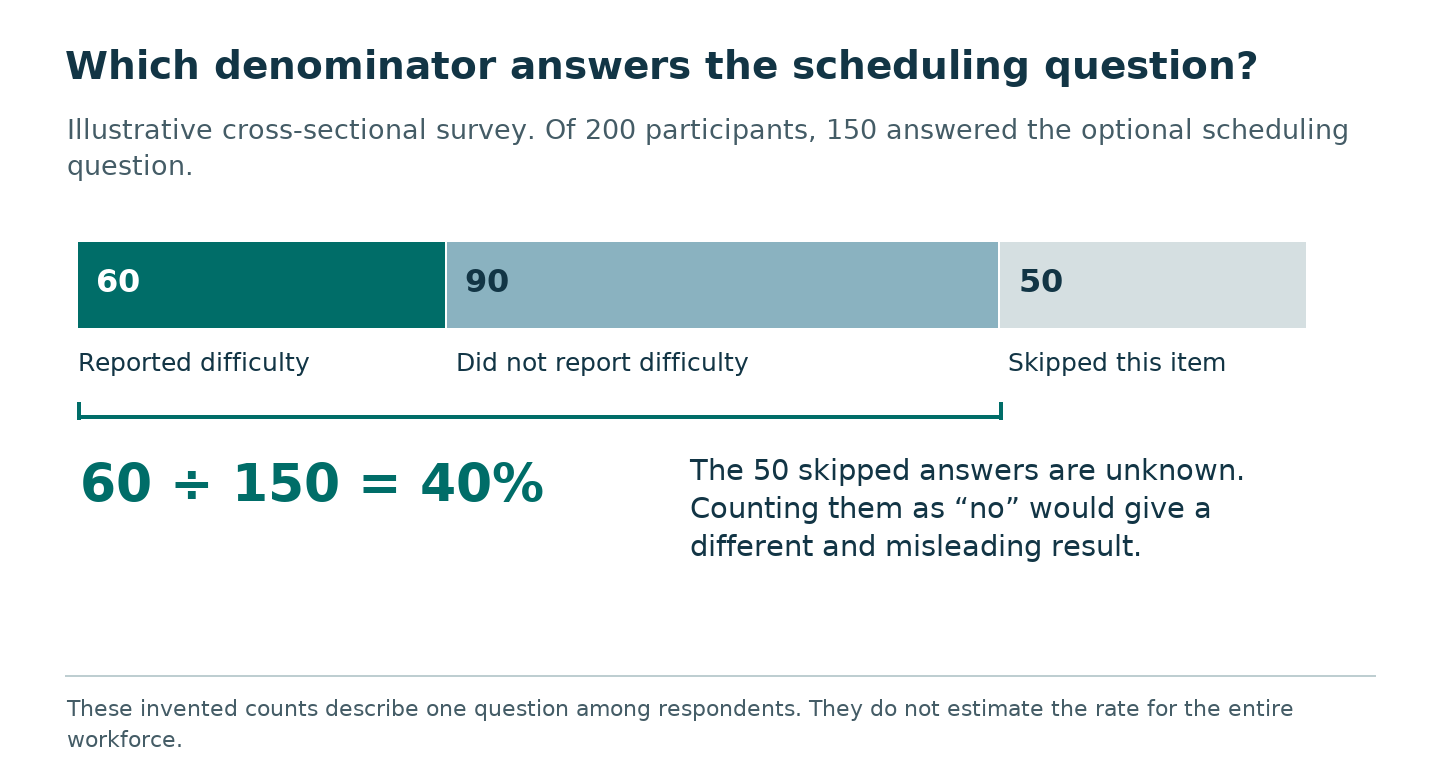
Start with who was eligible, how invitations were distributed, who responded, and which responses were analyzed. A percentage of respondents is not automatically a percentage of the nursing workforce. If a question was optional, its denominator may be smaller than the survey's total number of participants.
An illustrative survey receives 200 completed responses, but only 150 people answer a scheduling question. If 60 of those 150 report difficulty changing shifts, the proportion for that item is 40%, not 30%. Neither calculation establishes the prevalence among all employees unless the sampling and response process supports that inference.
Read the actual question
Intentions, experiences, and actions are different measures. “Considering leaving,” “planning to leave within a year,” and “left employment” should not be treated as the same result. Likewise, a symptom reported on a questionnaire is not necessarily a clinical diagnosis.
Record the wording, response options, and time frame. A question about the last shift may produce a different picture from a question about the past month. Neither is inherently wrong, but they answer different questions.
Examine who could be missing
A survey distributed through one professional group may not reach nurses outside that group. People with a strong interest in the topic may choose to respond. People too busy or uncomfortable to participate may be absent. These are reasons to investigate the sampling process, not to assume a particular direction or size of bias.
In a unit survey, examine whether night shifts, temporary staff, and staff on leave had comparable opportunities to respond. Report any known gaps openly rather than treating a large response count as a substitute for coverage.
Keep causal language restrained
Suppose the same survey measures workload concerns and plans to leave. An association could help identify a question for further study. It does not show that changing a particular staffing policy would cause a specified reduction in departures, nor does it measure actual departures.
A careful summary names the respondents, data-collection dates, question, denominator, and limitation. See sampling and representativeness and association and causation for further checks.
Before applying a survey result elsewhere, compare the respondents with the intended population.
Sources
- CDC Principles of Epidemiology: Analytic Epidemiology (archived teaching chapter) (accessed 2026-09-17).
- CDC Field Epidemiology Manual: Collecting Data (accessed 2026-09-17).