
An association is a relationship observed between variables. A causal claim goes further: it says that changing one factor would change an outcome under specified conditions. An observed relationship may reflect a causal effect, differences between groups, errors in measurement or selection, reverse direction, or chance.
The distinction matters when a paper is used to recommend an intervention. Evidence that two factors occur together does not, on its own, identify what will happen if a hospital changes one of them.
Establish the sequence
A proposed cause must precede its effect. A survey that measures current working conditions and current intentions at the same time often cannot establish that ordering. A cohort can establish a clearer sequence, but group differences may still provide alternative explanations.
Randomized trials use assignment by chance to strengthen a causal comparison. Their conclusions still depend on how the study was conducted, outcomes measured, and missing information handled. The design label alone is not enough.
An illustrative causal question
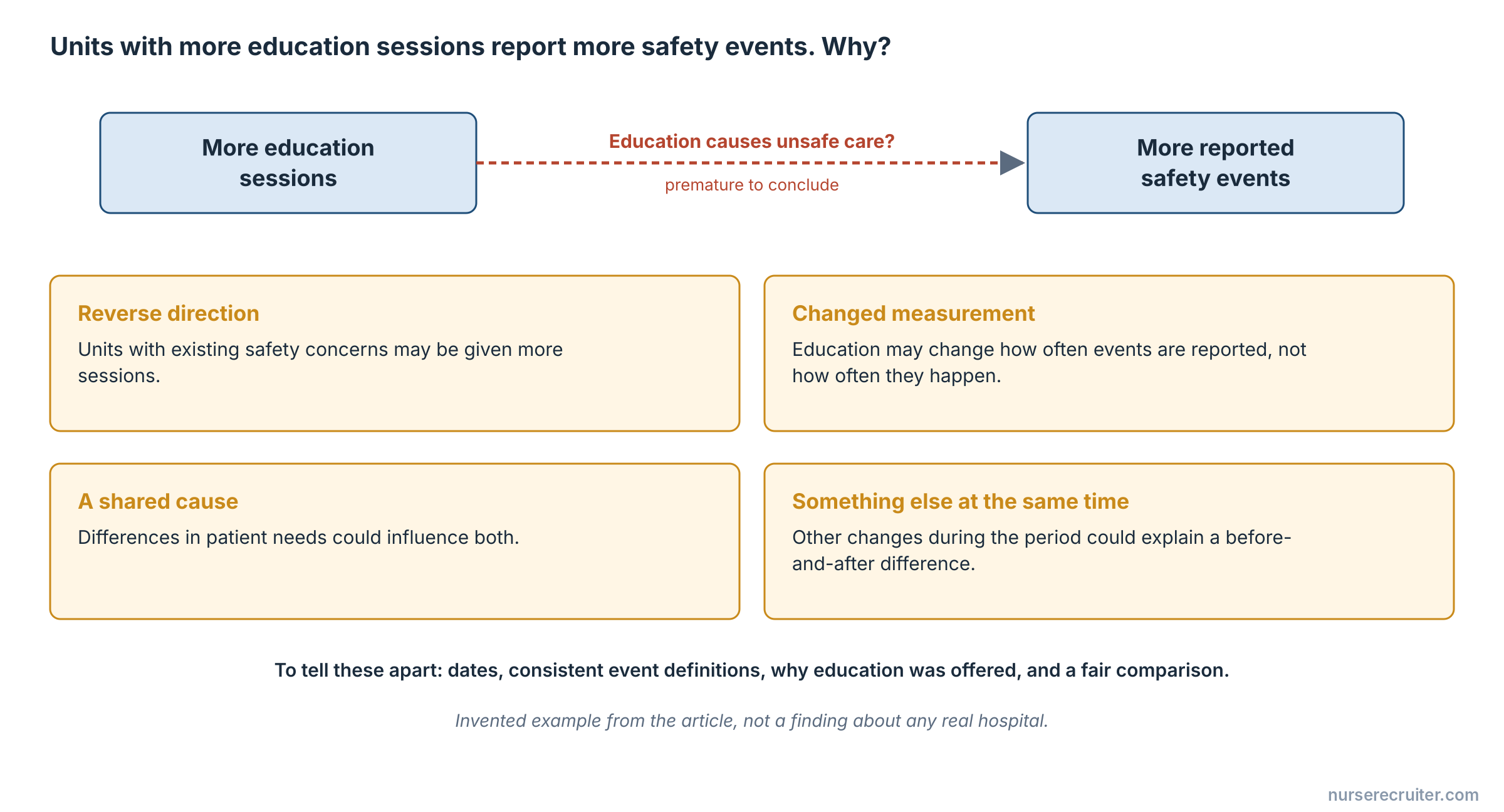
Suppose a hospital observes that units with more education sessions also have more reported safety events. It would be premature to conclude that education causes unsafe care. Units with existing safety concerns might receive more sessions. Education might also change reporting behavior rather than the underlying frequency of events. Differences in patient needs could influence both.
These are possible explanations for an invented example, not claims about a real hospital. To investigate them, the team would need dates, consistent event definitions, information about why education was offered, and an appropriate comparison.
A before-and-after decline would still need interpretation. Other changes might have occurred at the same time, and reporting might have changed. A temporal sequence is necessary for causation but does not settle every competing explanation.
Read the analysis as an argument
Ask what effect the researchers wanted to estimate, which groups they compared, and what assumptions connect that comparison to their conclusion. Identify potential confounders and how they were measured. Consider whether the outcomes are direct or substitutes for the outcome that matters.
An association that persists after statistical adjustment is not automatically causal. Adjustment addresses specified variables using a particular model; it cannot guarantee that unmeasured factors are irrelevant. Conversely, observational research should not be dismissed categorically. Its usefulness depends on the question, design, measurements, and the wider evidence.
Choose precise wording
Use “was associated with” for a reported observational association unless a stronger causal interpretation is justified and explained. Avoid turning intention into behavior or a reported event into a verified harm. Name the population and period instead of implying a universal relationship.
A practical evidence summary can present the finding, the strongest alternative explanation, and what additional evidence would help distinguish them. See confounding in health research for one common source of misleading comparisons.
For a comparison with an intervention study that assigns groups at random, see randomized controlled trials.
Sources
- CDC Principles of Epidemiology: Analytic Epidemiology (archived teaching chapter) (accessed 2026-09-17).
- Cochrane Handbook, Chapter 25: Assessing risk of bias in a non-randomized study (accessed 2026-09-17).
- CDC Field Epidemiology Manual: Analyzing and Interpreting Data (accessed 2026-09-17).