
A randomized controlled trial assigns participants to interventions using a chance-based process and compares outcomes. The comparison may be another treatment, usual care, a placebo, or another defined approach. Random assignment supports a fair comparison by preventing treatment allocation from being chosen according to participants' prognosis. It does not guarantee identical groups or eliminate every source of bias.
Random assignment is different from randomly sampling a population. A trial can allocate volunteers randomly while still recruiting a highly selected group.
Follow the assignment process
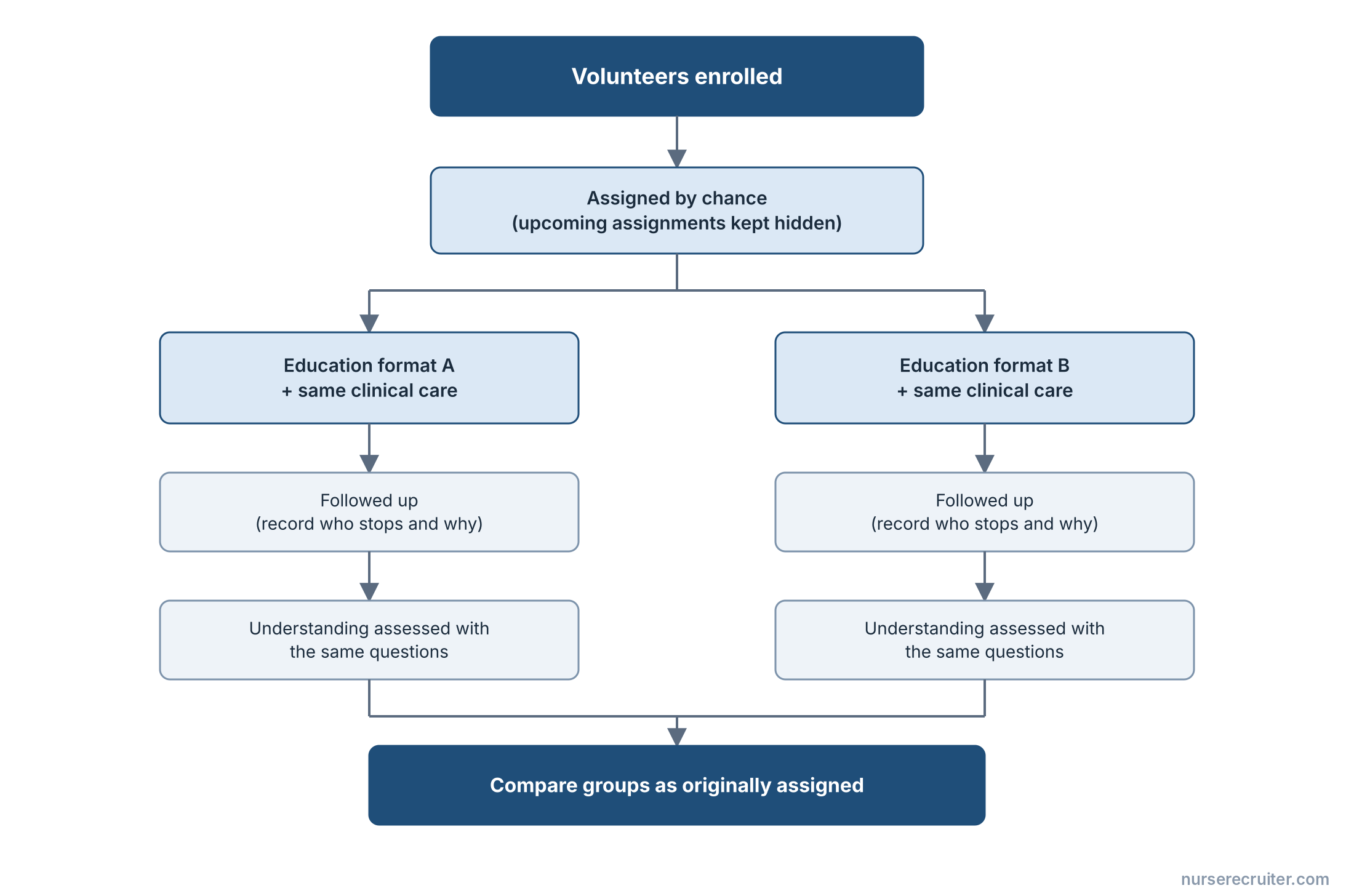
Look for how the sequence was generated and how upcoming assignments were concealed from people enrolling participants. Allocation concealment protects the assignment process. Blinding concerns knowledge of an assigned intervention afterward. They address different problems.
Some nursing interventions cannot be hidden from patients or staff. That does not automatically invalidate the trial. It makes the choice of outcome, consistency of measurement, and possible influence of expectations particularly important. A blinded outcome assessor may sometimes be possible even when the person delivering the intervention cannot be blinded.
An illustrative trial
Imagine volunteers are assigned to two formats of patient education. Both groups receive the same clinical care, and understanding is assessed later using the same questions. The example illustrates design only; it does not claim that one format is better.
A reader should ask whether people were recruited before anyone knew their assignment, whether extra teaching differed between groups, and whether the assessor could infer which format a participant received. If only participants who completed every session appear in the analysis, ask what happened to those who stopped attending.
The comparison should also remain recognizable. If the “usual education” group received substantial new materials halfway through the study, the trial's question may no longer match the label in the abstract.
Read the participant flow
Track the numbers enrolled, assigned, followed, and analyzed for the outcome that matters. Missing data need an explanation. A participant who leaves the study because the intervention is difficult to use may differ from someone lost for an unrelated reason.
For the effect of assignment, an analysis preserving original groups is generally the relevant starting point. Analyses of adherence answer a different question and require additional care. A favorable result among selected completers should not be presented as the experience of everyone offered the intervention.
Decide what the result establishes
Record the effect estimate, uncertainty, important harms, follow-up period, and study limitations. Consider whether the intervention and comparator could be delivered in the intended setting. Randomization helps address causal inference within the study; it does not settle whether the result transfers elsewhere.
See bias in nursing research and research generalizability for those next checks.
After examining the trial design, review the uncertainty around its estimated effect.
Sources
- Cochrane Handbook, Chapter 8: Assessing risk of bias in a randomized trial (accessed 2026-09-17).
- CDC Principles of Epidemiology: Analytic Epidemiology (archived teaching chapter) (accessed 2026-09-17).