
Confounding occurs when a comparison mixes the effect of interest with differences in other factors related to both exposure or intervention choice and the outcome. In studies of care, the reasons someone receives an intervention can also predict what happens afterward. That makes a simple comparison of recipients and nonrecipients difficult to interpret.
Cochrane's guidance describes confounding in intervention studies in terms of common causes of intervention choice and outcome. Which factors matter depends on the question and setting.
An illustrative clinical comparison
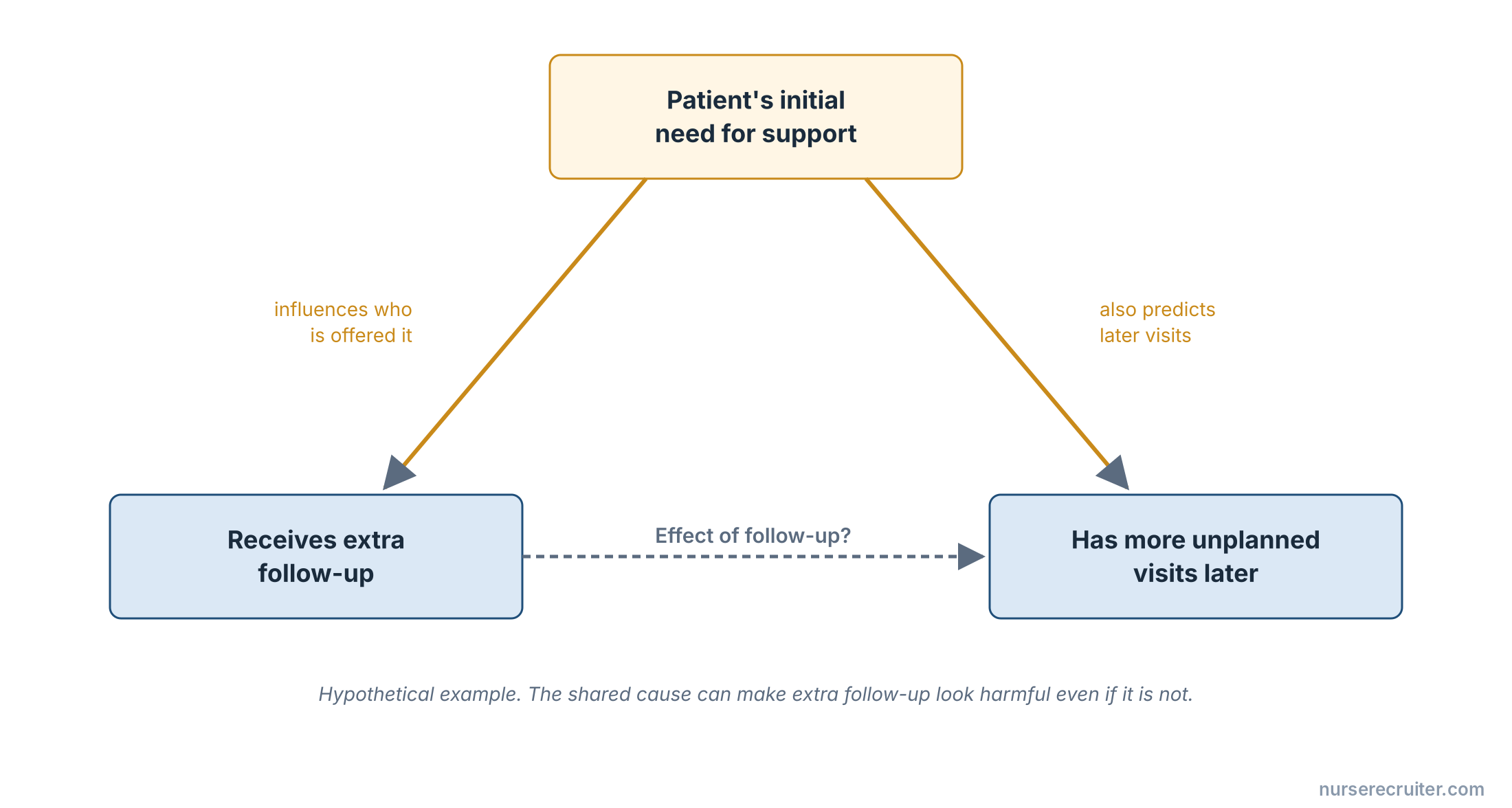
Imagine a service provides extra follow-up to patients judged to need more support. Those patients later have more unplanned visits than patients receiving standard follow-up. The result does not show that extra follow-up caused the visits. The initial need for support may influence both allocation and the likelihood of a later visit.
The example is hypothetical and is not evidence about follow-up care. It illustrates why a clinically sensible allocation process can produce groups with different starting risks.
Before interpreting the comparison, ask how need was assessed, whether those measurements preceded the intervention, and whether the study compared people with sufficiently similar starting circumstances.
What adjustment means
Researchers can address measured differences through design and analysis. A paper may report matching, stratification, regression adjustment, or weighting. Readers do not need to reproduce every calculation to ask which factors were included, why they were chosen, and how accurately they were measured.
Residual confounding can remain if important factors were omitted, poorly measured, or inadequately modeled. A broad diagnostic category, for example, might not capture differences in severity relevant to a treatment decision. “Adjusted for diagnosis” is therefore a description of an analysis, not proof of a fair comparison.
Do not adjust mechanically
The timing and role of a variable matter. A factor measured after treatment begins may be part of the pathway through which the intervention works rather than a baseline confounder. Including every available variable is not automatically a better analysis. Complex questions about changing exposures and health status may require specialist methods.
For a nursing journal club, draw a simple timeline: what existed before the exposure, what influenced the exposure, and what happened afterward. This can reveal assumptions hidden inside a long list of adjustment variables.
Report the remaining uncertainty
A balanced summary identifies the comparison, the main factors addressed, and the important factors that might remain. It should neither imply that all observational results are useless nor that statistical sophistication removes every limitation.
If an adjusted association becomes smaller, do not assume the new estimate is automatically the truth. Consider whether the adjustment was appropriate to the intended question. If it remains large, that still does not rule out unmeasured confounding.
See association and causation for placing this issue within a broader causal assessment.
For an example of how the groups arise over time, see cohort studies.
Sources
- Cochrane Handbook, Chapter 25: Assessing risk of bias in a non-randomized study (accessed 2026-09-17).