
A cohort study follows a defined group through time to examine outcomes in relation to an exposure or characteristic. Investigators observe the exposure rather than assign it as an experimental intervention. A prospective cohort records participants and follows later outcomes; a retrospective cohort reconstructs this sequence from existing information after the exposure and outcomes have occurred.
“Retrospective” does not mean “case-control.” The way participants are selected and the question being estimated determine the design.
Identify the starting point
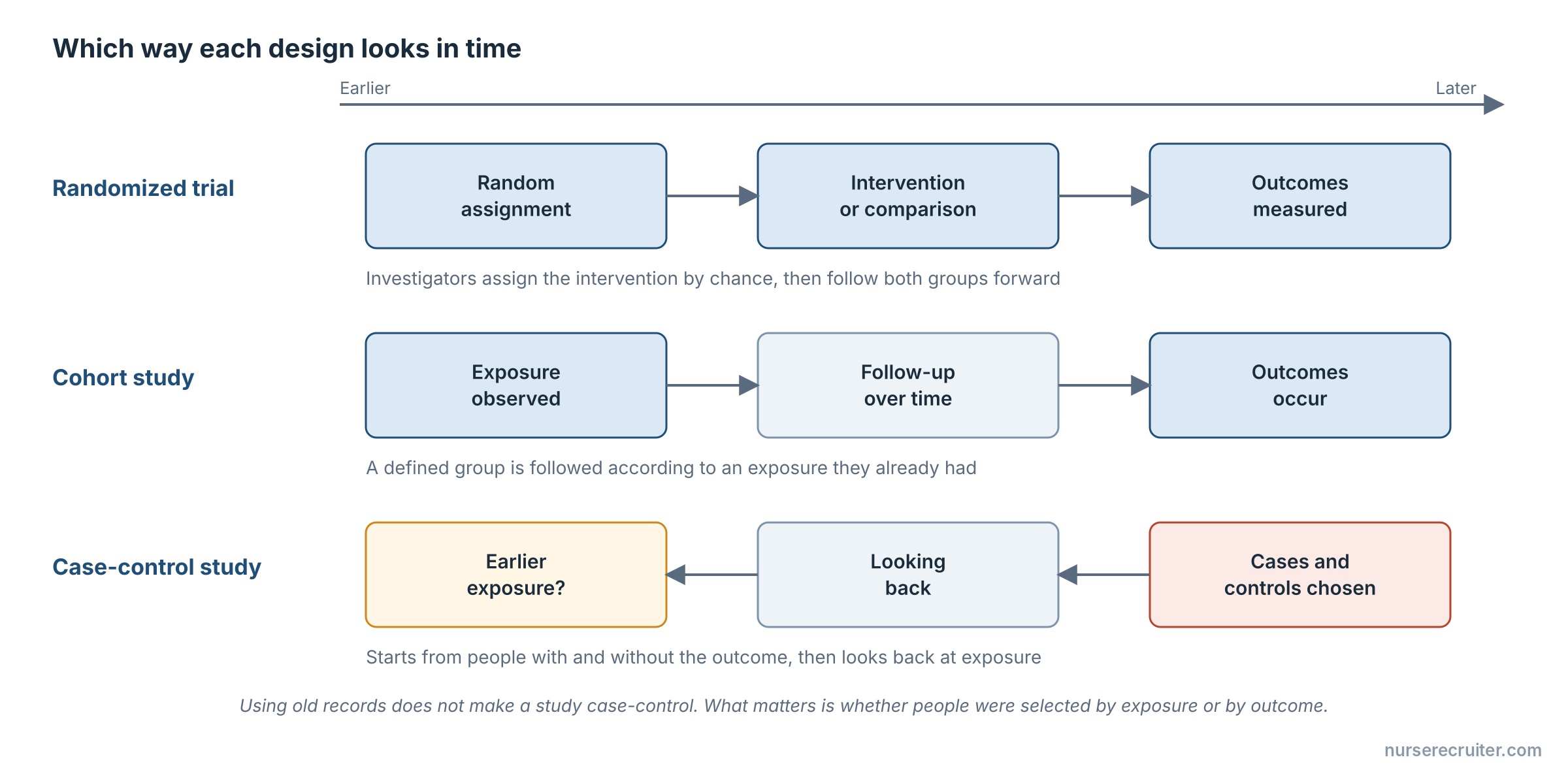
Read who was eligible, when follow-up began, how exposure was measured, and what counted as an outcome. People compared should have a meaningful opportunity to experience the outcome. A study of first occurrence needs to distinguish participants who already had that outcome at entry.
For an illustrative workforce question, a researcher might follow nurses joining a hospital and compare later employer retention according to their initial orientation arrangement. The study would need to define whether leaving a unit, leaving the employer, and leaving nursing count as the same event. They should not be assumed interchangeable.
Examine the comparison
Exposure groups in observational research can differ for reasons related to the outcome. In the orientation example, one program might be offered only on units with greater staffing difficulties. A difference in retention would not, by itself, establish a program effect.
Check what researchers measured about these differences and how they addressed them. An adjusted estimate is conditional on the information and methods used; the word “adjusted” is not a guarantee that all important differences disappeared. See confounding in health research.
Follow time and missing information
Ask whether groups were observed for comparable periods. A percentage leaving over three months cannot be directly compared with a percentage leaving over a year without accounting for time. When follow-up varies, the study may report rates using person-time or use time-to-event methods. Record which measure was actually used.
Also examine how researchers handled people no longer observed. In the illustrative example, a missing personnel record should not automatically be coded as remaining employed. The credibility of the result depends partly on how reliably the outcome could be determined.
Write a careful reading note
A useful note might say: “This observational cohort compared two orientation arrangements among eligible new employees, with retention defined at a stated follow-up. Differences may reflect the programs and differences between the groups.” Replace each general phrase with the paper's actual details.
Keep the data-collection period separate from the publication date. A newly published analysis of older records may reflect employment conditions or documentation systems that have since changed. That limits application without making the work useless.
Cohort evidence is especially useful for understanding sequences and outcomes over time, provided its comparison and measurement limitations remain visible.
Before drawing a conclusion from differences between groups, examine possible sources of bias.
Sources
- CDC Principles of Epidemiology: Analytic Epidemiology (archived teaching chapter) (accessed 2026-09-17).
- Cochrane Handbook, Chapter 25: Assessing risk of bias in a non-randomized study (accessed 2026-09-17).