
A process map shows how work moves from a starting point to an end point. In healthcare, it can make visible the decisions, handoffs, waiting and repeated work that are difficult to see from a policy document alone. A flowchart is one form of process map; a workflow diagram can also show the movement of people, information or materials through a physical space.
Map the work that happens
Start with a clear boundary. “Discharge” may include days of planning, a final order, teaching, prescriptions and transport. A team studying the period between a discharge order and the patient leaving the unit needs to say so. Otherwise participants may describe different processes and believe they disagree about the same one.
Invite the people who perform each part of the work. Include relevant shift and setting differences. A daytime map built only by managers may miss the phone call, paper list or workaround that keeps the process moving at night.
Distinguish the current process from the desired one. Both are useful, but a map that silently mixes them can make a problem appear solved before anything changes.
A nursing example
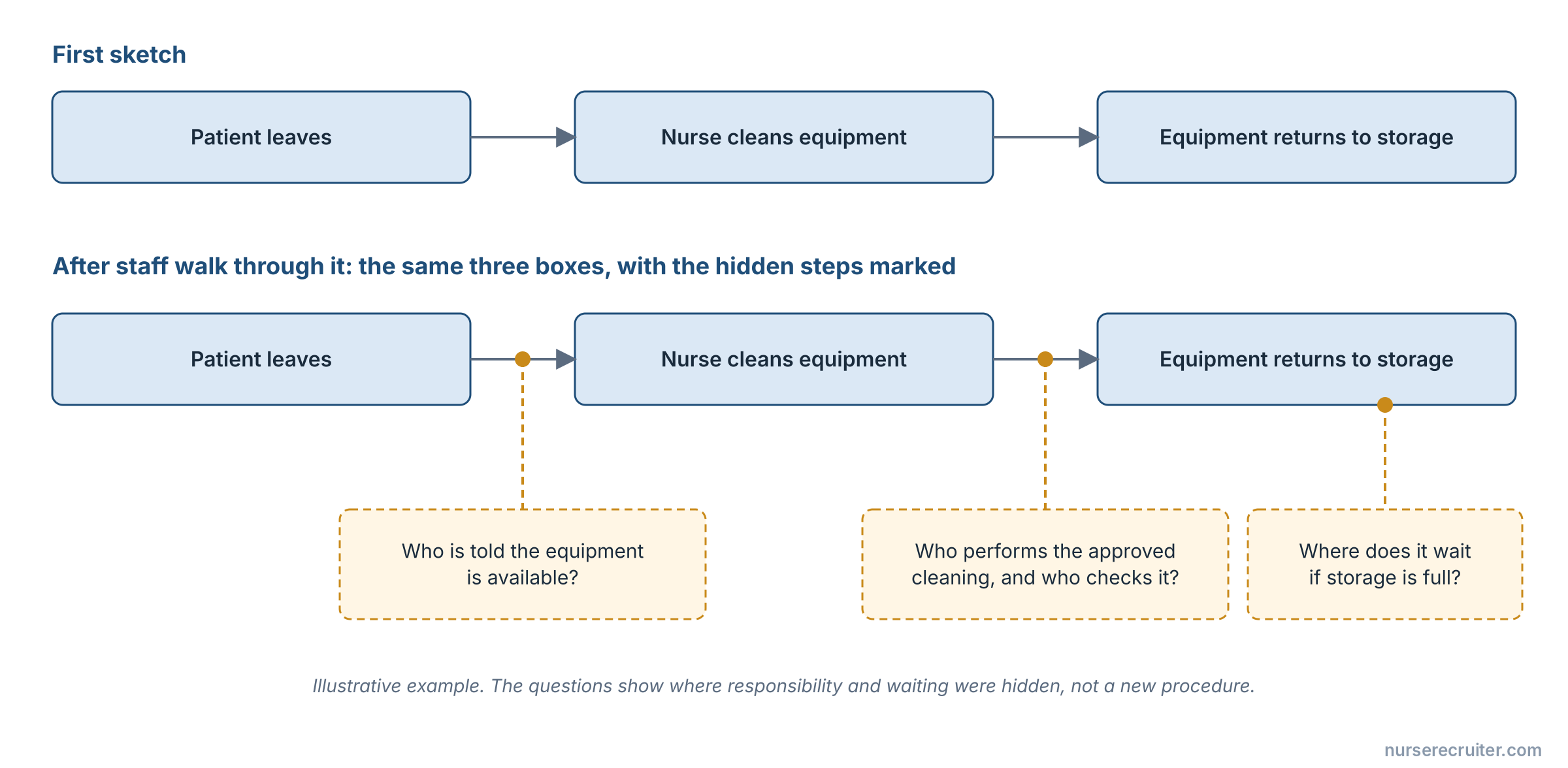
Consider an illustrative map of equipment return after a patient transfer. The first sketch might read: patient leaves, nurse cleans equipment, equipment returns to storage. Staff review could uncover several unanswered questions: who is notified that equipment is available, who performs the approved cleaning process, who checks it and where does it wait if storage is full?
Those questions are the value of mapping. The original three boxes were not necessarily false; they concealed responsibility and waiting. The map can be revised to show the actual handoff without inventing a new clinical cleaning procedure.
Do not assume every extra step is waste. A verification step may protect against a serious failure. Investigate its purpose before recommending removal.
Mapping a clinical referral
A referral can look complete in the electronic record as soon as someone clicks “send.” A closed-loop referral has several later steps. The receiving service accepts or redirects the request, someone arranges the visit, and the result reaches the team responsible for follow-up.
Trace one exception with the people who do the work. If the scheduling team cannot reach the patient, which queue holds the request? Who notices the failed contact, what do they do next, and how does the referring clinician learn what happened? Put the answer beside the handoff where responsibility changes. Label a proposed fix separately until staff confirm it works. When sharing the map, use roles and fictional cases so it can be read without disclosing patient identifiers.
Mark decisions and handoffs clearly
For each decision, identify what information is needed and what happens on each relevant branch. A box labeled “resolve problem” hides the very work that may need investigation. Likewise, a line between departments should explain what is transferred and how the receiving person knows action is needed.
If the map is intended to examine delays, add observed timing separately. Do not use the spacing between boxes as evidence of how long a step takes. Ask whether elapsed time and active staff work need different measures.
Validate before redesigning
Walk through the map with staff who were not in the original discussion and, where appropriate, with patients or caregivers. Compare it with observations and records rather than treating agreement in a meeting as proof.
Once the current process is understood, the team can select an improvement idea and test it through an approved PDSA cycle. A map can also support failure mode and effects analysis by making the steps and their dependencies explicit.
For a closer look at how tools and working conditions shape the steps on the map, see human factors in healthcare.
Sources
- AHRQ — Process Mapping Tools (accessed 2026-09-17).
- AHRQ — Flowchart (accessed 2026-09-17).
- IHI — Testing Changes (accessed 2026-09-17).
- AHRQ: Workflow Assessment for Health IT Toolkit (accessed 2026-11-11).
- SAFER: Organizational Responsibilities (accessed 2026-11-11).
- SAFER: System Management (accessed 2026-11-11).
- SAFER: Clinician Communication (accessed 2026-11-11).