
A closed-loop referral process tracks what happens after a referral is sent. It connects the requesting team, receiving service and patient so that the request, response and next actions do not disappear between organizations.
The Institute for Healthcare Improvement and National Patient Safety Foundation describe a nine-step approach to ambulatory referrals. Its purpose is to get relevant information to the appropriate person and follow that information over time. The framework treats referral management as shared work across participants.
Agree on what a useful referral contains
AHRQ recommends referral agreements that define appropriate requests, information exchange, urgent access and each party's responsibilities. It also recommends sending relevant information directly between clinicians rather than relying on the patient to carry the whole exchange.
For a nursing team, a practical starting point is to identify the question the referral is intended to answer. “Specialist review requested” may be less useful than a clearly stated clinical question supplied by the referring clinician. Confirm the receiving service's requirements before treating the request as ready.
Keep clinical urgency separate from administrative convenience. Use the responsible clinician's prioritization and the organization's escalation process.
Track distinct states
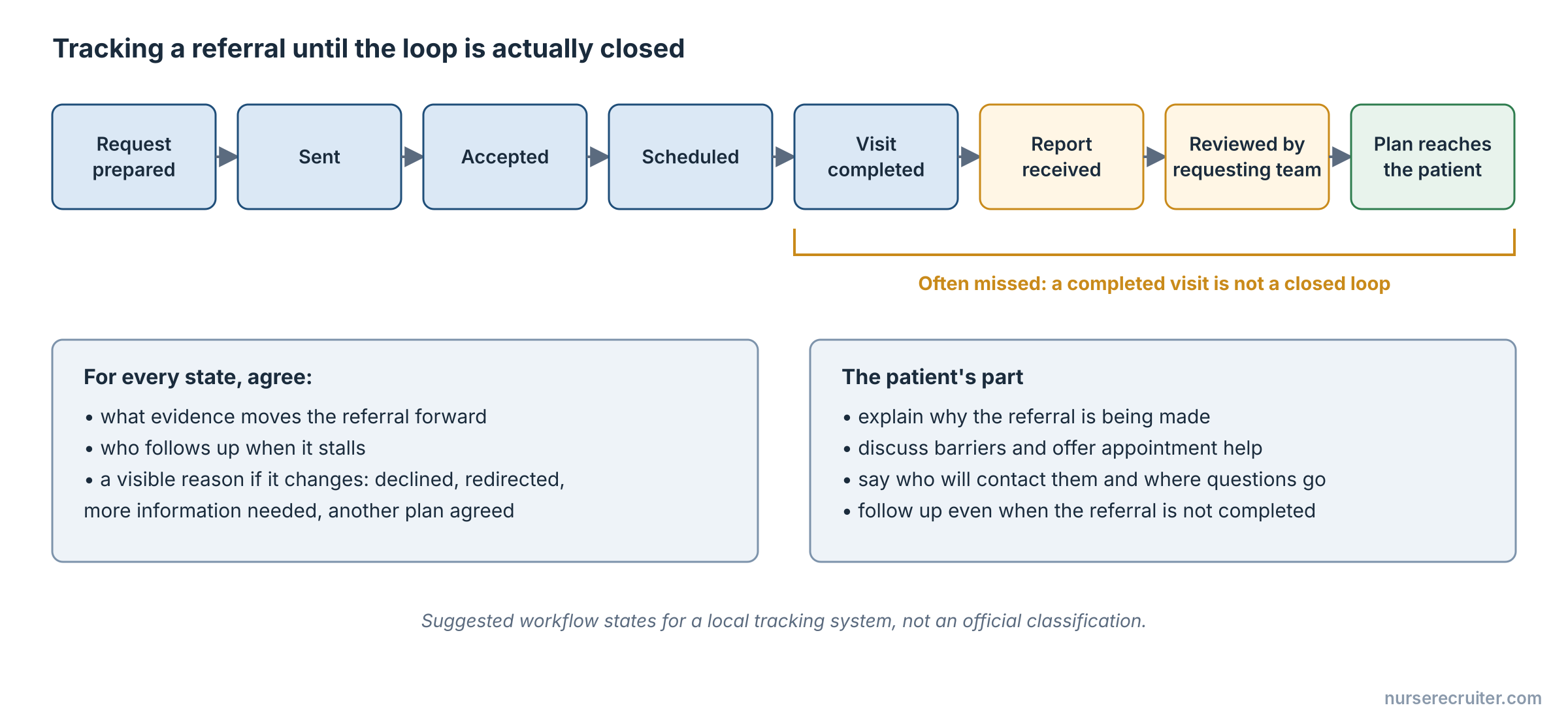
A local tracking system might distinguish a request that is prepared, sent, accepted, scheduled, completed or awaiting a response. Those are suggested workflow states, not an official universal classification.
For every state, identify what evidence changes the status and who follows up when progress stops. A scheduled appointment is evidence of scheduling. It is not evidence that the consultation occurred or that the requesting clinician reviewed the response.
Use a visible reason when the process changes: the patient declines, the service redirects the request, further information is needed or another plan is agreed. Avoid silently removing an unresolved item from a work queue.
Include the patient's part of the process
AHRQ's guidance includes explaining the purpose of the referral, discussing barriers, offering appointment help and confirming completion. It recommends obtaining the result and following up with the patient, including when a referral has not been completed.
Explain who will contact the patient, what preparation has been authorized and where questions should go. Check the patient's communication and access needs with the receiving service.
Close on a usable answer
Consider a fictional referral in which a consultation has occurred but the report has not reached the primary team. The patient has completed the visit; the professional communication remains unfinished.
The tracking record should show who will obtain the report, who will review it and how any resulting plan will reach the patient. “Visit completed” alone would conceal the remaining work.
A suggested quality review samples referrals from the original request forward, including redirected and incomplete cases. Ask where progress stopped and whether the patient was left to solve a problem between services. Define the local closure criteria before reporting a completion rate.
If the receiving service needs the patient present to clarify the request, a warm handoff can help. For community resource referrals, agreement on the next step matters just as much as sending the information. When measuring care coordination, count a referral as closed only when it meets the stated definition.
Sources
- Closing the Loop: A Guide to Safer Ambulatory Referrals in the EHR Era (accessed 2026-09-17) — IHI/National Patient Safety Foundation, 2017.
- Make Referrals Easy, Tool 21 (accessed 2026-09-17) — AHRQ, third-edition health literacy toolkit.