
A warm handoff brings the receiving team member into a care conversation with the patient. Its value as a communication method lies in making the transfer visible: the patient can hear the summary, correct information and understand what the next person will do.
AHRQ's Warm Handoff Plus strategy is an in-person exchange between two healthcare team members in front of the patient, with family included when present. The strategy was designed for transitions within primary care and can involve clinical or nonclinical team members.
Clarify what is being handed over
AHRQ's broader TeamSTEPPS guidance describes a handoff as transferring information together with responsibility and authority. It emphasizes acknowledgment by the receiver, clear communication and an opportunity to ask questions. The information includes the current plan and relevant uncertainty.
Before beginning, identify the purpose of this particular transfer. Is a colleague continuing education, responding to a new concern or taking responsibility for a different part of the plan? A friendly introduction alone does not answer that question.
Make the patient part of the exchange
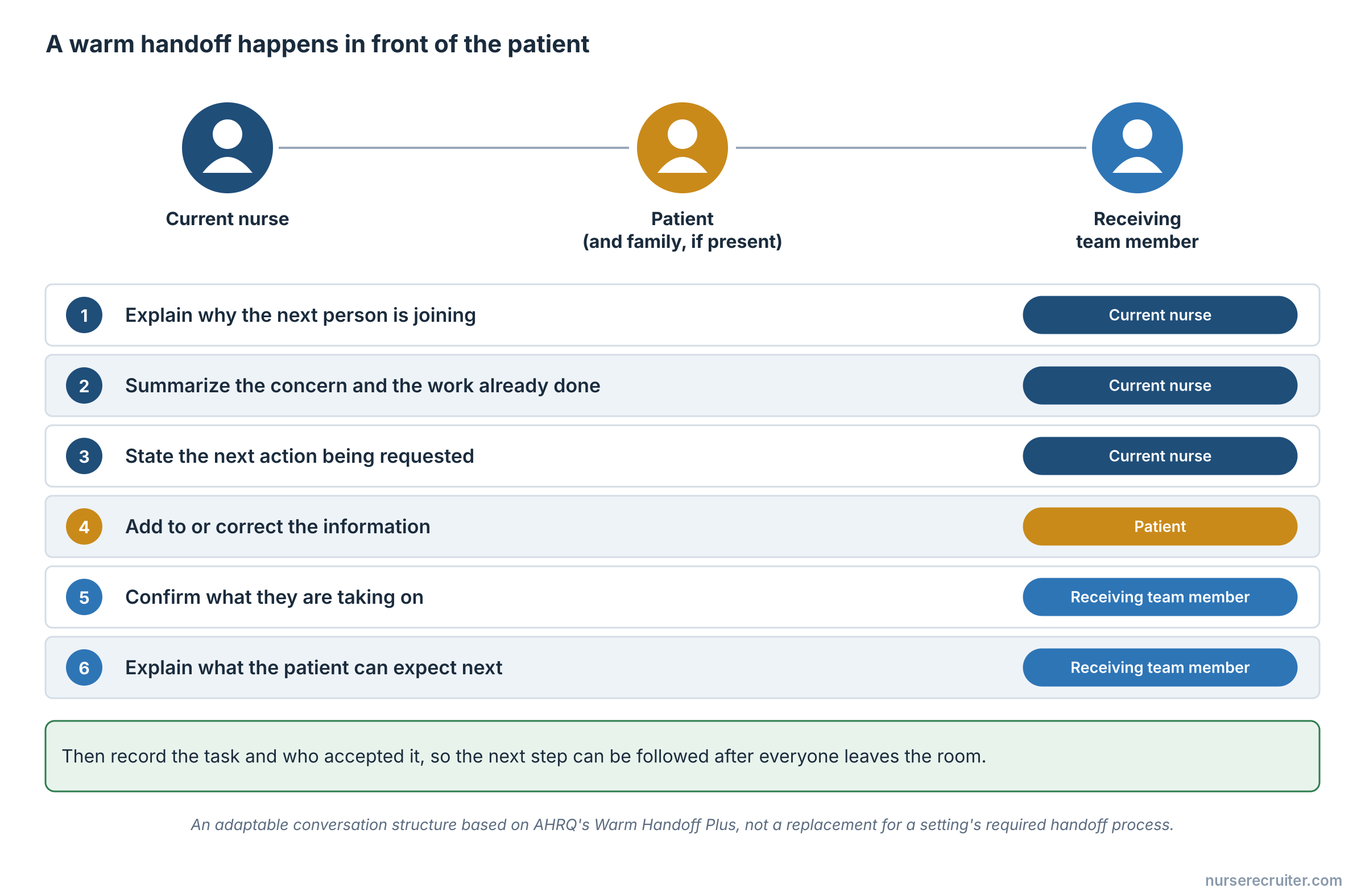
Use a brief explanation of why the next person is joining. Introduce each person's role, summarize the issue in language the patient can follow and invite correction. Bring communication supports into the arrangement rather than adding them after the team has finished talking.
A suggested sequence is:
- Explain the purpose of the transfer.
- Summarize the relevant concern and work already completed.
- State the requested next action.
- Invite the patient to add or correct information.
- Ask the receiving person to confirm what they are taking on.
- Explain what the patient can expect next.
This is an adaptable conversation structure, not a replacement for a setting's required handoff process.
Test the exchange with a practical example
In a fictional clinic visit, a nurse introduces a care coordinator because a patient needs help arranging transport for a planned appointment. The nurse describes the appointment and the unresolved transport question. The patient adds that the appointment location has changed.
The coordinator confirms the location, accepts the task of reviewing available options and explains how the patient will receive an answer. The conversation has uncovered an error and established a next step. It has not guaranteed that a transport service is available.
Document the task and agreed responsibility in the appropriate record so the exchange can be followed after the participants separate.
Plan for interruptions and unavailable staff
A team adopting warm handoffs should decide what happens when the intended receiver is unavailable, the patient needs privacy or the conversation is interrupted. Use an agreed alternative route and make acceptance of the task explicit.
Keep virtual or telephone adaptations clearly described as local adaptations. The AHRQ Warm Handoff Plus resource defines an in-person primary-care method; applying its principles elsewhere requires attention to the communication channel and local process.
Review whether patients can describe the next step and whether receivers know which tasks they accepted. These questions assess the exchange more usefully than counting introductions alone.
An introduction is only the beginning. After the handoff, use closed-loop referrals to check acceptance, family-centered communication to clarify who the patient wants involved, and shared care plans across organizations to record the agreed next step.
Sources
- Warm Handoff Plus (accessed 2026-09-17) — AHRQ.
- TeamSTEPPS Tool: Handoff (accessed 2026-09-17) — AHRQ.