
PICOT organizes an intervention question into population, intervention, comparison, outcome, and time. The underlying PICO structure is used in evidence reviews; adding time helps make the outcome interpretable. It is a thinking aid, not a promise that every component should become a search term or that every nursing question fits an intervention comparison.
A question about lived experience may need a different structure. For example, “How do newly qualified nurses experience asking for help?” does not become clearer by inventing a treatment and control group.
Build the question one choice at a time
Start with the population that faces the decision. “Adults discharged from an inpatient medical ward” is clearer than “patients.” Add restrictions only when they matter; an unnecessarily narrow population may exclude useful evidence.
Name the actual intervention. “Better education” leaves the reader guessing. “An individual teaching session using a written medication schedule” provides something that can be compared and reproduced. Describe the comparator as carefully. Usual care can differ across settings and across study years.
Choose an outcome the study can measure. Medication knowledge, medication-taking behavior, adverse events, and hospital use are separate outcomes. Select a follow-up period appropriate to the question, without presenting the chosen period as a universal standard.
An illustrative worked question
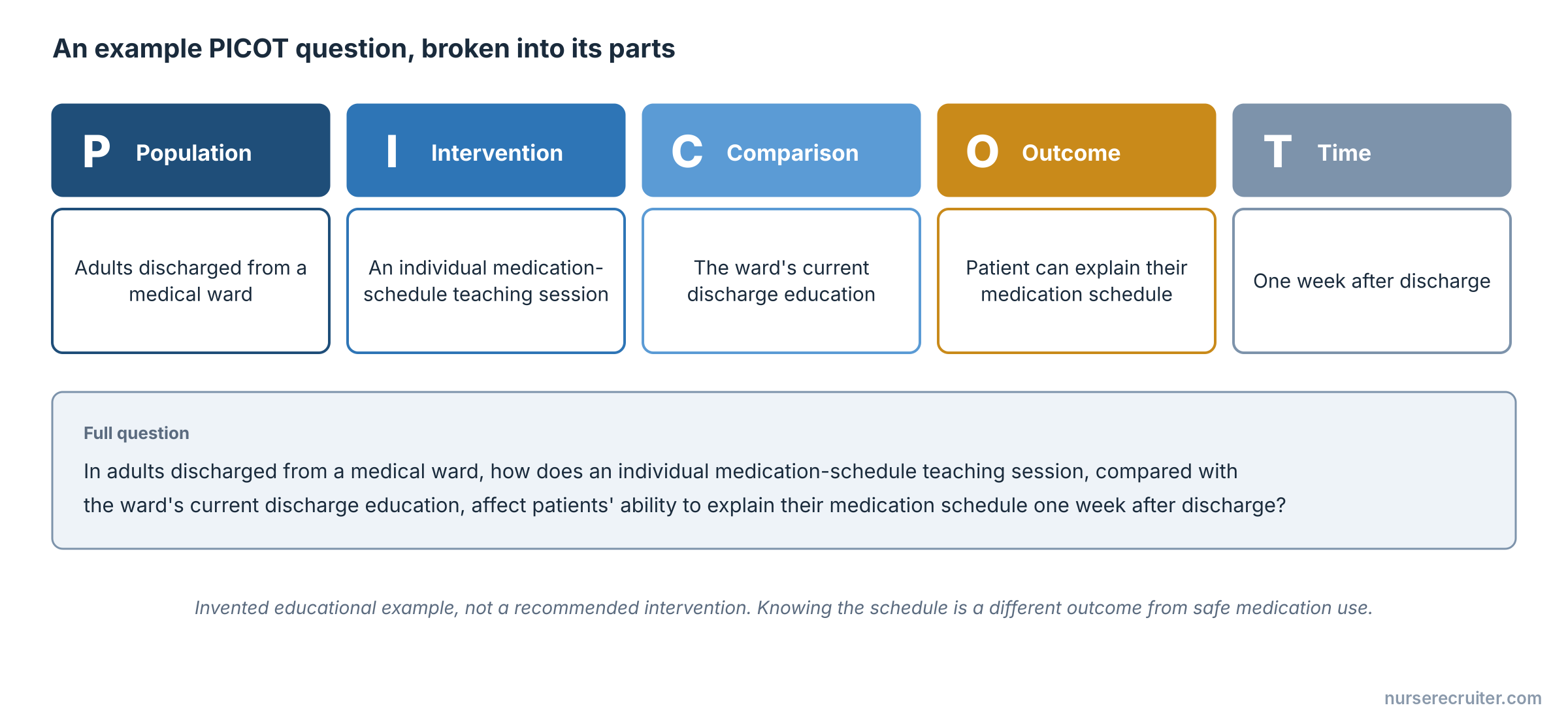
“In adults discharged from a medical ward, how does an individual medication-schedule teaching session, compared with the ward's current discharge education, affect patients' ability to explain their medication schedule one week after discharge?”
This is an invented educational example, not an evidence-backed intervention recommendation. Its population is adults leaving one type of ward. Its intervention is the specified session. Its comparator is existing education, which would still need description. Its outcome is an explanation assessed using a defined method. Its time point is one week.
The question avoids claiming that knowledge is the same as safe medication use. If the team's real concern is medication-related harm, it should ask a separate question about that outcome rather than relabel knowledge as harm prevention.
Turn the question into a search
Identify synonyms for the major concepts and look at terms used in relevant papers. Begin with the most useful population and intervention concepts, then adjust after inspecting results. An exact sentence search is unlikely to capture the full range of relevant wording. A librarian can help translate the question into a database-specific strategy.
Keep a record of changes. If the original comparator or outcome cannot be found, explain whether the question was broadened, the available evidence is indirect, or the question remains unanswered. Do not quietly substitute a convenient outcome and report that the original problem has been resolved.
See finding nursing research for the retrieval step and research generalizability for judging how closely evidence matches the intended setting.
If an existing review appears to answer the question, assess how its studies were selected and combined.
Sources
- Cochrane Handbook, Chapter 3: Defining the criteria for including studies and how they will be grouped for the synthesis (accessed 2026-09-17).
- Cochrane Handbook, Chapter 4: Searching for and selecting studies (accessed 2026-09-17).