
A systematic review answers a defined question using explicit methods for finding, selecting, assessing, and synthesizing relevant research. Its methods should make the route from question to conclusion inspectable. The word “systematic” does not guarantee that the search was comprehensive or the included studies were reliable.
A meta-analysis is a statistical combination of results. A systematic review may contain one, several, or none. Some studies differ too much in their populations, interventions, or measurements for a pooled estimate to answer a useful question.
Start with the question and search date
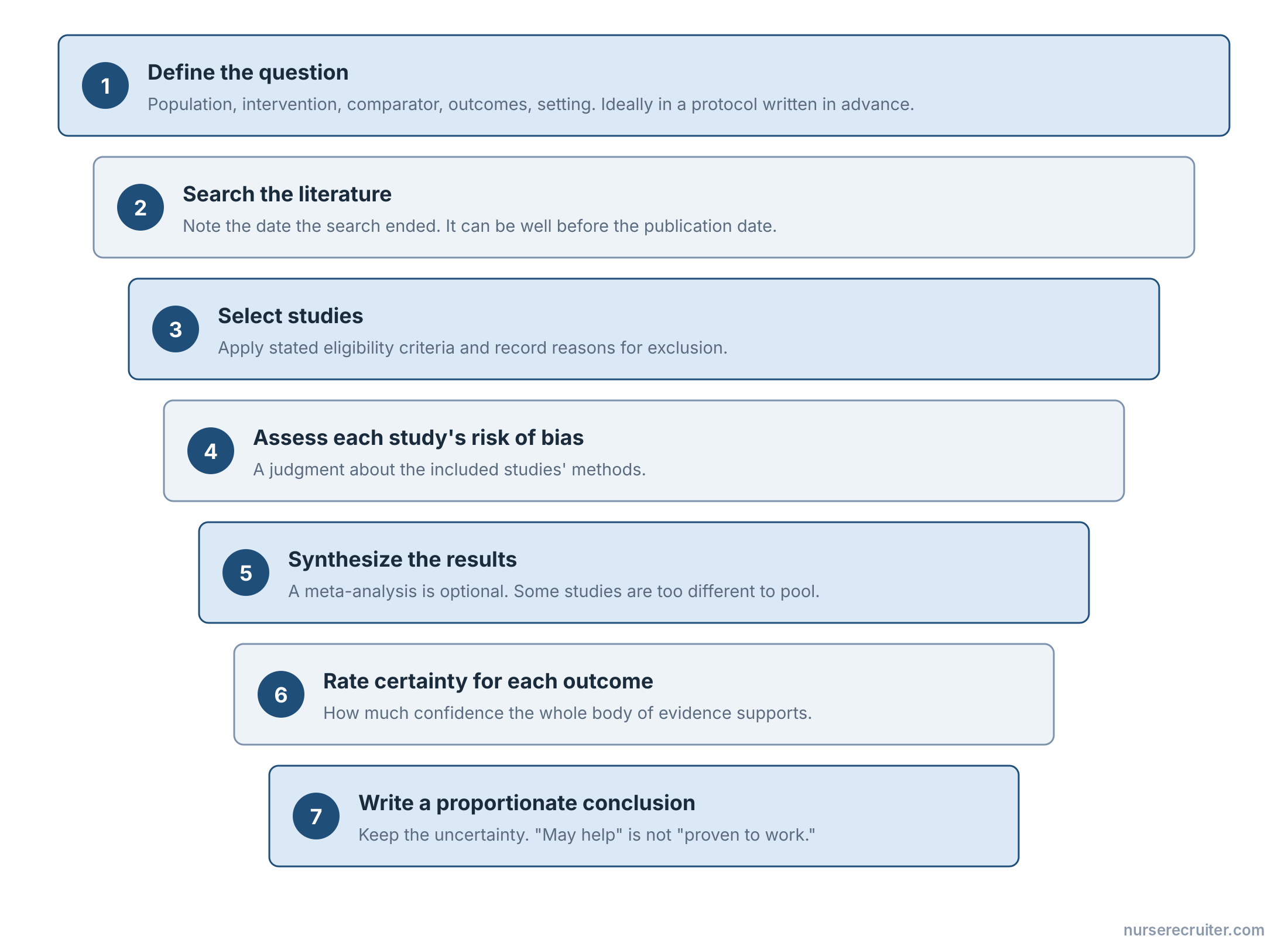
Compare the review's population, intervention, comparator, outcomes, and setting with the decision you face. Then find when its searches ended. A review published this year may have searched the literature substantially earlier. The publication date alone does not establish that new evidence was considered.
Look for an advance protocol, eligibility criteria, databases searched, selection process, and reasons for exclusions. These details help explain what was allowed into the review and reduce opportunities to select evidence because its results are attractive.
Read the evidence underneath the summary
Examine the number of studies and participants contributing to each outcome. A review's total participant count may be much larger than the evidence supporting one particular conclusion. Notice whether the outcome was measured directly, whether follow-up was long enough for the question, and whether harmful effects were considered.
A risk-of-bias assessment concerns the included studies' methods. A certainty assessment concerns how much confidence to place in a body of evidence for an outcome. Neither is the same as the journal's reputation or the review authors' confidence in their prose.
An illustrative appraisal
Suppose a review includes several studies of orientation programs and concludes that programs may improve retention. Before using it to choose a program, a nurse manager could check whether retention means remaining with the employer, staying on the same unit, or remaining in nursing. Those are different decisions and different denominators.
The manager could also examine whether every program had the same components. A pooled result combining paid supervised practice, optional mentoring, and classroom teaching would not identify which component should be purchased. This is an invented appraisal example, not a claim about actual orientation research.
Write a conclusion proportionate to the evidence
A useful summary names the intervention and comparator, the outcome, the population, and the uncertainty. If the evidence is inconsistent or indirect, preserve that qualification when presenting it to colleagues. Do not turn “may help” into “proven to work.”
If the review does not answer the local question, identify the gap precisely. It may still provide useful background or search terms. See evidence synthesis for nursing practice for comparing findings across reports without simply counting favorable conclusions.
When interpreting the pooled result, inspect the risks of bias in the underlying research.
Sources
- Cochrane Handbook, Chapter 1: Starting a review (accessed 2026-09-17).
- Cochrane Handbook, Chapter 10: Analysing data and undertaking meta-analyses (accessed 2026-09-17).
- Cochrane Handbook, Chapter 14: Completing Summary of findings tables and grading the certainty of evidence (accessed 2026-09-17).