
Evidence synthesis brings findings from multiple sources together to answer a question. It requires an explanation of what was included, how studies were assessed, and how the overall interpretation was reached. A stack of article summaries is useful preparation, but it is not yet a synthesis.
A practical nursing evidence review may be narrower than a formal systematic review. Label its scope honestly so that a focused search or local appraisal is not mistaken for an exhaustive account of the literature.
Organize by the decision
Begin with the population, intervention or exposure, comparator, outcomes, and time frame. Arrange findings by meaningful comparison and outcome rather than simply by publication date. Keep intervention benefits, harms, experience, and implementation questions distinct.
For each result, record the study design, participants, outcome definition, effect estimate where applicable, uncertainty, and important limitations. Check whether several reports come from the same study. Counting reports as independent studies can exaggerate the amount of evidence.
An illustrative synthesis table
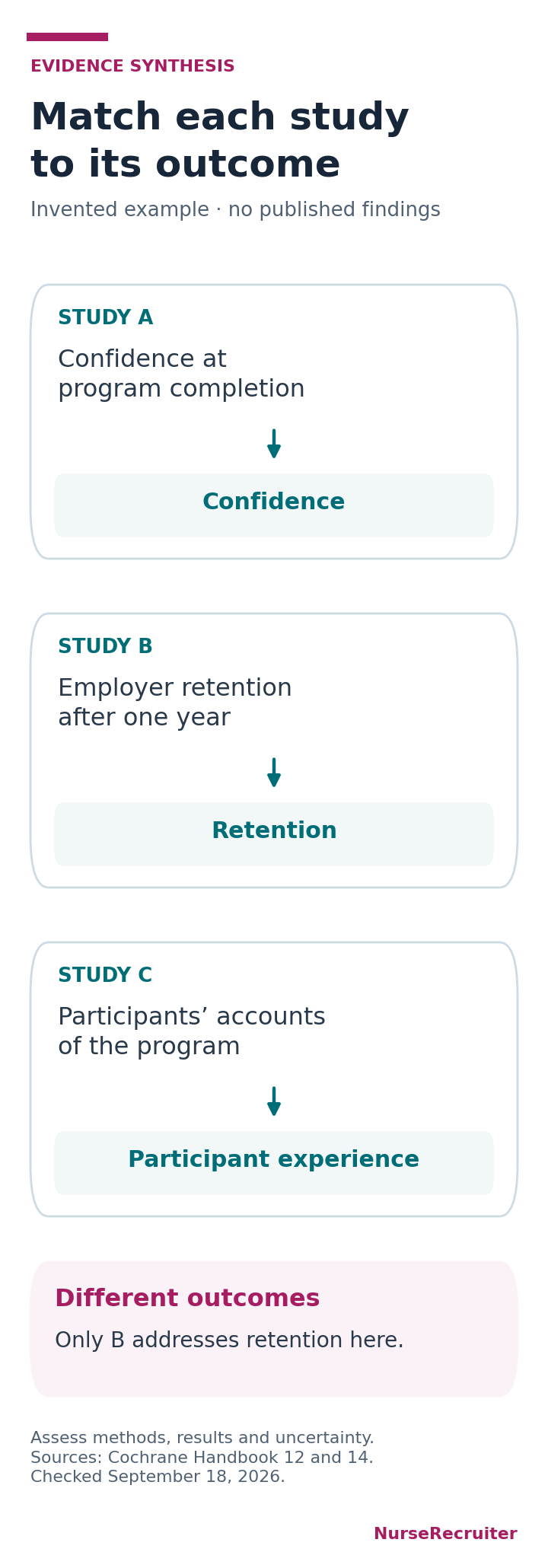
Invented teaching example, not published findings. The arrows map study questions to outcomes; they do not indicate an effect, a quality ranking or proof. Methods, results, limitations and uncertainty are still needed.
Imagine three studies of a transition-to-practice program. The entries below are invented to show how to separate outcomes; they are not findings from published studies.
| Evidence entry | What was measured | What to keep separate in the synthesis |
|---|---|---|
| Study A | Confidence at program completion | A confidence result does not establish whether nurses stayed with their employer. |
| Study B | Employer retention after one year | Assess this retention result using its comparison, uncertainty, and limitations; do not count the other two studies as additional retention estimates. |
| Study C | Participants' accounts of the program | Use these accounts to examine experience and context, rather than treating them as a numerical retention effect. |
A useful synthesis explains what each source contributes. It would not report that all three “prove better retention.” The table also shows what is still missing: actual results, study methods, limitations, and uncertainty must be added before it can support a decision.
If two programs share a name but differ in supervision, teaching time, or eligibility, describe those differences. They may be different interventions for the purpose of the decision. This example is hypothetical and makes no claim about actual programs.
A reader should be able to see which conclusion comes from which outcome and how much evidence supports it.
Do not decide by vote count
Simply counting how many papers report a favorable or statistically significant result ignores their precision, size, methods, and relevance. A small imprecise study and a large precise study should not automatically receive equal weight as votes. Formal synthesis based on effect direction has a limited role when fuller data are unavailable; it cannot estimate an average effect size.
Meta-analysis can combine compatible quantitative results using explicit methods, but pooling does not erase differences between studies. Clinical and methodological diversity should be examined before interpreting an average effect. A narrative synthesis also needs a clear method; “narrative” should not mean selecting whichever results fit a preferred story.
Keep certainty visible
Cochrane's GRADE guidance considers concerns such as bias, inconsistency, indirectness, imprecision, and publication bias when judging certainty for an outcome. Certainty may differ across outcomes within the same review. Do not transfer a strong conclusion about one measure to a poorly studied outcome.
The final synthesis should say what the evidence supports, what remains uncertain, and how directly it applies to the proposed decision. Separate the evidence statement from the recommendation, which also depends on preferences, resources, and context.
See clinical practice guidelines and evidence for how structured recommendations build on an evidence base.
If the question is what has been studied rather than how well an intervention works, compare scoping reviews.
Sources
- Cochrane Handbook, Chapter 10: Analysing data and undertaking meta-analyses (accessed 2026-09-17).
- Cochrane Handbook, Chapter 14: Completing Summary of findings tables and grading the certainty of evidence (accessed 2026-09-17).
- Cochrane Handbook, Chapter 4: Searching for and selecting studies (accessed 2026-09-17).
- Cochrane Handbook, Chapter 12: Synthesizing and presenting findings using other methods (accessed 2026-09-17).