
A scoping review maps the literature on a topic: what has been studied, how concepts are defined, which methods have been used, and where gaps appear. It can help clarify an emerging field or determine whether a more focused systematic review is warranted. It should not be read automatically as evidence that an intervention is effective.
The PRISMA extension for scoping reviews provides a reporting framework. Transparent reporting helps readers inspect a review, but completion of a checklist does not by itself establish that its methods or conclusions are sound.
What a map can tell you
A scoping review may organize publications by population, setting, intervention components, types of evidence, or measures. This can be useful when different authors use the same term for different things. A review of “nurse navigation,” for example, might need to distinguish referral coordination from ongoing clinical support before readers can compare studies.
When reading a map, ask what counted as an eligible source. Empirical research, policy documents, opinion pieces, and practice descriptions contribute different kinds of information. Their presence in the same review does not make them equivalent evidence of benefit.
An illustrative use
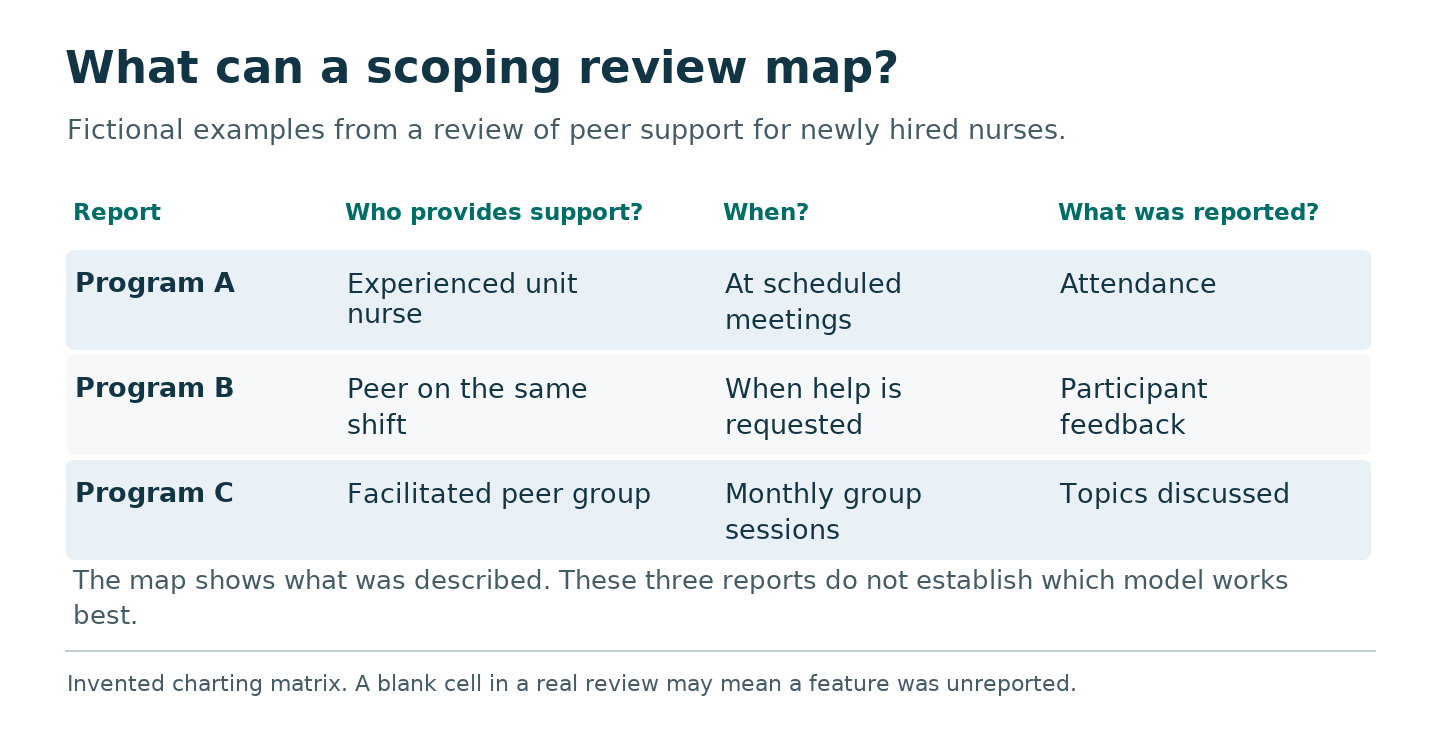
Imagine an educator wants to understand how published programs define peer support for new nurses. A scoping review could chart who provides support, when contact occurs, how participants are recruited, and what outcomes authors report. It might reveal that some programs are informal and others use scheduled meetings.
That map could help the educator write a clearer future research question. It would not show that the most frequently described model is best. Frequency of publication is not a comparative effectiveness result, and a gap in the map does not prove that a practice has never been tried.
This example is illustrative and does not describe findings from an actual review.
Check the boundaries
Read the question, eligibility rules, databases, language restrictions, and search dates. Then look at how sources were selected and information was charted. A review limited to one country or one database should not quietly become a description of the entire field.
Check whether critical appraisal was performed and what role it played. If methodological quality was not assessed, preserve that limitation when discussing the map. If appraisal was performed, inspect its findings rather than assuming every included source passed a quality threshold.
Use gaps carefully
A useful gap statement is specific: no eligible studies were found for a named population, outcome, and search period. “There is no evidence” is often too broad. The next step might be a better search, a focused review, a feasibility study, or clarification of terminology.
For decisions about an intervention's benefits and harms, move to systematic reviews for nurses. A scoping review can prepare that question without having answered it.
When the purpose shifts from mapping a field to combining findings, consider which approach to evidence synthesis fits the question.
Sources
- PRISMA Extension for Scoping Reviews (accessed 2026-09-17).