
The APRN Consensus Model is a framework for aligning how advanced practice registered nurses are educated, certified and authorized to practice. Released in 2008, it describes a common approach for the four APRN roles and their population preparation.
It is useful for understanding credentials, but it is not a substitute for a state's current law. NCSBN states that jurisdictions have adopted different elements, so regulation remains uneven.
Understand the four parts of LACE
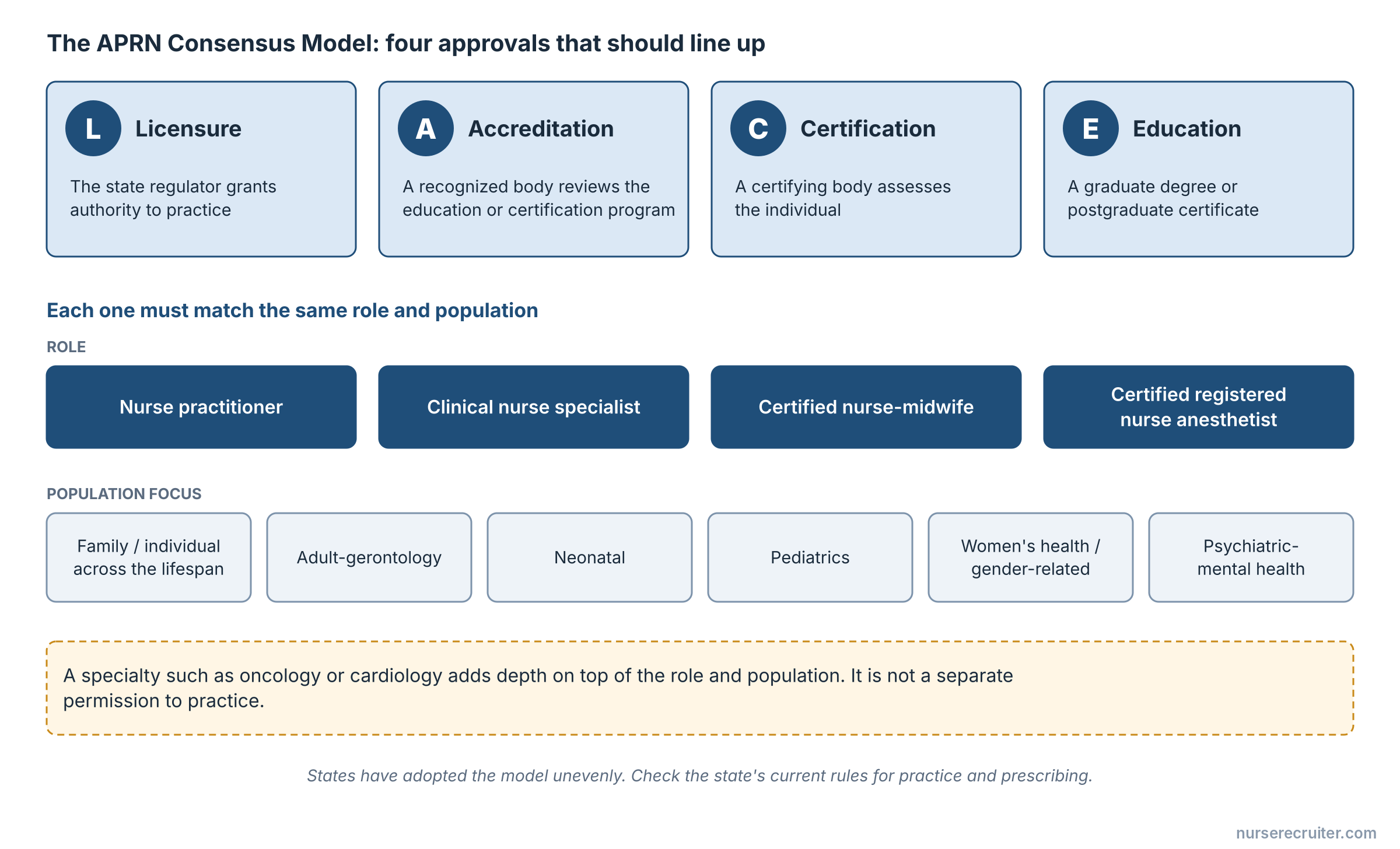
The model connects four decisions, often abbreviated LACE:
- Licensure: the regulator grants authority to practice.
- Accreditation: a recognized organization reviews an educational or certification program against its standards.
- Certification: a certifying body assesses whether an individual meets the credential's requirements.
- Education: a graduate degree or postgraduate certificate provides the formal preparation.
These decisions support each other but are not interchangeable. A program's accreditation is not an individual student's certification. Passing an examination is not the same event as receiving state authorization.
When evaluating an application, identify which organization owns each decision and which documents demonstrate completion.
Look for alignment in role and population
The model calls for education, certification and licensure to match the APRN's role and population focus. It recognizes nurse practitioners, clinical nurse specialists, certified nurse-midwives and certified registered nurse anesthetists.
A specialty such as oncology or cardiology adds depth within the underlying preparation. It does not replace that preparation with a new general permission to practice.
For a program comparison, write down the role and population each option prepares you for. Then identify the corresponding certification route and the state's requirements. The degree title alone may not answer those questions.
Separate the model's goals from current permission
The model supports independent practice and prescribing. NCSBN's current overview also explains that not every state has adopted every element.
Therefore, a statement that a role follows the Consensus Model does not establish the exact collaboration, prescribing or authorization requirements for a job. Those must be checked with the jurisdiction.
The same distinction matters when moving. Two clinicians can hold comparable education and certification while facing different state application or practice rules.
Use the framework to locate a mismatch
Suppose a job description asks for “any NP” but includes duties outside the candidate's documented population preparation. The model helps identify the question: do the requested services align with the person's education, certification and state authorization?
It does not settle the case without examining those records. Ask the program, certifier, board or employer for the part each controls, rather than treating one organization's answer as approval from all four.
Keep the records connected
Retain program documents, certification verification and state authorization together. When adding another population or moving jurisdictions, review the chain again.
See APRN roles and population foci for the categories and national certification and state licensure for managing the separate approvals.
Sources
- APRN Consensus Work Group and NCSBN: Consensus Model (accessed 2026-09-17) — pages 5–7.
- NCSBN: APRN Consensus Model—Current Overview (accessed 2026-09-17).