
National APRN certification and state permission to practice are separate decisions. A certifying organization evaluates its credential requirements; a state regulator determines whether an applicant meets that jurisdiction's requirements for practice.
The word “certification” can make this distinction confusing because a state may use it for its own authorization. Always identify who issued the credential and what it permits.
Separate the organizations and records
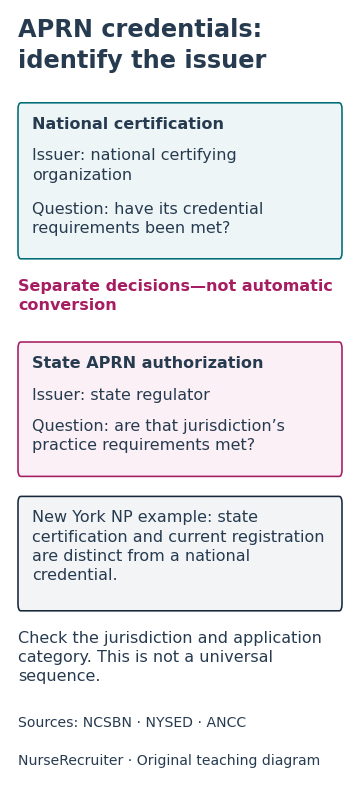
Track the issuer and current status of each credential. This comparison does not show a universal application sequence or replace checks of RN authorization and other permissions relevant to the work.
The APRN Consensus Model links licensure, accreditation, certification and education. It provides a framework for aligning them, but NCSBN notes that state implementation differs.
For an application or job change, create a record with separate entries for your RN authorization, national APRN certification, state APRN authorization and any additional permissions relevant to the work.
For each entry, record the issuing organization, current status, expiration or registration date and verification method. This makes missing requirements easier to see than a single list of initials.
Understand a state-specific terminology example
New York requires NPs to be certified and registered by the New York State Education Department. That state-issued NP certificate is distinct from certification by a national nursing organization.
New York also requires current RN and NP registration for NP practice. An enduring certificate should not be confused with current permission to work when registration has expired.
Its published education and experience pathways include qualifying education, acceptable national certification or comparable authorization in another jurisdiction, subject to the full requirements. This is why a national statement that every APRN follows one identical licensing route would be misleading.
Use the regulator's current instructions for your jurisdiction and application category.
Track testing and credential release separately
Passing an examination may be one step in a longer process. ANCC's FNP instructions, for example, distinguish authorization to test from certification issuance: all eligibility conditions, a passing result and the final degree-conferred official transcript must be complete before certification is released.
Then determine how the state receives the required certification verification. Do not assume that a preliminary result or screenshot is the document the regulator accepts.
Keep records of requests and receipts so you can identify whether a delay is with the school, certifier or regulator.
Plan a realistic start date
Ask the employer which approvals must be completed before orientation and which must be completed before patient care. Distinguish administrative onboarding from authorized clinical duties.
Check prescribing requirements and hospital privileges separately when they apply. A general employment offer does not resolve either question.
Build a contingency into relocation or scheduling plans if a credential remains pending. Ask the responsible organization directly when the application status is unclear.
Maintain the authorizations you use
A renewed state credential does not automatically renew national certification, and a renewed national credential does not complete a separate state application.
Review the relationship between them in the jurisdiction where you practice. Track education, practice-hour and documentation obligations for each.
When changing populations or roles, revisit the whole sequence. Formal transition planning helps identify which new education, certification and state approvals are needed.
Sources
- NCSBN: APRN Consensus Model (accessed 2026-09-17) — pages 5–12.
- NCSBN: APRN regulation (accessed 2026-09-17).
- NYSED: NP certification requirements (accessed 2026-09-17).
- ANCC: FNP certification (accessed 2026-09-17).