
Verify a specialty credential with its issuer. A résumé tells you what a nurse reports holding; the issuer's verification tells you what its records show about that specific certification.
Start by identifying the exact credential and issuer. Similar abbreviations, old credentials and multiple certifications can make an informal search ambiguous. Keep this check separate from verification of the nursing license.
Match the person and the credential
Ask for the name used in the certification record, credential designation and any identifier the issuer requires. A name change may explain a failed search; it should trigger clarification rather than an immediate conclusion that the credential is false.
Match the result to the requested specialty. If a job requires one certification, confirmation of another certification from the same organization does not answer the question.
Record the status and relevant dates shown, the verification date and the source used. If the issuer supplies an official verification document, preserve that document in the appropriate credentialing record.
Use the issuer's verification process
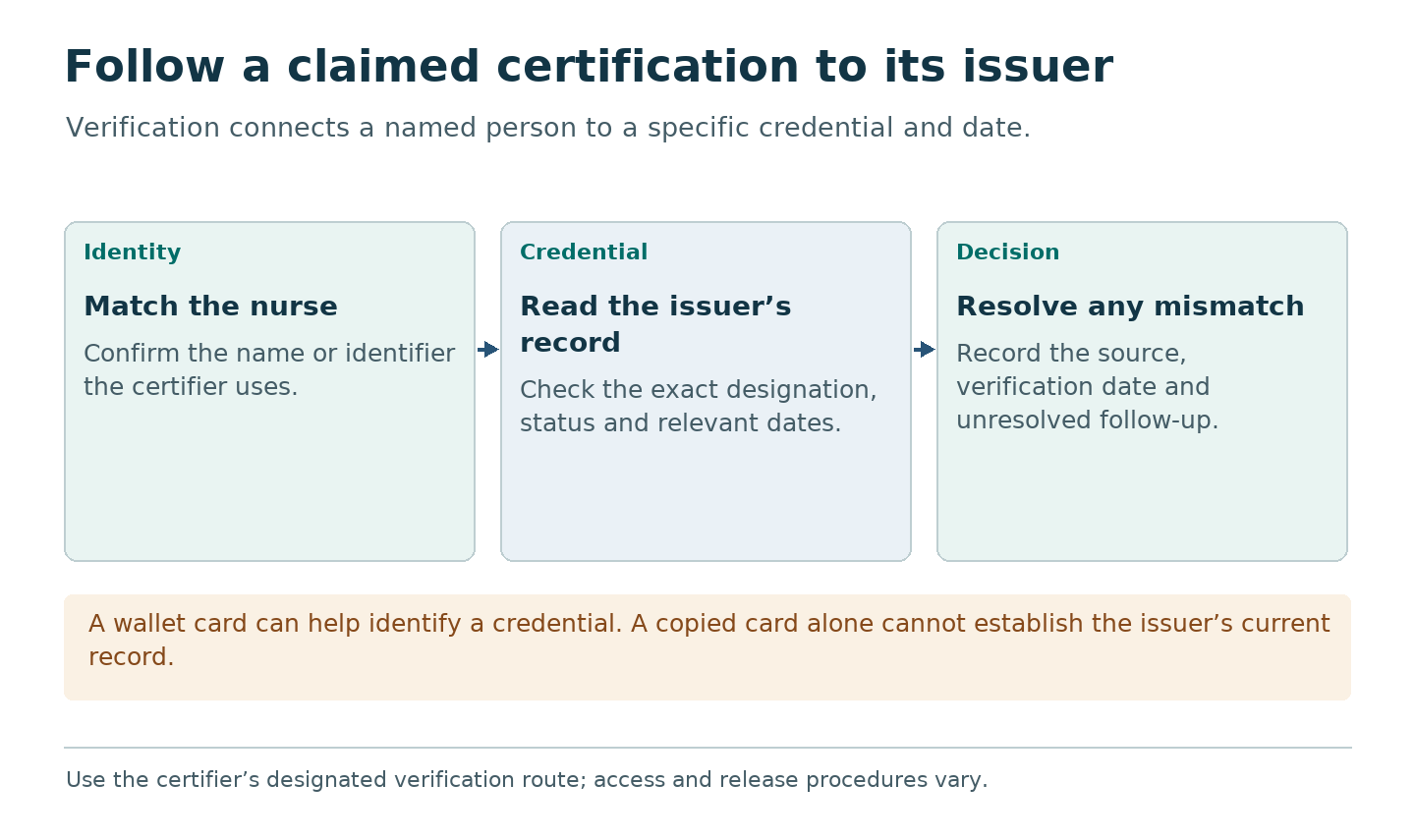
ANCC provides primary-source verification and discourages employers from relying on photocopies of wall certificates or wallet cards because those copies can be altered. It also directs users to verify each certification separately when a nurse holds more than one.
BCEN describes two routes: a linked digital badge that displays the credential's status and dates, and a credential-verification request initiated by the nurse and sent to the employer. A downloaded badge image alone does not provide the same current information as opening its verification link.
Follow the current instructions on the issuer's own site. Avoid reconstructing an official-looking verification from a screenshot, old email or résumé entry.
Resolve discrepancies before making the credentialing decision
An expired date, unmatched name or missing result needs a specific follow-up. Ask whether the nurse renewed, changed names, holds a different credential or selected a nonactive status.
Request clarification from the certifying organization when the result remains unclear. Keep “not yet verified” separate from “verified as expired” in your notes. Those are different findings and should not be collapsed into an accusation.
When the job depends on an active certification, have the responsible credentialing team resolve the discrepancy before treating the requirement as satisfied.
Check again when the record changes
A verification is a record of what was checked at a particular time. Save the expiration date and build a reminder appropriate to the employer's credentialing process.
If the nurse reports a renewal, verify the updated record rather than merely replacing the old certificate image. If the status is retired, inactive or lapsed, examine the issuer's rules for that status; retired recognition should not be entered as active certification.
Keep the result narrowly worded: identify the credential that was verified, its status and the verification date. Do not turn one successful specialty check into a statement that all licensing, education and employment requirements have been met.
Sources
- ANCC: Certification Verification (accessed 2026-09-17).
- BCEN: Verify Certification (accessed 2026-09-17).