
Primary-source verification checks a nursing credential against the licensing authority's records or a service the authority recognizes. It answers a more useful question than whether an applicant can produce a license card: what authorization does the current record show, and does it cover the proposed work?
Participating boards designate Nursys as a primary source equivalent. A board's own verification system can also provide primary source information. California, for example, identifies its Department of Consumer Affairs lookup as carrying records from the Board of Registered Nursing.
Start with the credential and the person
Ask which license type and jurisdiction the job requires. An RN license, an advanced practice credential and a specialty certification are separate items to verify. Avoid a single checklist box labeled “nursing credentials” that can be completed after checking only one of them.
Use the nurse's name, license number and issuing jurisdiction to locate the record. Compare the result with the applicant's identity information through the organization's established process. A matching name alone is a weak basis for deciding that a record belongs to the person being hired.
For a compact assignment, check whether the license is single-state or multistate and whether the proposed practice location is covered. The broader framework is explained in the Nurse Licensure Compact.
Read the whole result
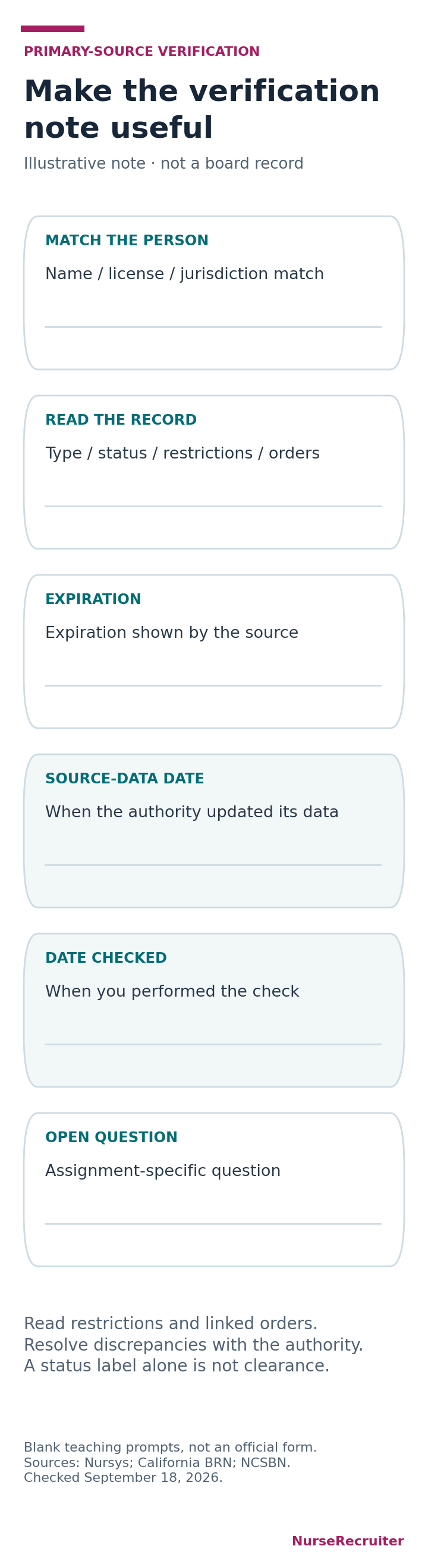
Illustrative verification note, not a board record. These blank prompts are an editorial worksheet, not an official form or a determination of practice authority. Follow the source’s terms and the organization’s credentialing process.
A useful verification note records the source, date checked, identifying details, license type, status, expiration date and any relevant restrictions or linked orders. Keep documentation through an approved credentialing process that respects the source's terms of use.
Do not stop at the word “active.” Read any accompanying restriction or disciplinary document before deciding whether the nurse can perform the particular assignment. Equally, do not treat a document alleging misconduct as if it were a final decision.
Check the date of the underlying data as well as the date of your search. Nursys publishes information submitted by boards; looking at the page today does not mean every board updated its records today. California likewise warns that posting delays or errors are possible.
Resolve discrepancies before clearing the assignment
A missing result needs investigation. Check spelling, prior names, license type and jurisdiction. Nursys explains that records may be absent because of participation or reporting issues, including newly issued licenses. Contact the issuing board when the record is missing, stale or inconsistent.
Describe the unresolved question precisely: “The board shows a renewal pending; we need confirmation of authorization for the proposed start date.” That gives the nurse and credentialing team something concrete to resolve without making an unsupported accusation.
Choose the service for the task
Nursys QuickConfirm supports license lookup. Its license verification for endorsement service serves a different purpose: transmitting verification for an application to another board. An employer's lookup should not be assumed to satisfy a nurse's endorsement application.
After the initial check, Nursys e-Notify can support ongoing monitoring. Assign someone to review alerts and unresolved discrepancies; collecting a notification is only useful if somebody acts on it.
Sources
- Nursys QuickConfirm terms and data explanations (accessed 2026-09-17).
- California Board of Registered Nursing: License Verification (accessed 2026-09-17).
- NCSBN: License Verification with Nursys (accessed 2026-09-17).