
Structure, process and outcome measures describe different parts of healthcare quality. The classification is associated with Avedis Donabedian. A structure measure concerns the capacity or arrangements for care, a process measure concerns what is done and an outcome measure concerns the result for patients.
Three questions about the same service
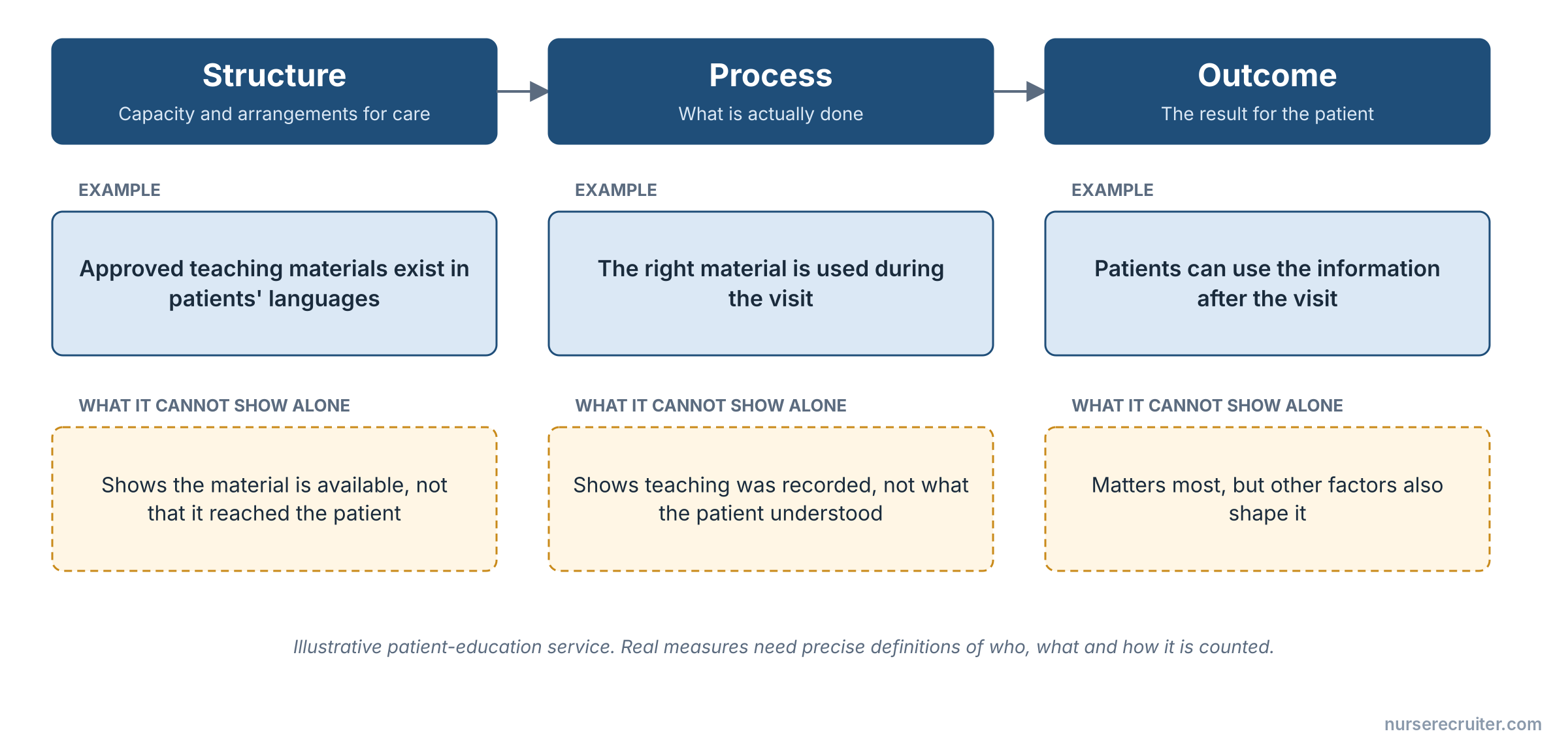
Consider an illustrative nursing education service. Whether the service has access to approved materials in patients' languages is a structural question. Whether the appropriate material is actually used during a visit is a process question. Whether patients can use the information after the visit concerns the intended result.
The categories can help a team discover a mismatch between its claim and its evidence. Having material available does not show that it reached the patient. Recording that teaching occurred does not by itself show what the patient understood.
Real projects need more precise definitions than these examples. They also need to explain how the selected measure relates to the clinical or service goal.
Why one category is not enough
An outcome can matter greatly while being influenced by factors beyond a single team. AHRQ cautions that patient outcomes reflect multiple influences and that comparisons can be misleading without attention to differences in the populations receiving care.
That does not make outcome measurement unhelpful. It means a result needs interpretation. A team examining a readmission rate, for example, should not assume that every change is caused by its discharge teaching. Access to follow-up, differences in illness and other conditions may also matter.
Process measures can be closer to what a team controls, but they are valuable only when the process itself has a sound rationale. Making a low-value activity more consistent is not automatically an improvement in care.
Translate labels into definitions
For each selected measure, write down the population, source of data, collection period and handling of missing information. For a proportion, define the numerator and denominator separately.
Imagine that a clinic reports 90 completed education records out of 100 visits. That is 90% documentation completion under the stated definition. It should not be described as a 90% patient understanding rate unless understanding was actually assessed. These numbers are hypothetical; the distinction is the point.
Use the categories in a project discussion
Ask what each measure can and cannot establish. If the team wants to claim that a new program improved patients' experience, structural readiness and attendance figures are supporting information, not a substitute for evidence about experience.
Pair this classification with balancing measures, which examine unintended consequences of a change. The two frameworks serve different purposes: one locates what is measured in the care system, while the other helps assess whether an improvement has costs elsewhere.
See also patient experience and nurses.
If a process or outcome rate differs between groups, consider how the comparison was defined.
Sources
- AHRQ — Types of Health Care Quality Measures (accessed 2026-09-17).
- IHI — Establishing Measures (accessed 2026-09-17).