
Shared decision-making brings clinical information and the patient's priorities into a conversation about care. It involves exploring the available options, discussing benefits and harms, and considering what fits the person's goals and circumstances.
AHRQ's SHARE approach provides a framework for that dialogue. It centers both the options and what matters to the patient.
Use the framework as a conversation
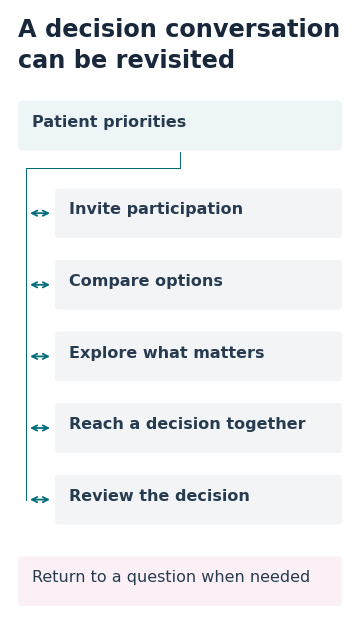
An original visual summary of AHRQ’s SHARE approach. Elements may be revisited rather than followed as a rigid sequence.
The revised SHARE conversation guide describes five elements that can be used in different orders and revisited:
- Seek: invite the patient to participate.
- Help: explore and compare the options.
- Assess: learn the patient's values and preferences.
- Reach: work toward a decision together.
- Evaluate: review the decision and whether the plan is workable.
These elements do not require rushing through five boxes during one encounter. A question that emerges late in the discussion may require returning to an option or clarifying a priority.
Make the nursing contribution explicit
AHRQ describes a team approach that can include nurses, health coaches and case managers. A useful nursing contribution is to make sure the patient's questions and priorities reach the clinician responsible for the decision.
Before the discussion, consider helping the patient identify:
- Which decision they understand is being considered.
- What they already know and what is unclear.
- Which benefit, burden or practical issue matters most.
- Whom they want involved in the conversation.
- What further explanation they need.
Use these as preparation prompts, adapting them to the encounter and your role. They are not a checklist for independently recommending an option outside your scope.
Know what a decision aid adds
A patient decision aid compares options and helps a person clarify their goals and preferences. AHRQ distinguishes this from general information about a condition or procedure. A good aid presents options fairly instead of steering everyone toward one treatment. Its content also needs to remain current.
Before introducing an aid, confirm its intended decision, audience and review date through the organization's process. Check that the patient can use its language and format. Give them an opportunity to discuss it; handing over a document should not be recorded as the entire shared decision.
Carry unresolved questions forward
In this fictional handoff, a nurse records: “Patient would like further explanation of the recovery time associated with the options discussed. Work responsibilities are a priority. Question sent to the treating clinician; decision discussion remains open.”
This note identifies the question, why it matters and who will address it. It does not imply that the nurse selected a treatment or that the patient consented to one.
After a decision, clarify the agreed next step and how questions or changes will be reviewed. AHRQ also suggests asking patients whether options, risks, benefits and preferences were actually discussed when evaluating the process.
Related methods include communicating health numbers and teach-back.
Sources
- The SHARE Approach (accessed 2026-09-17) — AHRQ.
- SHARE Conversation Starters (accessed 2026-09-17) — AHRQ, October 2024.
- Strategy 6I: Shared Decisionmaking (accessed 2026-09-17) — AHRQ.