
Teach-back is a conversation in which a patient or caregiver explains important information in their own words. Its purpose is to check whether the clinician's explanation was clear. Repeating a phrase from a handout, answering “yes” to “Do you understand?” or completing a memory quiz does not serve the same purpose.
For nurses, teach-back offers a specific way to explore what a person understands about an agreed plan. It should be used respectfully, with attention to the patient's communication needs and the task being discussed.
Plan the question around one action
Choose the point that needs checking rather than asking someone to repeat an entire visit. AHRQ identifies new diagnoses, medicines, devices and home-care instructions as useful situations for teach-back. Its primary-care implementation resources include training materials, role-play scenarios and practical aids.
An original example for appointment planning is: “I want to check that I explained the next step clearly. How will you arrange the follow-up visit?” This asks for the person's understanding while making the clinician responsible for the clarity of the explanation.
The question should match the actual care plan. Do not use a generic script that introduces an instruction the clinical team has not given.
Listen, clarify and check again
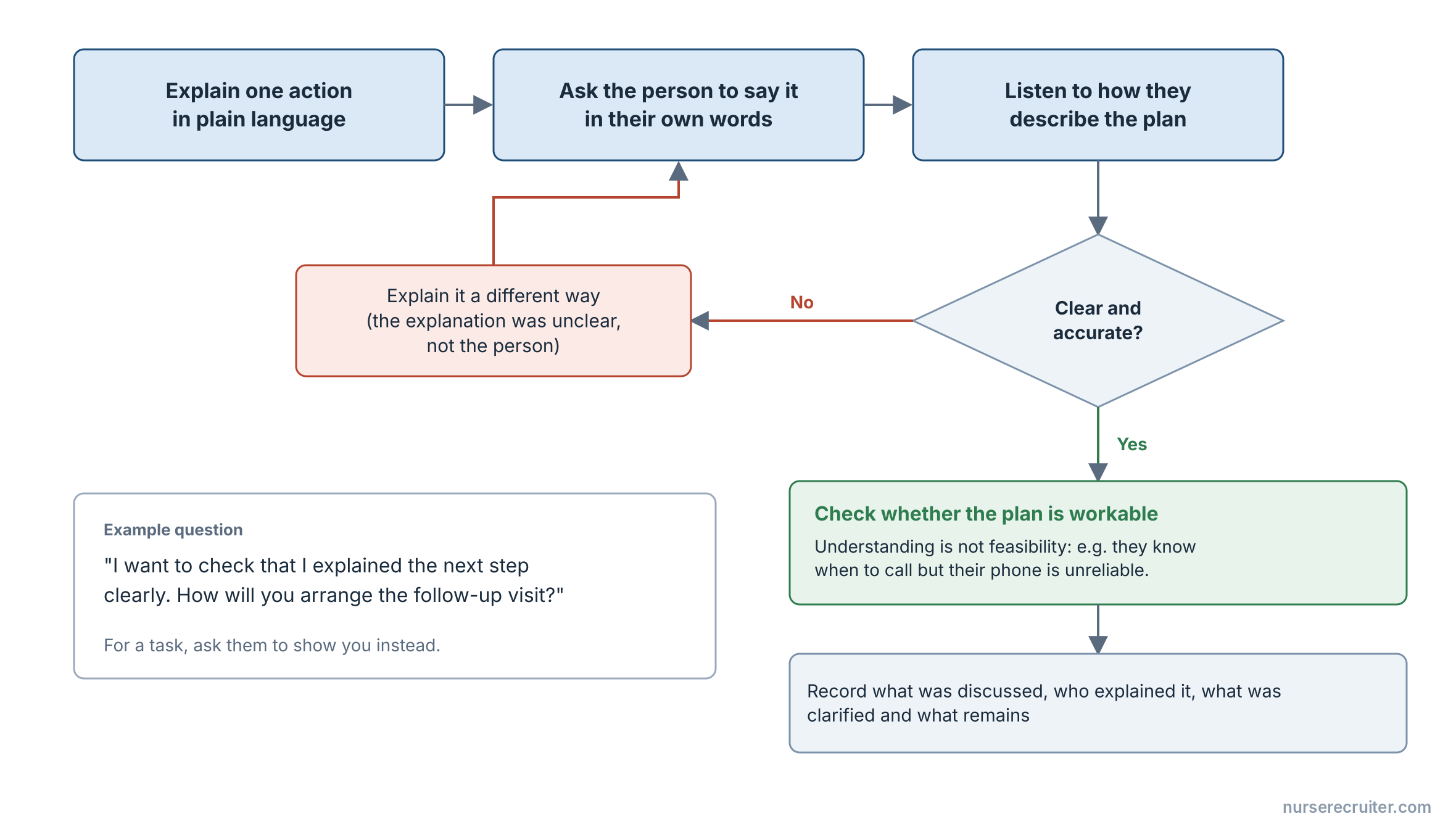
Listen for how the person describes the plan. If the explanation reveals a misunderstanding, use a different explanation and invite another teach-back. AHRQ also describes a related “show-me” approach for tasks that involve a demonstration. Patients may refer to written materials; the aim is meaningful understanding, rather than unaided recall.
Keep the response supportive. Avoid presenting an incorrect answer as a personal failure. If the conversation uncovers an unresolved clinical question, seek clarification through the appropriate care-team process instead of improvising a new plan.
Distinguish understanding from feasibility
In a fictional example, a patient accurately describes when to call a clinic but explains that their telephone service is unreliable. Teach-back has clarified understanding; the practical barrier still needs attention. Agree on an appropriate way to address that barrier and identify who will follow through.
Similarly, a caregiver's clear explanation should not be recorded as the patient's demonstration when they are different people. Be precise about who participated and what was checked.
Make the record useful
A suggested note structure is: the information discussed, the participant's explanation or demonstration, clarification provided and any remaining question or barrier. Follow local documentation requirements. Avoid an isolated “teach-back done” checkbox when the next clinician needs to know what remains unresolved.
A team introducing the method can practice with a nonclinical example, observe how questions are phrased and discuss whether the response led to a clearer explanation. Training should assess the communication process without claiming that a single successful conversation guarantees adherence or a clinical outcome.
See health literacy for the wider organizational approach and plain language for preparing an understandable explanation.
Sources
- Use the Teach-Back Method: Tool 5 (accessed 2026-09-17) — AHRQ, third-edition toolkit.
- Teach-Back: Guide to Improving Patient Safety in Primary Care (accessed 2026-09-17) — AHRQ.