
Plain language means shaping a message for the people who need to use it. In nursing communication, that includes choosing understandable words, organizing information around the patient's task and explaining what should happen next.
CDC's plain-language checklist emphasizes knowing the audience and purpose, placing the main message first, using active voice and organizing information into useful sections. AHRQ's clear-communication guidance adds listening, concrete explanations, appropriate pacing and checking understanding.
Begin with the reader's task
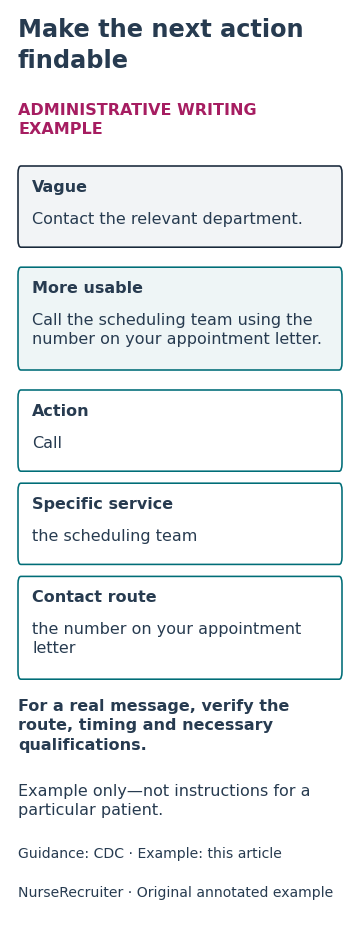
The revision makes three details findable. It still needs a verified route, relevant timing and any qualifications before use in a real message.
Before editing individual words, state the purpose of the message. Is the reader preparing for a visit, arranging a service or learning whom to contact? Put the information needed for that task ahead of background detail.
An original administrative example illustrates the difference:
| Vague message | More usable wording |
|---|---|
| “Please facilitate follow-up as appropriate.” | “Call the clinic to arrange the follow-up visit.” |
| “Contact the relevant department.” | “Call the scheduling team using the number on your appointment letter.” |
| “Bring pertinent documentation.” | “Bring the referral letter you received.” |
These are writing examples, not instructions for any particular patient. A real message also needs verified contact details, timing and any necessary qualifications from the responsible service.
Keep the meaning intact
Replacing jargon is only part of the work. Read the original instruction for conditions, exceptions and responsibility. A shorter sentence can still be incomplete if it omits who should act or when.
For a useful review, underline the action, circle the person responsible and check that any necessary time or place is clear. If the draft contains contradictory instructions, ask the clinical owner to resolve them before rewriting. Do not choose between conflicting care instructions solely to make the text read smoothly.
When a technical term matters, explain it rather than avoiding it at all costs. AHRQ recommends using familiar words and defining medical terminology when the patient needs to learn it. Avoid substituting an imprecise everyday word that changes the clinical meaning.
Review the message in its real format
Read the final letter, screen or handout, not only the text in an editing document. Check whether the main action is visible, whether headings describe their sections and whether a list represents a sequence or a set of choices.
A suggested review exercise is to ask someone unfamiliar with the draft to identify the next step and the contact for questions. Record what they could not find, then revise the message and check again. This is a usability exercise; a favorable response from one reader does not prove that every patient can use the material.
For a conversation, pair a clear explanation with teach-back. For written information, distinguish plain-language editing from readability scoring and a complete materials assessment.
Sources
- Plain Language Materials & Resources (accessed 2026-09-17) — CDC.
- Communicate Clearly: Tool 4 (accessed 2026-09-17) — AHRQ.