
Health numeracy is the ability to work with numbers used in health information and decisions. A person may need to interpret a measurement, compare a chance of an outcome or work out when an appointment takes place.
CDC describes numeracy in terms of accessing, using, interpreting and communicating mathematical information. It also notes that the surrounding environment can be adapted to support people's skills. In nursing communication, that means examining how a number is presented and what the patient is expected to do with it.
Start with the task, then explain the number
Before presenting a number, identify its purpose. Is the patient comparing options, reading an instruction, tracking a measurement or arranging a visit? Include the unit, timeframe and relevant context.
AHRQ's guidance recommends making unfamiliar numbers meaningful, asking about preferred measurement systems and using everyday language. It also recommends checking understanding, including when numbers appear in a chart or picture.
A useful preparation check is:
- What does this number measure?
- What unit and timeframe belong to it?
- What comparison, if any, is needed?
- What action has the care team actually recommended?
- Can the patient use the format provided?
Do not add an action threshold from memory merely to make an explanation feel complete. Confirm the appropriate patient-specific instruction through the clinical team.
Remove avoidable conversion work
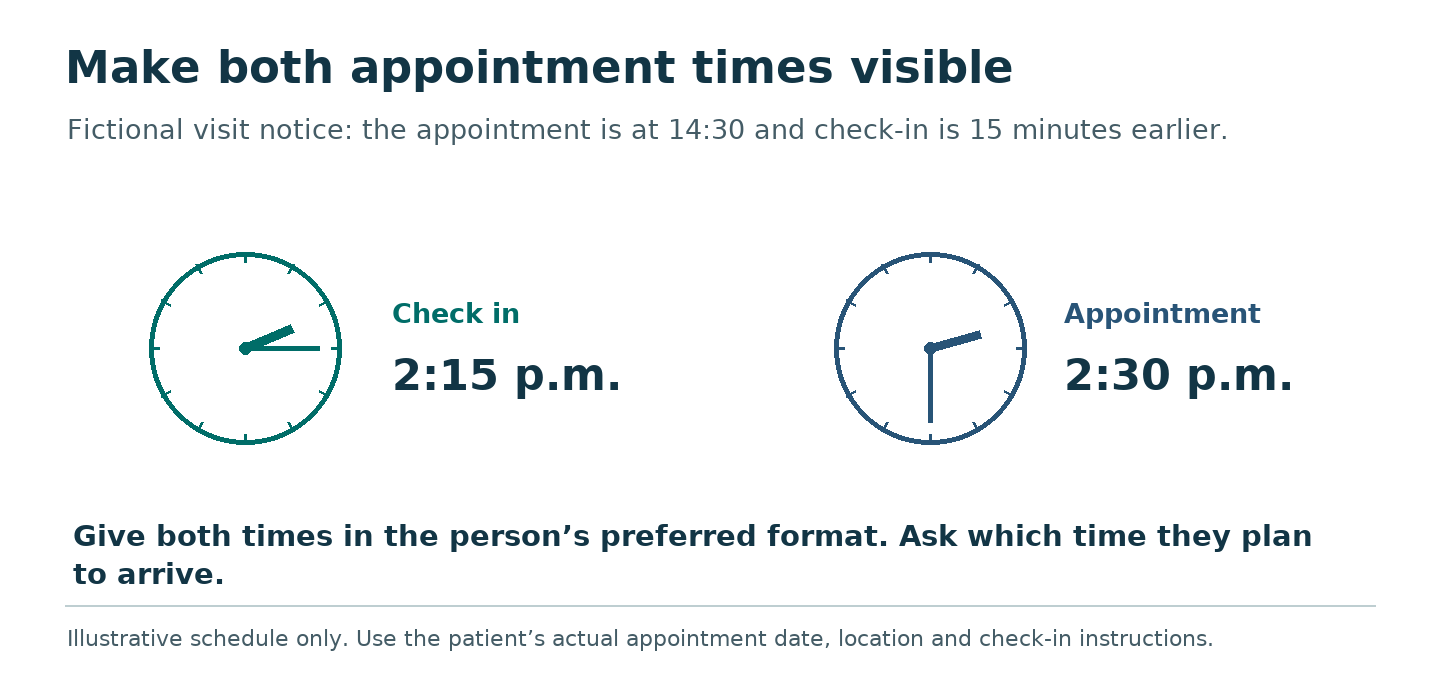
Consider a fictional appointment notice: the visit is at 14:30, and check-in is 15 minutes earlier. A patient who prefers a 12-hour clock can receive both times plainly: “Your appointment is at 2:30 p.m. Please check in at 2:15 p.m.”
The calculation is simple, but the communication improvement is practical: the patient does not have to convert the clock and subtract the interval at the point of use. Confirm the actual appointment date, location and instructions before using such wording in care.
Apply the same review to forms and handouts. Look for unexplained abbreviations, mixed measurement systems or numbers separated from their units.
Use visual displays deliberately
AHRQ recommends probability visuals that show the part and the whole, with accompanying text. Before choosing an icon array or chart, ask what specific comparison it should make easier.
Do not assume a picture explains itself. Identify what an icon represents, what the highlighted portion means and what group or timeframe is shown. If the display is inaccessible to the patient, provide another usable format.
Check the explanation without testing the person
Invite the patient to explain how they will use the information. For the appointment example: “To check that I explained the times clearly, what time will you plan to check in?” If the answer differs, clarify the notice and check again.
Record the useful support provided rather than making an unsupported judgment about the person's mathematical ability. For comparisons of treatment outcomes, see risk communication. For the broader communication framework, see health literacy in nursing.
Sources
- Understanding Literacy & Numeracy (accessed 2026-09-17) — CDC.
- Communicating Numbers to Your Patients (accessed 2026-09-17) — AHRQ, October 2024.