
Risk communication helps a patient understand possible benefits and harms in a form they can use. For nurses, the task includes making the comparison clear, identifying unanswered questions and connecting the patient with the clinician who can interpret the information for their situation.
FDA's discussion of medication communication emphasizes presenting both benefits and risks. It also recognizes that some safety problems become apparent only after longer use in a broader population. A risk explanation should leave room for those limits in knowledge.
State the outcome and the comparison
A number needs a named outcome, a population and a timeframe. “The risk is lower” leaves too much unspecified.
CDC recommends numerical absolute risks and consistent denominators and timeframes when comparing outcomes. Descriptive words alone, such as “low,” do not supply the size of a chance.
Before explaining a comparison, check:
- What event is being counted?
- Which groups or options are compared?
- Over what period?
- Where did the estimate come from?
- Which question does the patient want the estimate to answer?
These questions are a communication review, not a method for calculating an individual's clinical risk.
Show absolute size before a relative change
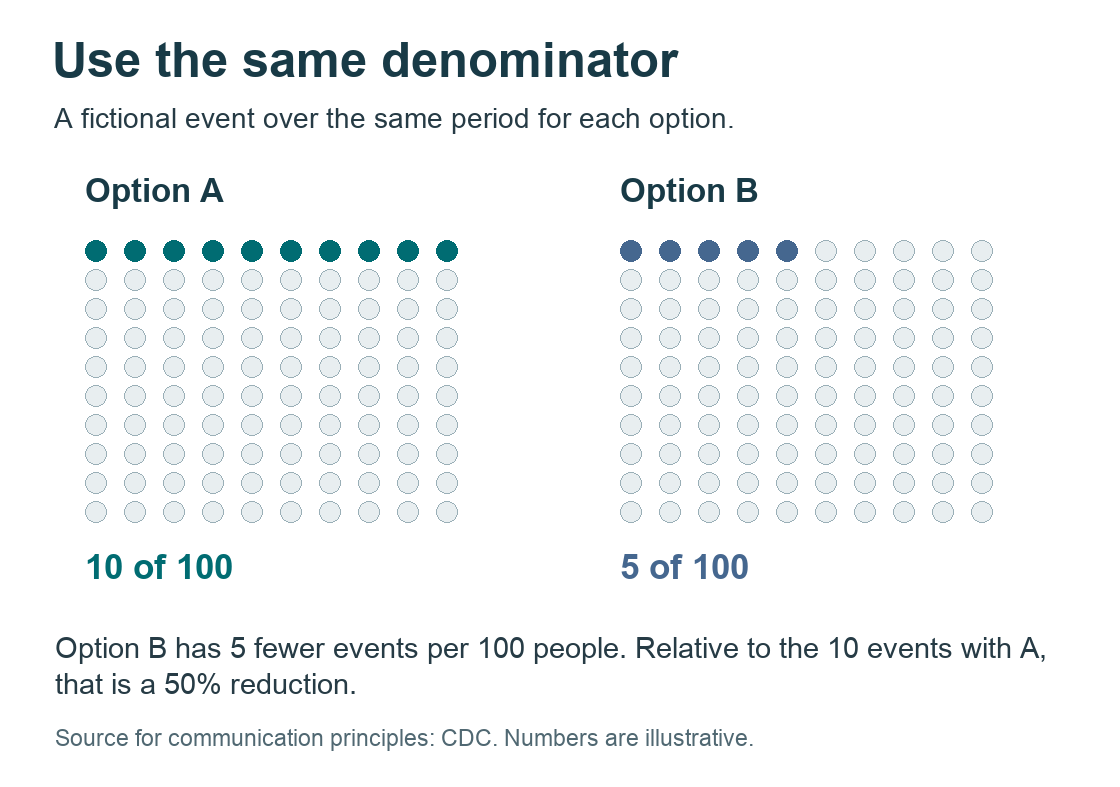
Each filled dot represents one event. The numbers illustrate communication, not a treatment effect.
The following numbers are fictional and demonstrate arithmetic only. They describe no treatment or real patient group.
Suppose an event occurs in 10 of 100 people with option A and 5 of 100 with option B over the same period.
| Description | Calculation |
|---|---|
| Absolute difference | 5 fewer people out of 100, or 5 percentage points |
| Relative reduction | 5 divided by 10, or 50% |
| People without the event | 90 of 100 with A; 95 of 100 with B |
“50% lower” and “5 fewer out of 100” describe the same fictional comparison. The absolute numbers make the size of that comparison visible. This table does not establish why the groups differed or show that option B caused the difference.
Put the patient's question back into the discussion
After explaining a number, ask what it means to the patient and what remains unclear. A patient may want to discuss the burden of an outcome, the uncertainty in an estimate or how the evidence relates to their situation.
If that question requires clinical interpretation beyond your role, communicate it to the responsible clinician. Do not fill the gap with a reassuring percentage that was never established for this patient.
Record the source and the remaining decision
A practical note can identify the aid or approved information used, the topic discussed and the question sent for follow-up. Avoid documenting “understands all risks” solely because information was handed over.
Check that patient-facing materials use the same outcome labels and timeframes as the explanation. See health numeracy, communicating uncertainty and shared decision-making for complementary methods.
Sources
- Guidance & Tools: Explain Risk and Numbers (accessed 2026-09-17) — CDC.
- Communicating Benefit and Risk Information (accessed 2026-09-17) — FDA.