
Prior learning assessment evaluates whether learning outside a program satisfies a specific academic requirement. The emphasis is on demonstrated learning and the receiving institution's criteria. Time spent in a job is not, by itself, a statement of which course outcomes have been met.
The American Council on Education evaluates certain nontraditional learning experiences and issues credit recommendations. Those recommendations can inform a college's decision, but the college or university decides whether to award credit. A recommendation, badge, or training certificate should not be confused with a nursing degree or license.
Identify what is being evaluated
Ask the school which forms of prior learning it will consider for the intended program. Possible questions concern formal training, examinations, documented military learning, or other evidence the institution accepts. Do not assume that a method available in one department is available for required nursing courses.
Find out whether the decision grants credits, waives content, satisfies an elective, or changes placement in the curriculum. Also ask how the result appears on the transcript and whether fees apply even when no credit is awarded. Those details should come from the institution's current policy.
Build evidence around outcomes
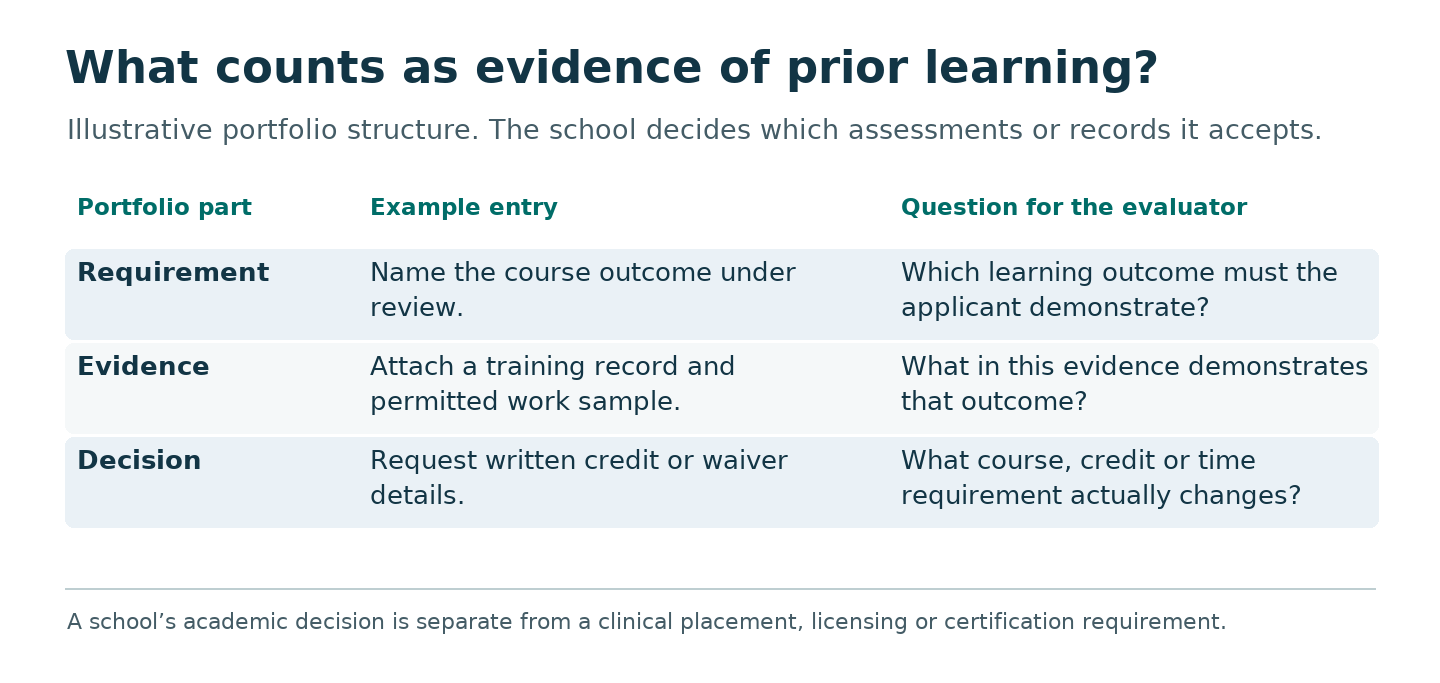
A useful submission connects the prior learning to a specific requirement. Provide the documents the school requests, such as a training record, syllabus, examination record, or portfolio. Explain what was learned and how the evidence shows it. Avoid substituting a long description of responsibilities for evidence of the required knowledge or skill.
For illustration, a fictional applicant completed an evaluated workplace training course. The applicant locates its exact title, provider, completion date, and credit recommendation, then asks the nursing program whether that learning can satisfy a particular requirement. The program may accept it, apply it differently, or decline it under its policy. The example does not promise a credit award.
Preserve clinical and credential distinctions
Academic recognition of experience does not automatically satisfy a licensing or certification requirement. One important specific example is ANCC's post-graduate APRN certification guidance: work experience cannot replace the faculty-supervised clinical hours needed for certification eligibility. That rule should not be broadened into a statement about every academic program, but it is a reason to check the credential's own requirements.
A nurse pursuing a new role should therefore ask both the school and the relevant credentialing authority which requirements must be met. An academic adviser cannot change another organization's eligibility rules.
Calculate the practical benefit
Before paying for an assessment, ask what successful recognition would actually change. It may reduce a course requirement, create elective credit, or leave the program sequence unchanged. Compare the assessment effort and cost with the remaining program plan using confirmed information.
Retain the decision and supporting documents. If a later transfer is possible, ask the next institution how it treats prior-learning credits. Acceptance in one program should not be represented as a guarantee of acceptance elsewhere.
Related
Transfer Credits in Nursing Education · Post-Master’s Nursing Certificates.
Sources
- American Council on Education: Credit for Prior Learning for Colleges and Universities (accessed 2026-09-17).
- American Council on Education: Learners Seeking Credit (accessed 2026-09-17).
- ANCC: Certification FAQs, Post-Graduate Certificates (accessed 2026-09-17).