
Transfer credit is credit a school accepts for learning completed elsewhere. For a nursing student, the important question is not only how many credits are accepted, but which remaining requirements those credits satisfy. Credit accepted as an elective may not replace a prerequisite or a required nursing course.
Institutions make their own credit-award decisions. The American Council on Education advises learners to consult the college or university directly about its policies. A previous school's assurance that coursework is transferable does not establish the receiving nursing program's decision.
Distinguish the decisions
A course can be accepted for general university credit, judged equivalent to a specific requirement, or considered insufficient for that requirement. These outcomes can have different effects on the remaining program of study.
As one concrete graduate-level example, the University of Washington School of Nursing distinguishes course equivalency from credit substitution. Equivalency can waive the need to repeat required content without granting credit; substitution applies prior credits toward the required total within university limits. That is UW's policy, not terminology every school must use.
Ask for a requirement-by-requirement evaluation
Prepare official transcripts and retain the syllabus or course description from the time the course was taken. Ask the receiving institution which documents it requires and whether an initial evaluation is provisional or final. A course title alone may not explain its content, level, laboratory component, or learning outcomes.
Useful questions include:
- Which exact requirement does each accepted course satisfy?
- Does a minimum grade or course-age rule apply?
- Are laboratory and clinical components reviewed separately?
- Does the decision change the course sequence or only the credit total?
- Who can review a disputed equivalency decision?
These questions help establish the applicable policy without assuming a universal transfer limit.
An illustrative outcome
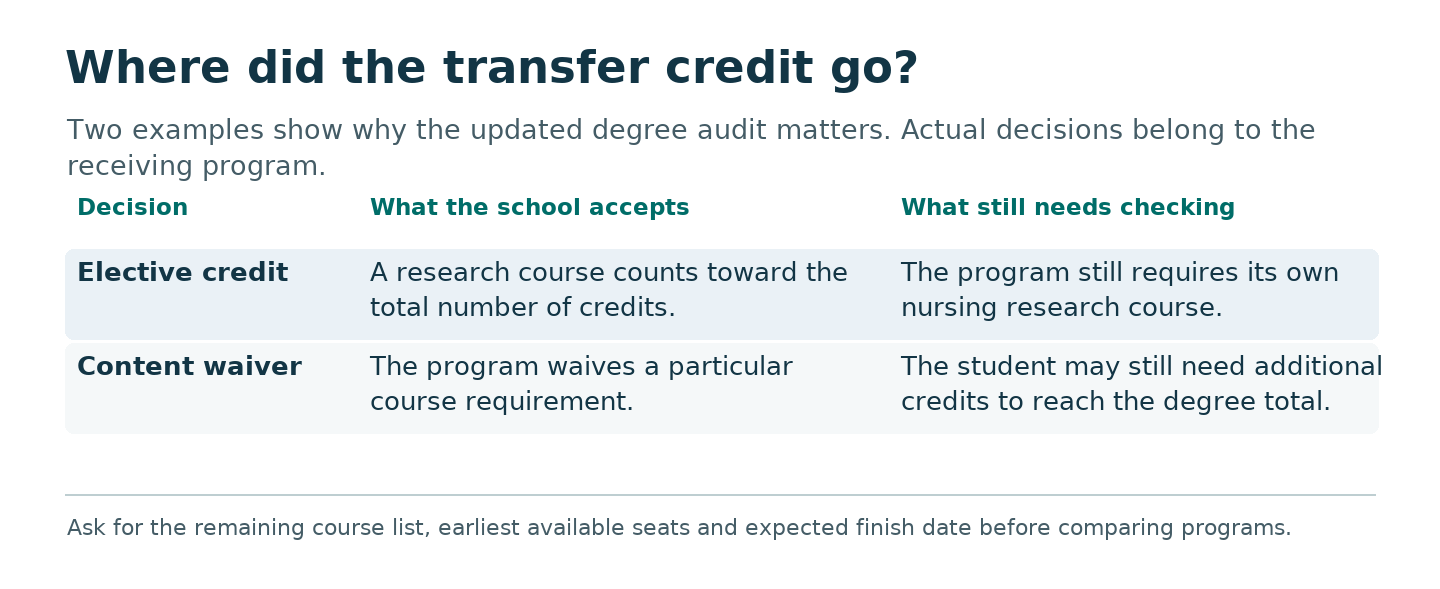
A fictional applicant has completed a research course. The receiving program accepts its credits as electives but still requires its own nursing research course. The applicant has gained accepted credits, but the required course remains. Another applicant may receive a content waiver yet still need additional credits to reach the degree total.
Both examples illustrate why “all credits accepted” can be an incomplete answer. Ask for the updated degree audit or program plan showing what remains to be completed.
Plan before committing
Request an estimated timeline based on the actual evaluated record. A reduced number of credits does not necessarily shorten the program if required courses are offered in sequence or only at particular times. Confirm the institution's own schedule rather than assuming a specific time saving.
If moving between nursing programs, ask separately about admission, standing, clinical coursework, and eligibility for the intended licensure pathway. Credit evaluation is not the same decision as nursing-program admission. Keep the written evaluation and the policy version used so that later planning is based on the same information.
Related
Prior Learning Assessment in Nursing · Part-Time Nursing Programs.
Sources
- American Council on Education: Learners Seeking Credit (accessed 2026-09-17).
- University of Washington School of Nursing: Course Equivalency and Credit Substitution (accessed 2026-09-17).