
A part-time nursing program schedules required study differently from its full-time option. The label alone does not tell an applicant when classes or clinical experiences occur, how much preparation is expected, or whether the schedule fits an existing job.
The most useful comparison is a complete program calendar, including prerequisites, classroom work, laboratory sessions, placements, examinations, and breaks. “Part-time,” “evening,” “weekend,” and “online” describe different features and should not be treated as synonyms.
Check the real schedule
Ask for the planned schedule for each term and identify which portions are fixed and which may change. Inquire about early starts, travel between sites, mandatory on-campus events, and the notice given for clinical assignments. Confirm whether a final preceptorship follows the preceptor's schedule.
A concrete example shows why this matters. Seminole State College's part-time nursing A.S. option is described as seven semesters, but the college says lecture, laboratory, and clinical schedules vary. It tries to arrange weekend clinicals for part-time students and explicitly does not guarantee them. That is one institution's published arrangement, not a rule for every part-time program.
Distinguish duration from weekly demand
A longer overall program does not establish that every week will be light. Ask how coursework and placements are distributed, including terms that combine several requirements. Review expected preparation time with the program rather than relying only on the number of hours physically spent in class.
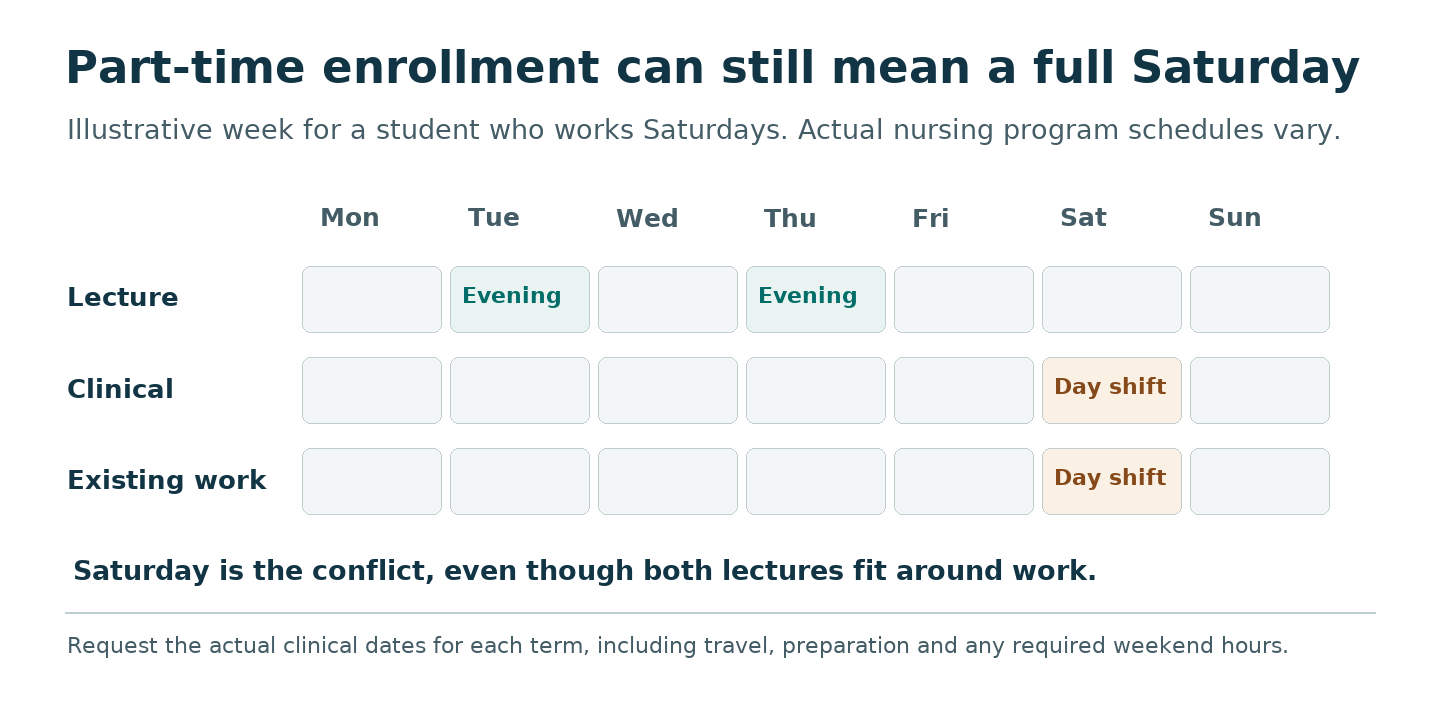
For illustration, a fictional applicant can attend evening lectures but works every Saturday. A course described as evening and weekend may still conflict with that job. The applicant needs the actual clinical schedule and a realistic plan for changing work commitments before accepting a place.
The example does not imply that employed students cannot succeed. It shows that compatibility depends on the specific schedule and available support.
Compare the whole path
Confirm the award and intended licensure pathway, the program's current approval and accreditation status, and whether the part-time option has the same admission or progression rules as other tracks. Ask for completion and examination outcomes specific to the option when available.
Obtain a written estimate of tuition and required fees across the full plan, including prerequisite courses and any additional terms. Ask the financial aid office how the proposed enrollment pattern affects the aid being considered; do not assume that a smaller course load produces a proportional reduction in every cost.
Plan for interruption
Review the policy for repeating a course, taking leave, and returning to the sequence. Ask when the next required course would be available and whether reentry depends on capacity. These details may matter as much as the advertised completion time.
A good decision rests on a schedule the applicant can explain, a current list of requirements, and clear answers about foreseeable conflicts. The part-time label is a starting point for those questions, not their answer.
Related
Nursing Program Graduation Rates · Transfer Credits in Nursing Education.
Sources
- Seminole State College: Traditional Nursing A.S. Program (accessed 2026-09-17).