
A program completion rate is the share of an entering group that finishes within a specified period. The number is meaningful only when the starting group, time limit, and treatment of students who leave or return are clear. It answers a different question from the proportion of examination candidates who pass NCLEX.
A college-wide graduation rate may also describe a different population from students admitted to the nursing sequence. Before comparing programs, determine exactly which students each published figure includes.
Define the beginning and the endpoint
ACEN's current Standard 5 asks programs to calculate on-time completion for each program option from the first nursing course through completion of the required courses. Its August 2026 position statement likewise defines completion in terms of on-time progress from the first nursing course to the final award.
The August 2026 position statement distinguishes the 2023 standards, which leave programs to set their own expected level of achievement, from ACEN's expectations for a quality program. It says setting that expectation below 50% is inconsistent with quality and identifies a goal of at least half of students completing on time. The absence of a fixed minimum in the standards should not be read as approval of arbitrarily low expectations.
The statement also recommends examining why students do not finish on time and tracking ultimate completion separately. Applicants should distinguish the accreditor's criteria, its explanatory guidance, and the program's own target when interpreting a published rate.
An illustrative calculation
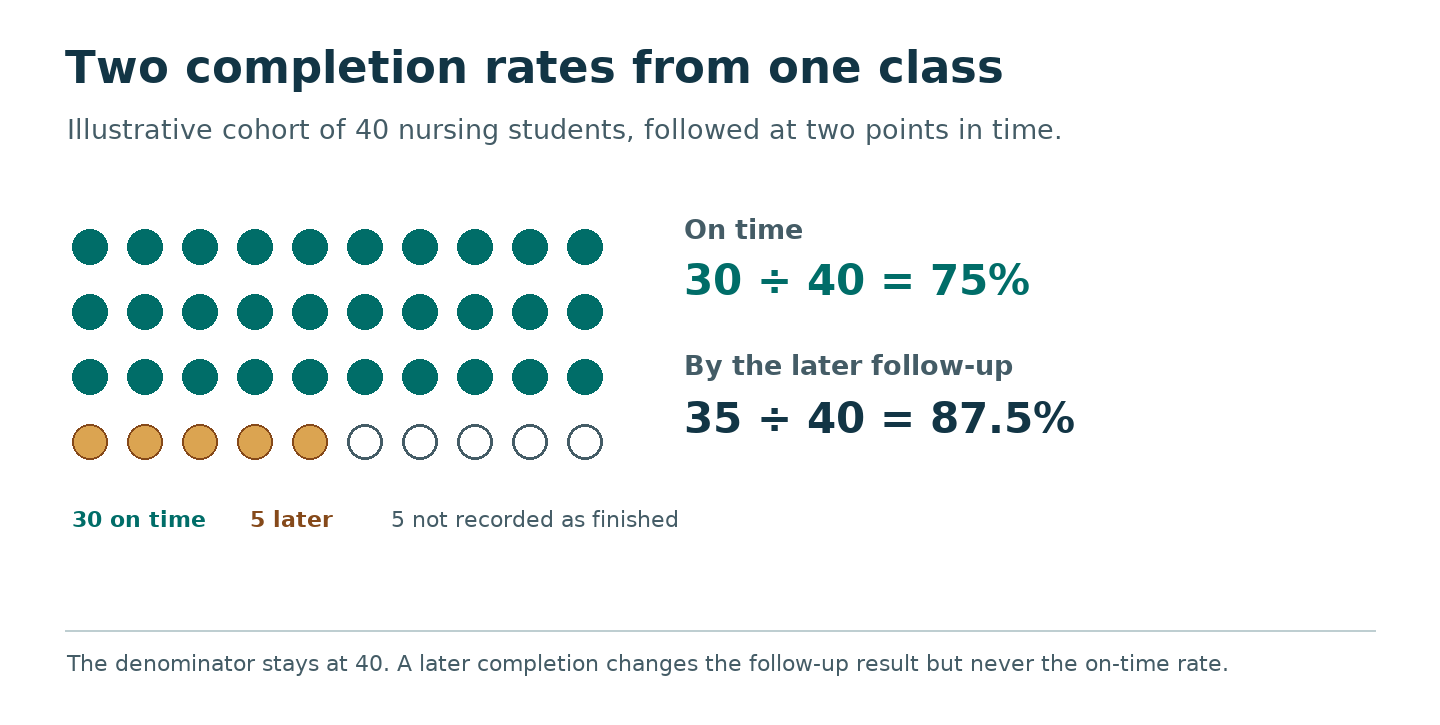
Suppose a fictional program begins with 40 students in the defined nursing cohort. Thirty finish on time and another five finish later. The on-time rate is 30 divided by 40, or 75%. The eventual rate at the later follow-up is 35 divided by 40, or 87.5%.
Both calculations can be correct, but they answer different questions. Calling the second figure an on-time rate would be wrong. The example also needs a stated follow-up date; some students might still be enrolled when the later figure is calculated.
Ask what is inside the denominator
Useful questions include whether the rate is specific to the campus and track, whether part-time students have a different expected timeline, and how transfers, withdrawals, leaves, or readmissions are handled. Ask for the number of students as well as the percentage.
A program's explanation of delays matters. Academic progression, access to required courses, placement availability, and personal circumstances may require different responses. A rate alone cannot establish which factor caused a delay, and an institution's explanation should be supported by its own data.
Read completion beside other evidence
Review several comparable cohorts rather than one unusually strong or weak year. Look at the program's current approval and accreditation status, clinical arrangements, support services, and NCLEX outcomes. A high pass rate among graduates does not tell an applicant how many entering students reached graduation.
For a personal decision, ask what the program does when a student needs to repeat a course or pause enrollment. Obtain the relevant policy and likely scheduling consequences. Published completion data describe past groups; they do not predict one applicant's outcome with certainty.
Related
Nursing Program NCLEX Pass Rates · Part-Time Nursing Programs.
Sources
- ACEN: Position Statement Related to Program Completion (August 2026) (accessed 2026-09-17).
- ACEN: Standard 5, Outcomes (accessed 2026-09-17).